With reference to revenue collection by Cornwallis, consider the following statements: 1. Under the Ryotwari Settlement of revenue collection, the peasants were exempted from revenue payment in case of bad harvests or natural calamities. 2. Under the Permanent Settlement in Bengal, if the Zamindar failed to pay his revenues to the state, on or before the fixed date, he would be removed from his Zamindari. Which of the statements given above is/are correct?
Contents16
- A1 only
- B2 only
- CBoth 1 and 2
- DNeither 1 nor 2
Show answer
Answer: (B) 2 only
Correct Answer: (b) Statement 2 only.
Statement 1:
Under Ryotwari, peasants were exempted during bad harvests — ✗ WRONG.
There was no such exemption.
Peasants were forced to pay revenue even during famines, which was one of the cruelties of the system.
Statement 2:
Under Permanent Settlement, if the Zamindar failed to pay on time, he could lose his Zamindari — ✓ CORRECT.
Lord Cornwallis introduced the Permanent Settlement in Bengal in 1793.
If a Zamindar could not pay the fixed revenue by the due date, his land would be auctioned off.
Key contrast:
- Ryotwari = peasant pays directly to government (no middleman).
- Permanent Settlement = Zamindar collects from peasants, pays government a fixed amount.
The Permanent Settlement created a rigid system where zamindars lost their estates if they missed even one revenue payment deadline, leading to frequent land auctions in Bengal.
UPSC is testing whether students can distinguish between the Ryotwari system (direct peasant-government payment) and Permanent Settlement (zamindar as middleman), since students often confuse the harsh features of each system.
Permanent Settlement in Bengal
Modern Indian History Permanent Settlement Bengal Zamindar
Permanent Settlement in Bengal (1793): Features & UPSC Traps
Introduced by Lord Cornwallis in 1793 in Bengal, Bihar, and Orissa
Fixed revenue amount decided permanently - no increase allowed
Zamindar = middleman who collects from peasants, pays government
Sunset Law: Payment due by sunset on fixed date, or lose zamindari
Context
Lord Cornwallis introduced the Permanent Settlement in Bengal in 1793 to create a stable revenue system and develop a loyal landowning class. Unlike other systems, the revenue amount was fixed forever.
Key Features
Aspect | Details | Impact |
|---|---|---|
Revenue Amount | Fixed permanently - no future increase | Government lost potential income from prosperity |
Payment System | Zamindar pays government, collects from peasants | Created middleman exploitation |
Sunset Law | Payment due by sunset on fixed date | Zamindari auctioned if payment delayed |
Land Ownership | Zamindars became proprietors of land | Created new landowning aristocracy |
Area Coverage | Bengal, Bihar, Orissa (about 19% of British India) | Limited geographical scope |
Critical Consequences
No exemptions for natural calamities - zamindars had to pay even during famines or floods
Peasant exploitation increased - zamindars squeezed ryots to meet fixed government demands
Government revenue capped permanently - could not benefit from agricultural growth or inflation
Absentee landlordism developed as zamindars moved to cities, leaving agents to manage estates
Trap: Confusing Permanent Settlement with Ryotwari - in Permanent Settlement, zamindar is the middleman, not direct peasant-government contact
Trap: Assuming exemptions for bad harvests - no such provision existed under any British land revenue system
Trap: Mixing up the introducer - Cornwallis introduced Permanent Settlement, Thomas Munro developed Ryotwari
Trap: Sunset Law confusion - payment was due by sunset, not sunrise or end of month
Ryotwari Settlement System
Modern Indian History Ryotwari Settlement
Ryotwari Settlement System: Direct Revenue Collection
Developed by Thomas Munro in Madras Presidency around 1820
Direct settlement between government and individual peasant (ryot)
No middleman like zamindar - peasant owns land and pays directly
No exemptions for bad harvests or natural calamities
Basic Concept
Ryotwari means 'of the ryot (peasant)'. Thomas Munro developed this system to eliminate middlemen and establish direct relationship between government and cultivator.
System Features
Feature | Ryotwari System | Key Point |
|---|---|---|
Who Pays | Individual peasant (ryot) | No zamindar middleman |
Land Ownership | Peasant = proprietor of his plot | Could sell, mortgage, or gift land |
Revenue Assessment | Periodically revised (usually 20-30 years) | Not permanent like Bengal |
Payment Flexibility | No exemptions for crop failure | Had to pay even during famines |
Geographic Coverage | Madras, Bombay Presidencies mainly | About 51% of British India |
Harsh Realities
Revenue demand remained fixed regardless of crop yield or weather conditions
Peasants forced to borrow from moneylenders at high interest during bad years
Land sales increased as peasants couldn't meet revenue demands during droughts
Cash crop cultivation promoted to generate money for revenue payments
Major Trap: Statement 1 in the question - Ryotwari had NO exemptions for bad harvests, this was its major criticism
Trap: Confusing with Permanent Settlement - Ryotwari has no zamindar, peasant deals directly with government
Trap: Assuming it was more humane - despite direct contact, revenue pressure was equally harsh
Trap: Geographic confusion - Ryotwari was mainly in South and West India, not Bengal
British Land Revenue Systems Comparison
Modern Indian History
British Land Revenue Systems: Complete Comparison
Three main systems: Permanent Settlement, Ryotwari, and Mahalwari
All systems aimed at maximum revenue extraction from Indian agriculture
No system provided relief during famines or natural disasters
Three Systems Compared
System | Who Pays | Area | Introducer | Revenue Nature |
|---|---|---|---|---|
Permanent Settlement | Zamindar (middleman) | Bengal, Bihar, Orissa (19%) | Lord Cornwallis (1793) | Fixed permanently |
Ryotwari | Individual peasant | Madras, Bombay (51%) | Thomas Munro (1820) | Revised periodically |
Mahalwari | Village community | North-West, Punjab (30%) | Holt Mackenzie (1822) | Revised periodically |
Common Features - All Systems
High revenue demands - typically 50-60% of gross produce value
No consideration for crop failures - payment required regardless of harvest
Cash payment mandatory - forced peasants to sell crops immediately
Land became commodity - could be bought, sold, and auctioned for revenue default
Geographic Distribution
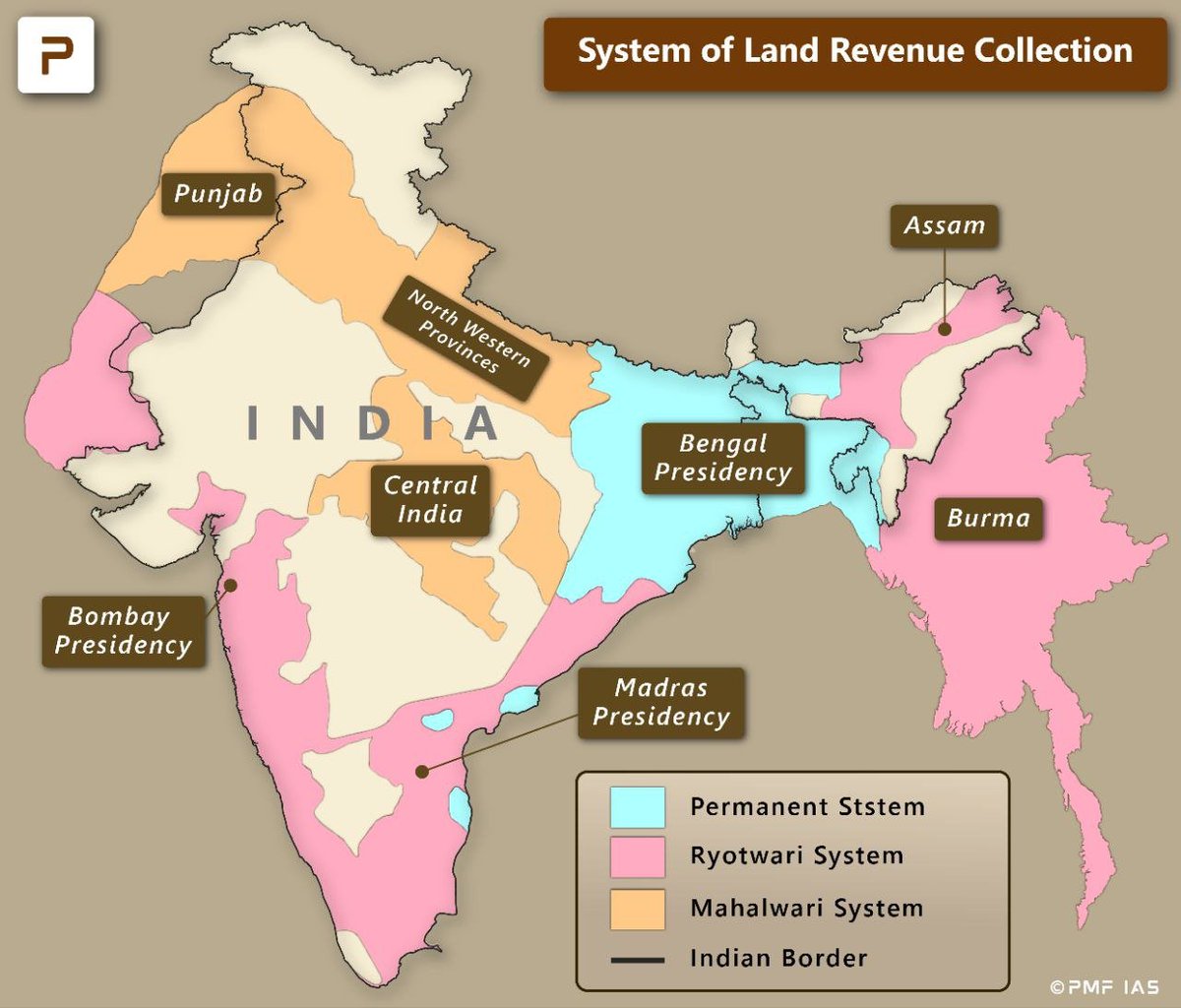
Source: x.com — British colonial administration introduced three major land ... · x.com
Major Trap: Assuming any system had harvest exemptions - none did, this was universal colonial exploitation
Trap: Confusing introducers - Cornwallis (Permanent), Munro (Ryotwari), Mackenzie (Mahalwari)
Trap: Percentage coverage - Ryotwari was largest (51%), not Permanent Settlement
Trap: Revenue nature - only Permanent Settlement had fixed revenue, others were revised
Lord Cornwallis Administrative Reforms
Modern Indian History Cornwallis
Lord Cornwallis (1786-1793): Administrative Reforms
Governor-General from 1786-1793 - known as the 'Father of Civil Service in India'
Introduced Permanent Settlement (1793) in Bengal for land revenue
Separated revenue and judicial functions - ended Collector's judicial powers
Established modern police system with regular salaries
Background
Lord Cornwallis came to India after the American War of Independence (where he surrendered at Yorktown). He focused on administrative efficiency and corruption control in the East India Company's administration.
Major Reforms
Reform Area | Key Changes | Impact |
|---|---|---|
Civil Service | Europeans only for senior posts, merit-based promotion | Excluded Indians but reduced corruption |
Judicial System | Separated from revenue collection, established district courts | Better justice delivery |
Police System | Regular police force with fixed salaries | Reduced dependence on local militia |
Land Revenue | Permanent Settlement in Bengal (1793) | Created loyal zamindar class |
Trade Regulation | Private trade by Company servants banned | Reduced conflicts of interest |
Administrative Principles
Separation of powers - revenue, judicial, and executive functions separated
Rule of law - same laws applied to all Europeans in India
Bureaucratic efficiency - fixed salaries, clear hierarchies, written procedures
Exclusion of Indians - only Europeans could hold positions above ₹500 per month
Trap: Cornwallis created Permanent Settlement, not Ryotwari - that was Thomas Munro
Trap: His reforms excluded Indians from senior civil service - not inclusive
Trap: Known as 'Father of Civil Service', not 'Father of Local Government' (that's Lord Ripon)
Trap: Tenure was 1786-1793, returned briefly in 1805 but died same year