Which one of the following groups of plants was domesticated in the ‘New World’ and introduced into the ‘Old World’?
Contents16
- ATobacco, cocoa and rubber
- BTobacco, cotton and rubber
- CCotton, coffee and sugarcane
- DRubber, coffee and wheat
Show answer
Answer: (A) Tobacco, cocoa and rubber
The correct answer is (A) — Tobacco, cocoa and rubber.
These three crops were originally grown in the Americas (the 'New World') and were brought to Europe, Asia, and Africa (the 'Old World') after Columbus's voyages in 1492.
Cotton (option B, C) was known in both the Old and New Worlds.
Coffee (option C, D) originated in Ethiopia (Old World).
Wheat (option D) is also an Old World crop.
Tip:
- Tobacco, cocoa, rubber, maize, potatoes, tomatoes = New World crops.
- Wheat, rice, coffee = Old World crops.
The Columbian Exchange after 1492 brought crops like tobacco, cocoa, and rubber from the Americas to Europe, Asia, and Africa, transforming global agriculture and trade patterns.
This question tests knowledge of which crops originated where before European colonization — a key concept for understanding how colonial trade networks developed and why Europeans sought control over specific regions.
New World Crops from Americas
Modern Indian History New World tobacco cocoa rubber
New World Crops: Tobacco, Cocoa & Rubber from Americas
Tobacco, cocoa, and rubber were domesticated in the Americas and introduced to the Old World after 1492
New World crops transformed global agriculture and economies
Maize, potatoes, tomatoes are other major New World crops
Columbian Exchange Context
The Columbian Exchange after 1492 transferred plants, animals, and diseases between the Americas ('New World') and Europe-Asia-Africa ('Old World'). Many crops now considered global staples actually originated in the Americas and were unknown elsewhere before Columbus.
Major New World Crops
Crop | Original Region | Key Uses | Global Impact |
|---|---|---|---|
Tobacco | North & South America | Smoking, medicine | Created plantation economies |
Cocoa | Mesoamerica (Mexico) | Chocolate, beverages | Foundation of confectionery industry |
Rubber | Amazon Basin | Latex products, tires | Essential for industrial revolution |
Maize (Corn) | Central Mexico | Food staple, animal feed | Now world's largest grain crop |
Potato | Andes Mountains | Food staple | Transformed European diets |
Tomato | Western South America | Food, cooking | Essential in Italian, Indian cuisine |
Question Connection
This PYQ tests knowledge of crop origins in the context of European colonial expansion. Options B, C, and D include cotton (known in both worlds), coffee (Ethiopian origin), and wheat (Old World origin) — making them incorrect.
Cotton was cultivated independently in both Old and New Worlds — don't assume it's purely American
Coffee originated in Ethiopia (Old World), not the Americas
Wheat is an ancient Old World crop from the Fertile Crescent
Sugar cane originated in New Guinea (Old World), despite association with New World plantations
Old World Crop Origins
Modern Indian History Old World cotton coffee wheat
Old World Crops: Cotton, Coffee, Wheat & Others
Cotton, coffee, and wheat originated in the Old World before 1492
Coffee comes from Ethiopia, wheat from Fertile Crescent
Cotton was independently domesticated in both Old and New Worlds
Key Old World Crops
Crop | Origin Region | Domestication Period | Spread Pattern |
|---|---|---|---|
Wheat | Fertile Crescent (Iraq/Syria) | ~10,000 years ago | Europe, India, then worldwide |
Rice | China/India | ~9,000 years ago | Asia first, then global |
Coffee | Ethiopian Highlands | ~1,000 years ago | Arabia, then Europe & colonies |
Cotton | Indus Valley/Egypt | ~7,000 years ago | Independent in Americas too |
Sugar cane | New Guinea | ~8,000 years ago | India, then global plantations |
Barley | Fertile Crescent | ~10,000 years ago | Europe, Asia, Africa |
Cotton Special Case
Cotton was domesticated independently in at least 4 different regions worldwide
Old World cotton: Indus Valley (Pakistan) and Africa around 7,000 years ago
New World cotton: Peru and Mexico around 5,000 years ago
Modern cotton varieties often combine Old and New World genetics
Don't assume sugar cane is from the Americas — it's from New Guinea (Old World)
Cotton appears in both New and Old World options — it was domesticated in both
Coffee is strongly associated with Ethiopia, not the Americas
Rice and wheat are classic Old World grains — never from the Americas
Columbian Exchange Process
Modern Indian History New World Old World
Columbian Exchange: Transforming Global Agriculture Post-1492
Columbian Exchange began in 1492 with Columbus's voyages
Transferred crops, animals, and diseases between Americas and rest of world
New World crops became global staples and colonial cash crops
Historical Context
The term 'New World' referred to the Americas after European contact in 1492. 'Old World' meant Europe, Asia, and Africa. The biological exchange between these regions — called the Columbian Exchange — was one of history's most significant agricultural transformations.
Exchange Process
%%{init: {"flowchart": {"wrappingWidth": 460}}}%%
flowchart TD
  s1["`**1492 - Columbus reaches Americas**
First sustained contact between Old and New Worlds`"]
  s2["`**Spanish/Portuguese establish colonies**
Create infrastructure for crop transfer and cultivation`"]
  s3["`**New World crops reach Europe**
Tobacco, cocoa, potatoes arrive in European ports`"]
  s4["`**Global spread via trade networks**
European traders and colonists spread crops to Asia, Africa`"]
  s5["`**Agricultural transformation**
New crops become staples, transform local cuisines and economies`"]
  s1 --> s2
  s2 --> s3
  s3 --> s4
  s4 --> s5
Bidirectional Exchange
Direction | Major Crops | Impact | Examples |
|---|---|---|---|
New → Old World | Maize, potato, tomato, tobacco | Population growth, new cuisines | Irish potato dependency, Italian tomatoes |
Old → New World | Wheat, rice, coffee, sugar cane | Plantation economies | Brazilian coffee, Caribbean sugar |
Animals (Old → New) | Horses, cattle, pigs | Transform Native societies | Plains Indian horse culture |
Diseases (Old → New) | Smallpox, measles | Devastating population decline | 90% Native population loss |
Crop Introductions to India
Modern Indian History
New World Crops in India: Portuguese & Dutch Introductions
Portuguese introduced many New World crops to India in 16th-17th centuries
Chili, tomato, potato, cashew transformed Indian cuisine and agriculture
Tobacco became a major cash crop under Mughal and colonial rule
Colonial Introduction Context
The Portuguese (from 1498) and Dutch were the primary channels for introducing New World crops to India. These crops, originally from the Americas, became so integral to Indian cuisine that many Indians consider them native.
Major New World Crops in India
Crop | Introduced By | Period | Current Status in India |
|---|---|---|---|
Chili (Red Pepper) | Portuguese | 16th century | Essential spice, transformed Indian cuisine |
Tomato | Portuguese | 16th century | Staple vegetable, key in curries |
Potato | Portuguese | 17th century | Major food crop, especially North India |
Tobacco | Portuguese | 17th century | Major cash crop, beedi industry |
Cashew | Portuguese | 16th century | Goa specialty, major export crop |
Maize (Corn) | Portuguese | 16th century | Fodder crop, tribal food staple |
Culinary Integration
Red chilies became so central that pre-1500 Indian cuisine used black pepper for heat
Potato reached Bengal through Portuguese trade, became staple in Bengali cuisine
Tomato was initially grown as ornamental plant before culinary adoption
Many tribal communities in central India adopted maize as primary food grain
Portuguese Trade Routes
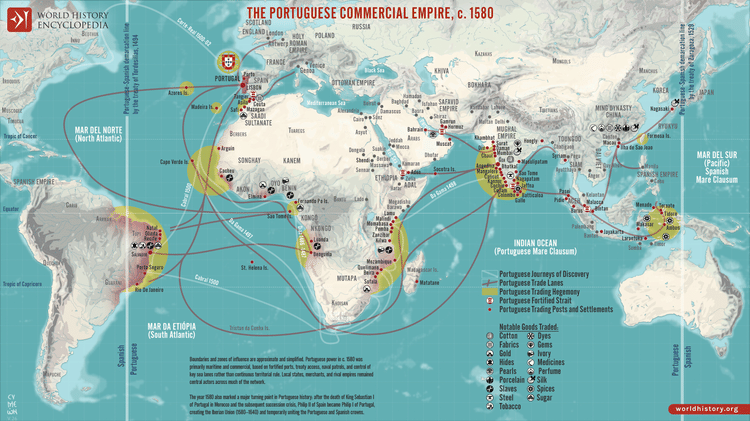
Source: World History Encyclopedia — The Portuguese Conquest of India - World History Encyclopedia · www.worldhistory.org