Which one of the following statements does not apply to the system of Subsidiary Alliance introduced by Lord Wellesley?
Contents18
- ATo maintain a large standing army at other's expense
- BTo keep India safe from Napoleonic danger
- CTo secure a fixed income for the Company
- DTo establish British paramountcy over the Indian States
Show answer
Answer: (C) To secure a fixed income for the Company
Correct Answer: (c) To secure a fixed income for the Company
This is a 'which does NOT apply' question. Let's check each option:
Option A: Maintain a large army at others' expense — YES, this APPLIES. The Indian ruler had to pay for the British troops stationed in his territory. The Company maintained a large army without spending its own money.
Option B: Keep India safe from Napoleonic danger — YES, this APPLIES. One reason for the Subsidiary Alliance was Wellesley's fear that Napoleon (France) might attack India with help from Indian rulers. The alliance prevented Indian rulers from allying with the French.
Option C: Secure a fixed income for the Company — NO, this does NOT apply. The Company did not earn a 'fixed income' from the Subsidiary Alliance. Instead, the Indian ruler paid for the British troops, but this was a military expense, not a commercial revenue stream for the Company.
Option D: Establish British paramountcy over Indian States — YES, this APPLIES. The Alliance made Indian rulers dependent on the British for military protection, effectively making them subordinate to the Company.
REMEMBER: Subsidiary Alliance (Lord Wellesley) = Indian rulers had to:
(1) pay for British troops,
(2) not hire Europeans without British approval,
(3) not negotiate with other states independently.
In return, British 'protected' them. It was about military control, not earning fixed income.
The Subsidiary Alliance forced Indian rulers to pay for British troops stationed in their territory while giving up diplomatic independence in exchange for British protection.
The system was primarily a military and political control mechanism, not a revenue-generating scheme - the payments covered troop maintenance costs rather than providing commercial profits to the Company.
Subsidiary Alliance System
Modern Indian History Subsidiary Alliance Lord Wellesley
Subsidiary Alliance System: Wellesley's Tool of Expansion
Quick Recall
Introduced by Lord Wellesley (1798-1805) to control Indian rulers without direct annexation
Indian rulers paid for British troops stationed in their territory
Rulers could not hire Europeans or negotiate with other states without British permission
Not a revenue system - was about military control and political dominance
Context
Lord Wellesley introduced the Subsidiary Alliance in 1798 as a systematic policy to control Indian rulers without the cost of direct administration. Unlike earlier ad-hoc military agreements, this became the Company's standard expansion tool.
Key Provisions
Provision | Ruler's Obligation | British Benefit |
|---|---|---|
Military Protection | Pay for British troops in their territory | Large army maintained at zero cost |
Diplomatic Control | Cannot negotiate with other states independently | Prevents anti-British alliances |
Personnel Control | Cannot hire Europeans without British approval | Eliminates French influence |
Territorial Security | Accept British Resident at court | Direct political supervision |
Strategic Objectives
Counter Napoleonic threat - prevent French alliance with Indian rulers during European wars
Establish paramountcy - make Indian states subordinate without direct rule
Cost-effective expansion - control territory while Indian rulers bear military expenses
Buffer system - create dependent states as barriers against external threats
Major States Under Alliance
State | Ruler | Year | Outcome |
|---|---|---|---|
Hyderabad | Nizam Ali | 1798 | First to accept - became model |
Mysore | After Tipu's defeat | 1799 | Wodeyar restored under alliance |
Tanjore | Serfoji II | 1799 | Accepted after brief resistance |
Awadh | Saadat Ali Khan | 1801 | Forced after military pressure |
Question Connection
The 2018 UPSC question tested whether candidates understood that Subsidiary Alliance was a political-military tool, not a revenue system. Option C (fixed income) was the trap - the Company gained military control and reduced expenses, but did not earn direct commercial income from the alliance.
Trap: Confusing with Doctrine of Lapse - that was Dalhousie's annexation policy, not Wellesley's alliance system
Trap: Thinking it provided fixed income - it reduced Company's military costs but wasn't a revenue scheme
Trap: Mixing with Permanent Settlement - that was Cornwallis's land revenue system in Bengal
Trap: Assuming all rulers accepted willingly - many like Tipu Sultan and Marathas resisted strongly
Lord Wellesley's Expansion Policies
Modern Indian History Lord Wellesley
Lord Wellesley (1798-1805): Architect of British Dominance
Key Achievements
Doubled British territory in India through aggressive expansion
Defeated Tipu Sultan in Fourth Anglo-Mysore War (1799)
Crushed Maratha power in Second Anglo-Maratha War (1803-05)
Established British paramountcy over most Indian states
Historical Context
Lord Wellesley arrived as Governor-General during the Napoleonic Wars in Europe. His aggressive expansion was driven by fear that Napoleon might attack India through alliance with Indian rulers, especially Tipu Sultan who had French connections.
Wellesley's Expansion Methods
Method | Example | Result | Timeline |
|---|---|---|---|
Subsidiary Alliance | Hyderabad, Awadh | Political control without annexation | 1798-1805 |
Direct War | Fourth Anglo-Mysore War | Tipu Sultan killed, Mysore partitioned | 1799 |
Outright Annexation | Carnatic, Tanjore | Complete Company control | 1801-1803 |
Divide & Rule | Maratha territories | Weakened major power bloc | 1803-1805 |
Major Conquests
# Wellesley's Expansion
## Southern India
- Mysore (1799)
- Carnatic (1801)
- Tanjore (1799)
- Subsidiary states
## Central India
- Maratha territories
- Orissa
- Delhi region
- Bundelkhand
## Northern India
- Awadh (alliance)
- Delhi (occupied)
- Rohilkhand
- Doab regions
Territorial Expansion
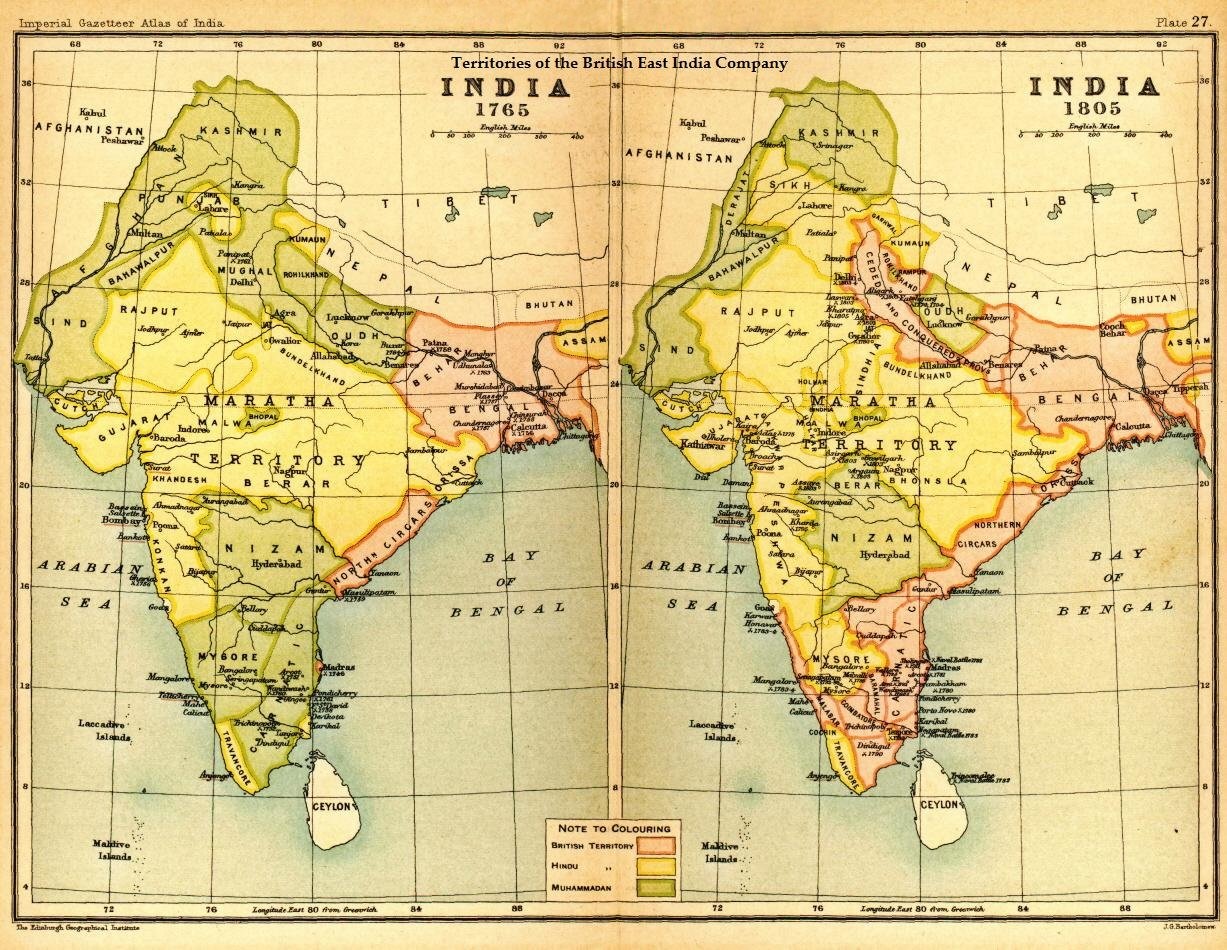
Source: TutorialsPoint — Lord Wellesley (1798-1805) · www.tutorialspoint.com
Trap: Confusing with Duke of Wellington - that was his brother Arthur Wellesley who fought Tipu and Marathas
Trap: Mixing Maratha wars - Second was under Wellesley (1803-05), Third was under Hastings (1817-18)
Trap: Recall was due to excessive expansion costs, not military failures - he was too successful for Company's budget
British Expansion Strategies in India
Modern Indian History
Evolution of British Expansion Strategies (1757-1857)
Three Phases
Phase 1: Trade to territorial control (1757-1798) - Bengal model
Phase 2: Aggressive expansion (1798-1823) - Wellesley & Hastings era
Phase 3: Systematic annexation (1823-1856) - Doctrine of Lapse period
Major Expansion Policies
Policy | Governor-General | Period | Method | Key Feature |
|---|---|---|---|---|
Subsidiary Alliance | Wellesley | 1798-1805 | Military protection for payment | Control without annexation |
Doctrine of Lapse | Dalhousie | 1848-1856 | Annexation of heirless states | Direct Company rule |
Paramountcy Doctrine | Hastings | 1813-1823 | British supremacy over all | Residency system |
Forward Policy | Bentinck onwards | 1828-1856 | Preemptive expansion | Buffer state creation |
Expansion Process
%%{init: {"flowchart": {"wrappingWidth": 460}}}%%
flowchart TD
  s1["`**Trade Disputes**
Commercial conflicts with local rulers`"]
  s2["`**Military Intervention**
Company troops intervene to 'protect' trade`"]
  s3["`**Political Control**
Subsidiary Alliance or Residency imposed`"]
  s4["`**Administrative Integration**
Gradual absorption into Company system`"]
  s5["`**Complete Annexation**
Direct Company rule established`"]
  s1 --> s2
  s2 --> s3
  s3 --> s4
  s4 --> s5
Strategic Drivers
Economic motives - securing trade routes, raw materials, and markets for British goods
Strategic security - protecting existing territories from external threats (French, Russians)
Political opportunism - exploiting succession disputes and internal conflicts
Imperial competition - preventing rival European powers from gaining Indian footholds
Trap: Ring Fence Policy was Cornwallis's non-expansion doctrine - opposite of Wellesley's aggressive expansion
Trap: Doctrine of Lapse was Dalhousie (1840s-50s), Subsidiary Alliance was Wellesley (1798-1805)
Trap: Permanent Settlement was land revenue policy, not territorial expansion policy