After the Santhal Uprising subsided, what was/were the measure/measures taken by the colonial government? 1. The territories called 'Santhal Paraganas' were created. 2. It became illegal for a Santhal to transfer land to a non-Santhal. Select the correct answer using the code given below:
Contents19
- A1 only
- B2 only
- CBoth 1 and 2
- DNeither 1 nor 2
Show answer
Answer: (C) Both 1 and 2
Correct Answer: (c) Both 1 and 2
Both statements are correct:
Statement 1 is CORRECT: After the Santhal Uprising (1855-56), the British carved out a separate territory called 'Santhal Parganas' (about 5,500 square miles) from the districts of Bhagalpur and Birbhum. The idea was to create a dedicated area for the Santhals and govern them with special laws to prevent future revolts.
Statement 2 is CORRECT: The British also appointed a special administrator for the Santhal Parganas. This administrator had more direct control over the area, different from the usual district administration. Special regulations were introduced to address the Santhals' grievances, particularly about land and money-lending issues.
Background: The Santhals revolted because they were being exploited by moneylenders (called dikus/outsiders) and zamindars. The British response after the revolt was to isolate the Santhals in a separate territory with special rules.
REMEMBER: After Santhal Uprising → Santhal Parganas created (carved from Bhagalpur and Birbhum) + special administrator appointed. The British tried to address grievances by creating a separate territory with special laws.
The Santhal Uprising (1855-56) was one of the largest tribal revolts against British rule, involving around 60,000 Santhals who rebelled against exploitation by zamindars and moneylenders.
The British response created the Santhal Parganas district as a separate administrative unit with special laws - this became the template for how colonial administration later handled other tribal areas across India.
UPSC is testing whether students understand that British policy after tribal uprisings involved territorial separation and legal protection, not just military suppression.
Santhal Uprising (1855-56)
Modern Indian History Santhal Uprising
Santhal Uprising (1855-56): Causes, Course & Colonial Response
Santhal Uprising (1855-56) was a major tribal rebellion in present-day Jharkhand
Led by Sidhu and Kanhu Murmu brothers against British, zamindars, and moneylenders
British response: created Santhal Parganas territory with special laws
Revolt suppressed but led to administrative reforms for tribal areas
Context
The Santhal Uprising was one of the most significant tribal rebellions against British colonial rule. The Santhals, an Adivasi community, faced systematic exploitation that pushed them to armed resistance.
Causes of the Uprising
Exploiter | Method of Exploitation | Impact on Santhals |
|---|---|---|
Dikus (outsiders/moneylenders) | Charged 50-500% interest rates | Lost ancestral lands through debt traps |
Zamindars | Imposed illegal taxes and begaar (forced labor) | Economic bondage and social humiliation |
British Officials | Corrupt revenue collection, no legal protection | No recourse against exploitation |
Police & Courts | Biased against Santhals, bribery common | Denial of justice |
Course of Rebellion
June 30, 1855: Sidhu and Kanhu Murmu declared rebellion at Bhagnadihi village
Santhals proclaimed end of British rule and establishment of Santhal kingdom
10,000+ Santhals participated with traditional weapons (bows, arrows, axes)
British deployed military force and Martial Law to suppress the revolt
Rebellion crushed by 1856 with heavy casualties among Santhals
Santhal Territory
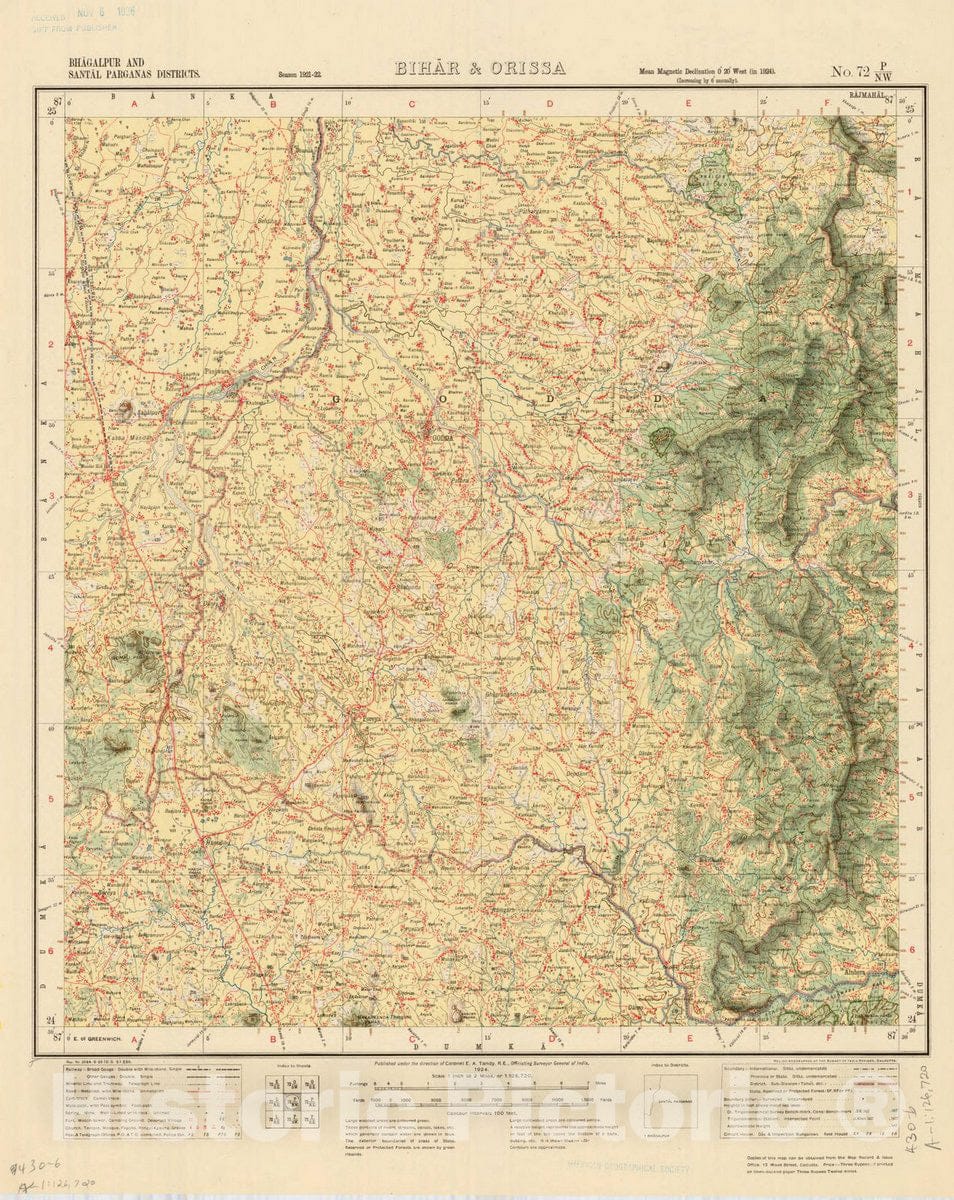
Source: Historic Pictoric — Map : Bhagalpur and Santal Parganas Districts, Bihar & Orissa, No ... · historicpictoric.com
Don't confuse Santhal Uprising (1855-56) with Kol Uprising (1831-32) - both were tribal revolts in similar regions
Sidhu-Kanhu led Santhals, not Birsa Munda who led Ulgulan movement later
Santhal Parganas was created after the uprising as British response, not before
The uprising was in present-day Jharkhand, not Odisha or Chhattisgarh
Post-Santhal Uprising Administrative Measures
Modern Indian History Santhal Paraganas colonial government
British Administrative Measures After Santhal Uprising
Santhal Parganas territory created from 5,500 sq miles of Bhagalpur and Birbhum
Special Administrator appointed with direct control, bypassing normal district system
Land transfer restrictions: Santhal could not sell land to non-Santhals
Aimed to isolate Santhals and prevent future revolts through separate governance
British Strategy
After crushing the Santhal Uprising, the British realized that administrative neglect had fueled the rebellion. Their response was to create a separate territorial unit with special laws rather than address the root causes of exploitation.
Key Administrative Changes
Measure | Details | Purpose |
|---|---|---|
Santhal Parganas Creation | Carved 5,500 sq miles from Bhagalpur & Birbhum districts | Separate territory for Santhals |
Special Administrator | Direct British control, not through zamindars | Bypass exploitative intermediaries |
Land Transfer Ban | Santhals cannot sell land to non-Santhals | Prevent land alienation |
Special Regulations | Different legal framework for tribal area | Address money-lending grievances |
Direct Revenue Collection | British officials collect revenue directly | Eliminate zamindar exploitation |
Question Connection
This PYQ tests both measures mentioned in the options. Statement 1 (Santhal Parganas creation) and Statement 2 (land transfer restrictions) were both implemented by the British as direct responses to the uprising's causes.
Significance of Measures
First major territorial reorganization by British specifically for a tribal community
Set precedent for tribal administration - influenced later colonial tribal policy
Paternalistic approach: British positioned themselves as 'protectors' of Santhals
Isolation strategy: Separate governance to prevent cross-community solidarity
Limited success: Reduced immediate grievances but didn't end exploitation entirely
Both statements are correct - common trap is thinking only one measure was taken
Don't confuse with Santhal Pargana Tenancy Act which came much later
The territory was carved from existing districts, not created from virgin land
Special administrator was British official, not a Santhal self-governance system
Major Tribal Rebellions in Colonial India
Modern Indian History
Major Tribal Rebellions Against British Rule
Tribal rebellions were major form of resistance against British colonial exploitation
Common causes: land alienation, moneylender exploitation, forest laws, cultural interference
Most rebellions were localized but showed fierce resistance to colonial rule
British response usually involved military suppression followed by administrative reforms
Pattern of Resistance
Tribal communities across India resisted British colonial rule through armed uprisings when their traditional way of life was threatened. These rebellions shared common causes but had distinct local characteristics.
Major Tribal Uprisings
Rebellion | Year | Region | Leader | Key Cause |
|---|---|---|---|---|
Kol Uprising | 1831-32 | Chhotanagpur (Jharkhand) | Buddho Bhagat | Land alienation by outsiders |
Santhal Uprising | 1855-56 | Santhal Parganas | Sidhu-Kanhu Murmu | Moneylender & zamindar exploitation |
Birsa Munda Ulgulan | 1899-1900 | Ranchi (Jharkhand) | Birsa Munda | Forest laws & missionary activities |
Rampa Rebellion | 1879-80, 1922-24 | Godavari Agency (AP) | Alluri Sitarama Raju | Forest regulations & forced labor |
Tana Bhagat Movement | 1914-19 | Gumla (Jharkhand) | Jatra Oraon | Rent enhancement & social reform |
Common Features
# Tribal Rebellions
## Causes
- Land alienation
- Moneylender exploitation
- Forest laws
- Cultural interference
- Revenue burden
## Leadership
- Traditional chiefs
- Religious leaders
- Charismatic individuals
- Tribal councils
## Methods
- Guerrilla warfare
- Traditional weapons
- Mass mobilization
- Forest hideouts
## British Response
- Military suppression
- Administrative reforms
- Special regulations
- Territorial reorganizationDon't mix up leaders: Birsa Munda ≠ Sidhu-Kanhu ≠ Alluri Sitarama Raju
Timeline confusion: Kol (1831) → Santhal (1855) → Birsa Munda (1899) → Rampa (1922)
All major tribal rebellions were in eastern & central India, not western regions
Ulgulan specifically refers to Birsa Munda's movement, not other tribal uprisings
British Colonial Tribal Policy
Modern Indian History
Evolution of British Policy Towards Tribal Areas
British tribal policy evolved from exploitation to administrative control after major rebellions
Government of India Act 1935 created framework for Scheduled Areas governance
Policy aimed at isolation and indirect control rather than integration
Created precedent for special constitutional provisions for tribals in independent India
Policy Evolution
British tribal policy underwent three distinct phases: initial neglect and exploitation, reactive measures after rebellions, and systematic administrative framework by the 1930s.
Phases of British Tribal Policy
Phase | Period | Approach | Key Features | Examples |
|---|---|---|---|---|
Exploitation Phase | 1790s-1850s | Indirect rule through intermediaries | Zamindari system extended, no protection | Permanent Settlement impact |
Reactive Phase | 1850s-1900s | Crisis management after revolts | Special territories, protective laws | Santhal Parganas creation |
Systematic Phase | 1900s-1947 | Structured administration | Scheduled Areas, Governor's special powers | Govt of India Act 1935 |
Policy Development Process
%%{init: {"flowchart": {"wrappingWidth": 460}}}%%
flowchart TD
  s1["`**Tribal Exploitation**
Zamindars & moneylenders exploit tribal lands and labor`"]
  s2["`**Tribal Rebellion**
Major uprisings like Santhal, Kol, Birsa Munda movements`"]
  s3["`**British Suppression**
Military action to crush rebellions with heavy casualties`"]
  s4["`**Administrative Response**
Create special territories, appoint special officers`"]
  s5["`**Systematic Framework**
Scheduled Areas concept in Government of India Act 1935`"]
  s1 --> s2
  s2 --> s3
  s3 --> s4
  s4 --> s5
Key Policy Features
Isolation Strategy: Keep tribals separate from mainstream society to prevent unrest
Protective Discrimination: Special laws to prevent land alienation and exploitation
Indirect Control: Govern through special administrators rather than local intermediaries
Cultural Preservation: Allow traditional customs while maintaining British control
Economic Extraction: Continue resource extraction but with better administrative control
British tribal policy was paternalistic protection, not genuine empowerment
Scheduled Areas concept started in 1935 Act, not earlier colonial acts
Policy aimed at preventing rebellions, not promoting tribal development
Isolation approach continued into independent India's initial tribal policy