With reference to Swadeshi Movement consider the following statements: 1. It contributed to the revival of the indigenous artisan crafts and industries. 2. The National Council of Education was established as a part of Swadeshi Movement. Which of the statements given above is/are correct?
Contents20
- A1 only
- B2 only
- CBoth 1 and 2
- DNeither 1 nor 2
Show answer
Answer: (C) Both 1 and 2
The correct answer is (C) — Both 1 and 2.
The Swadeshi Movement (1905-1908) had wide-ranging effects.
Statement 1 is correct — it revived indigenous crafts and industries by encouraging Indians to boycott foreign goods and use Indian-made products.
Statement 2 is correct — the National Council of Education was established in August 1906 as part of the movement's push for national education free from British control.
Tip:
Swadeshi Movement =
- boycott foreign goods
- promote Indian industry
- national education.
The Swadeshi Movement created the first large-scale revival of Indian industries and crafts by boycotting British goods, leading to growth of textile mills, soap factories, and traditional artisan work.
The movement established parallel institutions like the National Council of Education in 1906 to replace British-controlled education with national alternatives.
UPSC tests whether students understand Swadeshi as both an economic boycott movement and a constructive program that built Indian institutions.
Swadeshi Movement (1905-1908)
Modern Indian History Swadeshi Movement
Swadeshi Movement: Economic & Educational Dimensions
Swadeshi Movement (1905-1908) emerged as response to Partition of Bengal
Boycott foreign goods + promote Indian products = dual strategy
Revived indigenous crafts and industries through mass participation
Established National Council of Education in August 1906
Context & Launch
The Swadeshi Movement began in 1905 as a direct response to Lord Curzon's Partition of Bengal. What started as economic resistance evolved into comprehensive self-reliance covering industry, education, and culture.
Four Dimensions of Swadeshi
Dimension | Key Actions | Impact | Leadership |
|---|---|---|---|
Economic | Boycott foreign cloth, use khadi | Revival of handloom industry | Bal Gangadhar Tilak |
Educational | National Council of Education | Alternative to British education | Aurobindo Ghose |
Political | Mass meetings, protests | Popular participation in politics | Bipin Chandra Pal |
Cultural | Rakhi Bandhan, folk songs | Hindu-Muslim unity efforts | Rabindranath Tagore |
Economic Revival Impact
Handloom industry experienced significant growth as foreign cloth import dropped
Soap, matches, shoes — Indian alternatives emerged to replace British products
Tata Iron & Steel Company (1907) established during this period of industrial consciousness
Cotton mills in Bombay and Ahmedabad saw increased demand for Indian textiles
National Education Movement
%%{init: {"flowchart": {"wrappingWidth": 460}}}%%
flowchart TD
  s1["`****August 1906****
National Council of Education established in Calcutta`"]
  s2["`****Bengal National College****
Founded with Aurobindo as Principal`"]
  s3["`****Technical Schools****
Engineering and vocational training institutes opened`"]
  s4["`****Literary Renaissance****
Promotion of Bengali language and literature`"]
  s1 --> s2
  s2 --> s3
  s3 --> s4
Question Connection
This 2019 PYQ tests both economic (Statement 1: craft revival) and educational (Statement 2: National Council) dimensions. Students who knew only the boycott aspect might miss the constructive educational initiatives.
Trap: Confusing Swadeshi Movement (1905-1908) with Khilafat-Non-Cooperation (1919-1922) Swadeshi
Trap: Thinking National Council of Education came after the movement, not during it
Trap: Believing Swadeshi was only economic boycott — it had educational and cultural dimensions too
Dates confusion: Swadeshi = 1905, Partition of Bengal = 1905, National Council = 1906
Partition of Bengal (1905)
Modern Indian History Partition of Bengal
Partition of Bengal: Trigger for Swadeshi Movement
Lord Curzon partitioned Bengal on 16 October 1905
Created East Bengal & Assam (Muslim majority) and West Bengal (Hindu majority)
Official reason: Administrative efficiency; Real motive: Divide and rule
Annulled in 1911 due to massive protests and Swadeshi Movement
Curzon's Strategy
Lord Curzon announced the partition claiming Bengal was too large to administer effectively. The real motive was 'divide and rule' — weakening Bengali nationalism by creating religious divisions.
Before vs After Partition
Aspect | Original Bengal | East Bengal & Assam | West Bengal |
|---|---|---|---|
Area | 189,000 sq miles | 106,000 sq miles | 83,000 sq miles |
Population | 78.5 million | 31 million | 47.5 million |
Religion | Mixed | Muslim majority (18M vs 12M) | Hindu majority (42M vs 5M) |
Capital | Calcutta | Dacca | Calcutta |
Economy | Jute + Rice | Jute cultivation | Jute processing |
Partition Geography
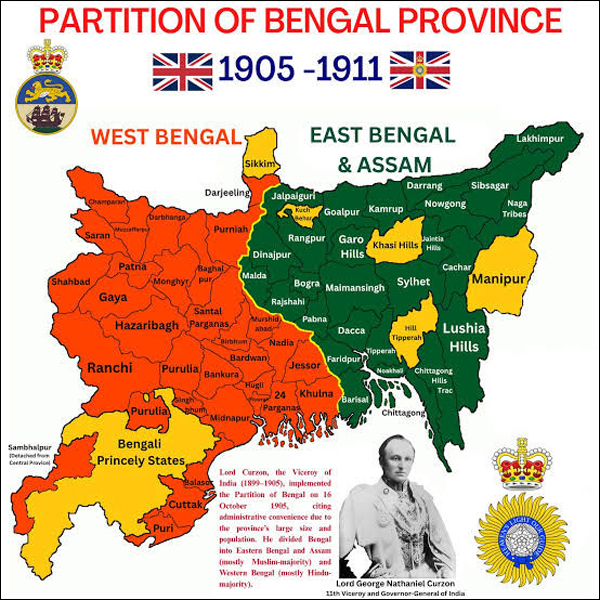
Source: Finance News: Latest Financial News, Finance News today in Bangladesh — Finance News: Latest Financial News, Finance News today in Bangladesh · today.thefinancialexpress.com.bd
Immediate Reactions
16 October 1905 observed as 'mourning day' with fasting and prayers
Rakhi Bandhan ceremony symbolized unity between Hindus and Muslims
Arandhan (no cooking) observed in Bengali Hindu households as protest
Mass meetings in Calcutta Town Hall and throughout Bengal
Date trap: Partition announced in 1905, not 1906 or 1904
Geography trap: East Bengal got Dacca as capital, not Chittagong
Reversal trap: Partition annulled in 1911, not just modified
Leader confusion: Curzon did partition, Hardinge annulled it
National Council of Education
Modern Indian History National Council of Education
National Council of Education: Swadeshi Educational Alternative
Established in August 1906 during Swadeshi Movement
Aurobindo Ghose served as Principal of Bengal National College
Promoted technical and vocational education alongside liberal arts
Used Bengali language as medium of instruction, not English
Educational Nationalism
The National Council of Education was founded in August 1906 to create an alternative to British-controlled education. It aimed to develop national character through indigenous curriculum and methods.
British vs National Education
Aspect | British System | National System |
|---|---|---|
Language | English medium | Bengali medium |
Curriculum | Western literature, European history | Indian literature, Indian history |
Focus | Administrative jobs | Technical & vocational skills |
Philosophy | Colonial mindset | National consciousness |
Control | Government controlled | Indian managed |
Institutions Established
# National Council of Education
## **Bengal National College**
- Aurobindo as Principal
- Liberal arts
- National curriculum
## **Technical Schools**
- Engineering training
- Industrial skills
- Practical education
## **Teacher Training**
- National teachers
- Bengali medium
- Indigenous methods
## **Research Centers**
- Scientific research
- Literary societies
- Cultural studies
Key Features & Impact
Self-financing through public donations, not government grants
Rabindranath Tagore supported the movement and contributed ideas on education
Women's education also promoted through separate institutions
Decline after 1908 when Swadeshi movement lost momentum
Timing trap: Established during Swadeshi (1906), not after it ended
Leadership confusion: Aurobindo was Principal, not Tilak or Lajpat Rai
Institution confusion: Bengal National College was the main college, not National University
Language trap: Promoted Bengali medium, not just anti-English sentiment
Militant Nationalism (1905-1918)
Modern Indian History
Militant Nationalism: Beyond Petitions to Mass Action
Lal-Bal-Pal trinity led extremist faction (1905-1918)
Rejected petitions and prayers, adopted mass resistance
Combined boycott, swadeshi, national education as strategy
Surat Split (1907) divided Congress into Moderates vs Extremists
Ideological Shift
Militant Nationalism emerged around 1905 as younger leaders rejected the moderate approach of petitions. They demanded swaraj (self-rule) through mass action, not gradual reforms.
Moderates vs Extremists
Aspect | Moderates (Pre-1905) | Extremists (1905-1918) |
|---|---|---|
Leaders | Dadabhai Naoroji, Gokhale | Lal-Bal-Pal (Lajpat Rai, Tilak, Bipin Pal) |
Methods | Petitions, constitutional means | Boycott, mass protests, swadeshi |
Goal | Administrative reforms | Swaraj (complete self-rule) |
Inspiration | Western liberalism | Indian traditions, Hindu revivalism |
Mass base | Educated elite | Common people, artisans, students |
Extremist Programme
# Militant Nationalism Strategy
## **Boycott**
- Foreign goods
- Government services
- British institutions
## **Swadeshi**
- Indian products
- Indigenous industries
- Economic self-reliance
## **National Education**
- Alternative schools
- Indian curriculum
- Cultural nationalism
## **Passive Resistance**
- Non-cooperation
- Mass protests
- Civil disobediencePeriod confusion: Militant phase was 1905-1918, before Gandhi's arrival
Leadership trap: Lal-Bal-Pal were extremists, Gokhale-Naoroji were moderates
Methods confusion: Extremists used mass action, not violence (that was revolutionary terrorism)
Split date: Surat Congress 1907 split moderates-extremists, not 1906 or 1908