Regarding Wood's Dispatch, which of the following statements are true? 1. Grants-in-Aid system was introduced. 2. Establishment of universities was recommended. 3. English as a medium of instruction at all levels of education was recommended. Select the correct answer using the code given below:
Contents13
- A1 and 2 only
- B2 and 3 only
- C1 and 3 only
- D1, 2 and 3
Show answer
Answer: (A) 1 and 2 only
Correct Answer: (a) 1 and 2 only
Grants-in-Aid system — CORRECT: Wood's Dispatch (1854) introduced the Grants-in-Aid system, where the government would give financial help to private schools that met certain standards. This encouraged private participation in education.
Establishment of universities — CORRECT: Wood's Dispatch recommended setting up universities in Calcutta, Bombay, and Madras (modelled on the University of London). These were indeed established in 1857.
English as medium at all levels — WRONG: Wood's Dispatch did NOT mandate English as the medium of instruction at all levels. In fact, it recommended using vernacular (local) languages for lower levels of education and English for higher education. It recognised the importance of Indian languages.
What was Wood's Dispatch? Charles Wood, the President of the Board of Control, sent this dispatch in 1854. It is called the 'Magna Carta of English Education in India' because it was the first comprehensive plan for education in India.
REMEMBER: Wood's Dispatch (1854) = Grants-in-Aid + Universities (Calcutta, Bombay, Madras). But it did NOT impose English at ALL levels — it supported vernacular languages too.
Wood's Dispatch (1854) was the first comprehensive education policy for British India, introducing the Grants-in-Aid system and leading to establishment of India's first three universities in 1857.
The trap here is statement 3 - Wood's Dispatch actually supported vernacular languages for primary education, not English at all levels, making it more progressive than many students expect.
Wood's Dispatch 1854
Modern Indian History Wood's Dispatch
Wood's Dispatch 1854: The Magna Carta of English Education in India
Charles Wood sent this dispatch in 1854 as President of Board of Control
Called 'Magna Carta of English Education in India' - first comprehensive education plan
Introduced Grants-in-Aid system for private schools meeting government standards
Recommended establishing universities in Calcutta, Bombay, and Madras (established 1857)
Supported vernacular languages for lower education, English for higher education
Wood's Dispatch was the first systematic attempt by the British to create a comprehensive education policy for India. Charles Wood, as President of the Board of Control, sent this landmark dispatch in 1854 to address the growing need for structured education in colonial India.
Key Provisions of Wood's Dispatch
Provision | Details | Impact |
|---|---|---|
Grants-in-Aid System | Government financial support to private schools meeting standards | Encouraged private participation in education |
University Establishment | Recommended universities in Calcutta, Bombay, Madras | All three established in 1857, modelled on University of London |
Language Policy | Vernacular for lower education, English for higher | Balanced approach - not English-only at all levels |
Education Department | Separate department in each province | Systematic administration of education |
Teacher Training | Training schools for teachers | Improved quality of instruction |
The dispatch earned the title 'Magna Carta of English Education' because it laid the foundation for modern education in India. Unlike earlier policies that were fragmented, Wood's Dispatch provided a complete blueprint covering primary to university education.
Why Wood's Dispatch Matters
First comprehensive education policy - covered all levels from primary to university
Balanced language approach - recognized importance of both vernacular and English
Public-private partnership model through Grants-in-Aid system
Institutional foundation - created the framework for modern Indian universities
Trap: Statement 3 claims English was recommended at all levels - Wrong! Wood's supported vernacular for lower levels
Confusion: Don't mix with Macaulay's Minute (1835) which strongly favored English over Indian languages
Date trap: Universities recommended in 1854, actually established in 1857
Name trap: Charles Wood sent the dispatch, not William Wood or other Woods in British history
Grants-in-Aid System
Modern Indian History Grants-in-Aid system
Grants-in-Aid System: Government Support for Private Education
Government financial support to private schools meeting prescribed standards
Introduced by Wood's Dispatch 1854 to encourage private participation
Schools had to follow government curriculum and inspection to receive grants
Created public-private partnership model in education
The Grants-in-Aid system was a revolutionary funding mechanism where the British government provided financial assistance to private educational institutions that met specific standards. This created the first public-private partnership in Indian education.
How Grants-in-Aid Worked
%%{init: {"flowchart": {"wrappingWidth": 460}}}%%
flowchart TD
  s1["`**Private School Establishment**
Individual or organization starts a school`"]
  s2["`**Government Standards**
School must follow prescribed curriculum, teaching methods`"]
  s3["`**Inspection Process**
Government officials inspect school quality and compliance`"]
  s4["`**Grant Approval**
Schools meeting standards receive financial support`"]
  s5["`**Ongoing Monitoring**
Regular inspections to maintain grant eligibility`"]
  s1 --> s2
  s2 --> s3
  s3 --> s4
  s4 --> s5
Impact on Indian Education
Rapid expansion of schools across India due to private initiative
Quality control through government inspection and standards
Cost-effective for government - private funding + government support
Foundation for modern aided school system in independent India
Remember: Grants-in-Aid was Wood's Dispatch 1854, not earlier education policies
Key point: Private schools had to meet government standards - not complete freedom
Early Indian Universities
Modern Indian History universities Calcutta Bombay Madras
First Indian Universities: Calcutta, Bombay & Madras (1857)
Three universities established in 1857: Calcutta, Bombay, and Madras
Wood's Dispatch 1854 recommended their establishment
Modelled on University of London - examining bodies, not teaching institutions
Affiliating universities - affiliated colleges did the actual teaching
Following Wood's Dispatch recommendation, the British established India's first three universities in 1857 in the three presidency towns. These were affiliating universities modelled on the University of London, focusing on examinations rather than direct teaching.
The Three Pioneer Universities
University | Location | Established | First Chancellor | Key Feature |
|---|---|---|---|---|
University of Calcutta | Calcutta (Kolkata) | 24 Jan 1857 | Lord Canning | First university in India |
University of Bombay | Bombay (Mumbai) | 18 July 1857 | Lord Elphinstone | Strong in commerce & law |
University of Madras | Madras (Chennai) | 5 Sep 1857 | Lord Harris | Focus on regional languages too |
University Structure & Features
# Early Indian Universities (1857)
## **London Model**
- Examining bodies
- Not teaching institutions
- Degree conferring authority
- Quality control
## **Affiliating System**
- Affiliated colleges
- Colleges did teaching
- University set curriculum
- University conducted exams
## **Governance**
- British Chancellor
- Senate (governing body)
- Government control
- English medium
Historical Significance
Foundation of modern higher education in India
English education became pathway to government jobs and social mobility
Standardized curriculum across affiliated colleges
Created educated middle class that later led independence movement
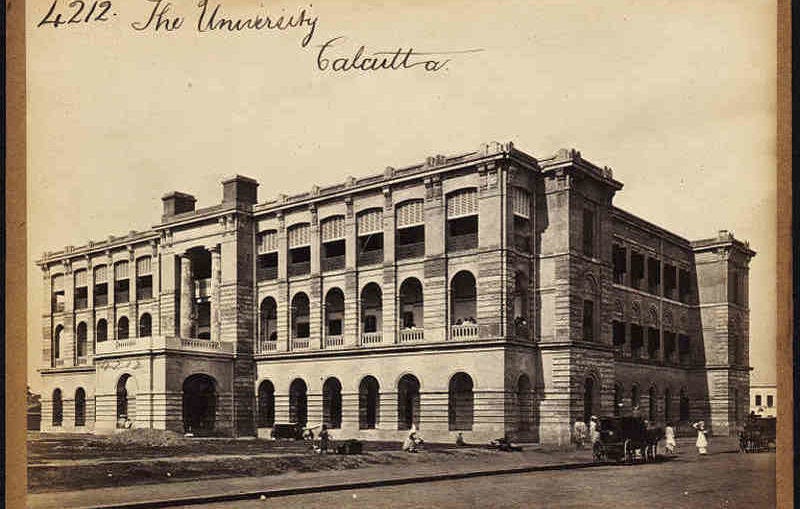
Source: Medium — The University of Calcutta, the Influence and the Influenced. | by ... · medium.com
Date precision: Universities recommended in 1854 by Wood's Dispatch, established in 1857
Model confusion: Based on University of London, not Oxford or Cambridge
Function trap: They were examining bodies, not direct teaching institutions like modern universities
Language Policy in British Education
Modern Indian History English as a medium of instruction vernacular
Language Debate: English vs Vernacular in Colonial Education
Wood's Dispatch supported vernacular for lower education, English for higher
Macaulay's Minute 1835 strongly favored English over Indian languages
Orientalists wanted education in Sanskrit and Persian
Anglicists wanted English-only education system
The language debate was central to British education policy in India. Unlike popular belief, Wood's Dispatch took a balanced approach - supporting vernacular languages for primary education while promoting English for higher studies.
Evolution of Language Policy
Policy/Event | Year | Language Approach | Rationale |
|---|---|---|---|
Orientalist Approach | 1813-1835 | Sanskrit & Persian | Preserve classical Indian learning |
Macaulay's Minute | 1835 | English only | Create English-educated Indian class |
Wood's Dispatch | 1854 | Vernacular + English | Practical approach - local languages for masses, English for administration |
Hunter Commission | 1882 | Vernacular emphasis | Strengthen primary education in local languages |
Wood's Balanced Language Policy
Lower levels: Vernacular languages for better understanding and mass reach
Higher education: English for science, technology, and administrative training
Practical reasoning: Most Indians could only learn effectively in their mother tongue
Administrative need: English-educated Indians needed for colonial administration
Major trap: Wood's Dispatch did NOT recommend English at all levels - it supported vernacular for primary education
Confusion with Macaulay: Macaulay's Minute 1835 favored English-only, Wood's Dispatch 1854 was more balanced
Statement 3 trap: The word 'all levels' is key - Wood's recommended English only for higher education