With reference to the United Nations General Assembly, consider the following statements: 1. The UN General Assembly can grant observe status to the non-member States. 2. Inter-governmental organisations can seek observer status in the UN General Assembly. 3. Permanent Observers in the UN General Assembly can maintain mission at the UN headquarters. Which of the statements given above are correct?
Contents14
- A1 and 2 only
- B2 and 3 only
- C1 and 3 only
- D1, 2 and 3
Show answer
Answer: (D) 1, 2 and 3
The answer is (D) All three are correct.
Statement 1 is CORRECT:
The UN General Assembly can grant observer status to non-member STATES.
For example, Palestine and the Vatican (Holy See) are non-member observer states.
Statement 2 is CORRECT:
Inter-governmental organizations can also seek observer status.
For example, the International Solar Alliance got UNGA observer status in December 2021.
Other examples: African Union, EU, etc.
Statement 3 is CORRECT:
Permanent Observers can maintain their own diplomatic missions at UN headquarters in New York.
They can participate in sessions and workings of the General Assembly, though they cannot vote.
Key points about observers:
- Can participate in discussions but CANNOT vote
- The Sixth Committee (Legal) reviews all applications
- Both states and intergovernmental organizations can get observer status
Observer status allows non-UN members to participate in General Assembly discussions without voting rights, making it crucial for international diplomacy.
The International Solar Alliance received UN General Assembly observer status in December 2021, making intergovernmental organization observer status a relevant current affairs topic.
UPSC is testing whether students understand that observer status applies to both non-member states like Palestine and intergovernmental organizations, not just one category.
UN Observer Status Types
World Affairs (International Relations) observer status non-member States Inter-governmental organisations
UN Observer Status: States vs Organizations & Key Rights
Two types: Non-member observer states and observer organizations
Can participate in UNGA discussions but cannot vote
Can maintain diplomatic missions at UN headquarters
Sixth Committee (Legal) reviews all observer applications
Observer status allows entities to participate in UN General Assembly proceedings without voting rights. The UNGA grants this status to both non-member states and intergovernmental organizations through a formal application process.
Observer Status Categories
Type | Examples | How They Get Status | Key Feature |
|---|---|---|---|
Non-member Observer States | Palestine, Vatican (Holy See) | UNGA resolution | Sovereign entities not UN members |
Observer Organizations | International Solar Alliance, African Union, European Union | Application via Sixth Committee | Intergovernmental bodies |
Observer Rights & Limitations
Can participate in UNGA sessions and committee discussions
Can maintain diplomatic missions at UN headquarters in New York
Cannot vote on any resolutions or decisions
Receive all official documents and can attend most meetings
Question Connection
This PYQ tested whether students know both states and organizations can get observer status, and that observers can maintain missions at UN headquarters. All three statements were correct traps designed to catch partial knowledge.
Trap: Thinking only states can be observers - organizations like ISA also qualify
Trap: Confusing observer status with membership - observers cannot vote
Trap: Assuming observers cannot maintain diplomatic missions - they can at UN HQ
UN Sixth Committee (Legal)
World Affairs (International Relations)
UN Sixth Committee: Legal Affairs & Observer Applications
Legal Committee of the UN General Assembly
Reviews observer status applications from organizations
One of six main committees of UNGA
The Sixth Committee (Legal) is the primary legal committee of the UN General Assembly. It handles legal matters including reviewing applications for observer status from intergovernmental organizations.
Key Functions
Reviews observer status applications from intergovernmental organizations
Deals with international legal matters and treaties
Works on codification and progressive development of international law
Handles legal aspects of UN operations and procedures
UNGA Main Committees
Committee | Focus Area | Key Role |
|---|---|---|
First (Disarmament) | Security, disarmament | Peace and security issues |
Second (Economic) | Economic, financial | Development and economic issues |
Third (Social) | Social, humanitarian | Human rights, social issues |
Fourth (Political) | Decolonization | Non-self-governing territories |
Fifth (Administrative) | Budget, administrative | UN budget and management |
Sixth (Legal) | Legal affairs | Observer applications, international law |
Palestine & Vatican Observer States
World Affairs (International Relations) Palestine Vatican
Palestine & Vatican: UN Non-Member Observer States
Palestine and Vatican (Holy See) are the two main non-member observer states
Both can participate in UNGA but cannot vote
Palestine upgraded from PLO observer to state observer in 2012
Only two entities currently hold non-member observer state status at the UN: Palestine and the Vatican (Holy See). This special status recognizes their sovereign character while acknowledging they are not full UN members.
Non-Member Observer States
Entity | Year Granted | Previous Status | Special Notes |
|---|---|---|---|
Palestine | 2012 | PLO observer organization | Upgraded from organization to state status |
Vatican (Holy See) | 1964 | No previous UN status | Sovereign city-state, neutral in conflicts |
Why These Two
Palestine: Recognized sovereign entity by many countries but disputed statehood
Vatican: Sovereign city-state but chooses not to seek full UN membership
Both maintain diplomatic relations with many countries globally
Neither pays UN membership dues but can maintain missions at UN HQ
Trap: Confusing PLO (organization observer) with Palestine (state observer since 2012)
Trap: Thinking Vatican is a full member - it's deliberately an observer only
International Solar Alliance Observer Status
World Affairs (International Relations) International Solar Alliance
International Solar Alliance: India's UN Success Story
ISA got UNGA observer status in December 2021
India-France joint initiative launched in 2015
Headquartered in Gurugram, India
The International Solar Alliance (ISA) achieved observer status at the UN General Assembly in December 2021, marking a diplomatic success for India's multilateral initiatives. This made ISA the first international organization headquartered in India to gain UN observer status.
ISA Journey to UN Observer Status
%%{init: {"flowchart": {"wrappingWidth": 460}}}%%
flowchart TD
  s1["`****2015**: Launch**
India-France launch ISA at Paris Climate Summit`"]
  s2["`****2016**: Framework Agreement**
ISA framework agreement opened for signature`"]
  s3["`****2018**: Legal Entity**
ISA becomes international organization after ratifications`"]
  s4["`****2021**: UN Observer**
UNGA grants observer status in December`"]
  s1 --> s2
  s2 --> s3
  s3 --> s4
ISA Key Features
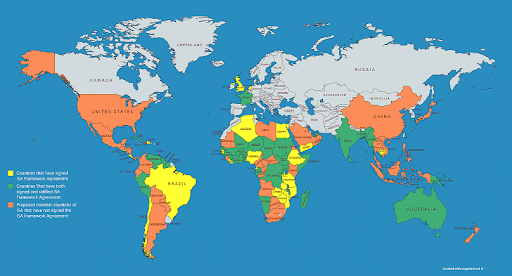
121 countries are potential members (located between Tropics)
Focuses on solar energy deployment and technology sharing
Headquarters in Gurugram, India with Indian leadership
Promotes solar financing and capacity building globally
ISA Global Reach
Source: Prepp — International Solar Alliance - Environment Notes · prepp.in