Consider the following countries: 1. Australia 2. Canada 3. China 4. India 5. Japan 6. USA. Which of the above are among the 'free-trade partners' of ASEAN?
Contents13
- A1, 2, 4 and 5
- B3, 4, 5 and 6
- C1, 3, 4 and 5
- D2, 3, 4 and 6
Show answer
Answer: (C) 1, 3, 4 and 5
The Association of Southeast Asian Nations (ASEAN) was established in August 1967 in Bangkok, Thailand, with the signing of the ASEAN Declaration (Bangkok Declaration).
Currently, it has 10 member nations which are:
- Brunei
- Cambodia
- Indonesia
- Laos
- Malaysia
- Myanmar
- the Philippines
- Singapore
- Thailand
- Vietnam.
Option (c) is correct: ASEAN has a total of 6 free trade partners namely:
- Australia
- New Zealand
- South Korea
- Japan
- India
- China.
ASEAN and its 5 free trade partners (excluding India) have entered into a regional trading agreement called the Regional Comprehensive Economic Partnership (RCEP).
The purpose of RCEP was to make it easier for products and services of each of these countries to be available across this region.
India has however chosen to stay out of RCEP.
ASEAN has formal free trade agreements with only six countries: Australia, New Zealand, China, India, Japan, and South Korea.
Despite being major economies, the USA and Canada do not have free trade agreements with ASEAN, which is the key trap in this question.
The question tests knowledge of specific bilateral economic partnerships rather than general trade relationships or dialogue partnerships.
ASEAN Free Trade Agreements
World Affairs (International Relations) free-trade partners ASEAN Australia China India Japan
ASEAN Free Trade Agreements: Partners & Key Details
ASEAN has FTAs with 6 major economies: Australia, New Zealand, China, India, Japan, South Korea
USA and Canada do NOT have FTAs with ASEAN
AANZFTA covers Australia-New Zealand together with ASEAN
These FTAs form the building blocks for RCEP (Regional Comprehensive Economic Partnership)
ASEAN (Association of Southeast Asian Nations) has built a network of free trade agreements with major Asia-Pacific economies, creating one of the world's largest trading blocs. These agreements eliminate or reduce tariffs and trade barriers between ASEAN's 10 member states and their partner countries.
ASEAN's FTA Partners
Country/Region | Agreement Name | Status | Key Feature |
|---|---|---|---|
Australia & New Zealand | AANZFTA | ✓ Active FTA | Covers goods, services, investment |
China | ACFTA | ✓ Active FTA | World's largest FTA by population |
India | ASEAN-India FTA | ✓ Active FTA | Covers goods trade primarily |
Japan | AJCEP | ✓ Active FTA | Comprehensive Economic Partnership |
South Korea | AKFTA | ✓ Active FTA | Includes services and investment |
USA | No FTA | ✗ No Agreement | Only strategic partnership |
Canada | No FTA | ✗ No Agreement | Limited trade cooperation |
The 2018 PYQ tested this exact knowledge — which countries from the given list are ASEAN's FTA partners. The trap was including USA and Canada, which have strategic partnerships but no formal FTAs with ASEAN.
Strategic Context
ASEAN+3 refers to ASEAN plus China, Japan, South Korea
ASEAN+6 includes the above plus Australia, New Zealand, India
These FTAs became the foundation for RCEP negotiations (signed in 2020)
USA's absence from ASEAN FTAs reflects its preference for bilateral deals over multilateral trade agreements
Trap: USA and Canada are major economies but have NO FTAs with ASEAN
Trap: Don't confuse strategic partnerships with free trade agreements
Trap: Australia comes with New Zealand together in AANZFTA, not separately
Confusion: ASEAN+3 vs ASEAN+6 — know which countries belong to each grouping
ASEAN Organization & Members
World Affairs (International Relations) ASEAN
ASEAN: Organization Structure & Economic Integration
ASEAN has 10 member countries in Southeast Asia
ASEAN Economic Community (AEC) launched in 2015 for deeper integration
Founded in 1967 with Bangkok Declaration by 5 founding members
Operates on consensus-based decision making called the 'ASEAN Way'
ASEAN Member Countries
Country | Joined | Capital | Economic Status |
|---|---|---|---|
Thailand | 1967 (Founding) | Bangkok | Upper middle income |
Malaysia | 1967 (Founding) | Kuala Lumpur | Upper middle income |
Singapore | 1967 (Founding) | Singapore | High income |
Indonesia | 1967 (Founding) | Jakarta | Upper middle income |
Philippines | 1967 (Founding) | Manila | Lower middle income |
Brunei | 1984 | Bandar Seri Begawan | High income |
Vietnam | 1995 | Hanoi | Lower middle income |
Laos | 1997 | Vientiane | Lower middle income |
Myanmar | 1997 | Naypyidaw | Lower middle income |
Cambodia | 1999 | Phnom Penh | Lower middle income |
ASEAN's Three Pillars
# ASEAN Community
## Political-Security
- Democratic governance
- Conflict prevention
- Counter-terrorism
- Maritime security
## Economic Community
- Free trade area
- Single market
- Production base
- Investment hub
## Socio-Cultural
- Human development
- Social welfare
- Environmental protection
- Cultural identity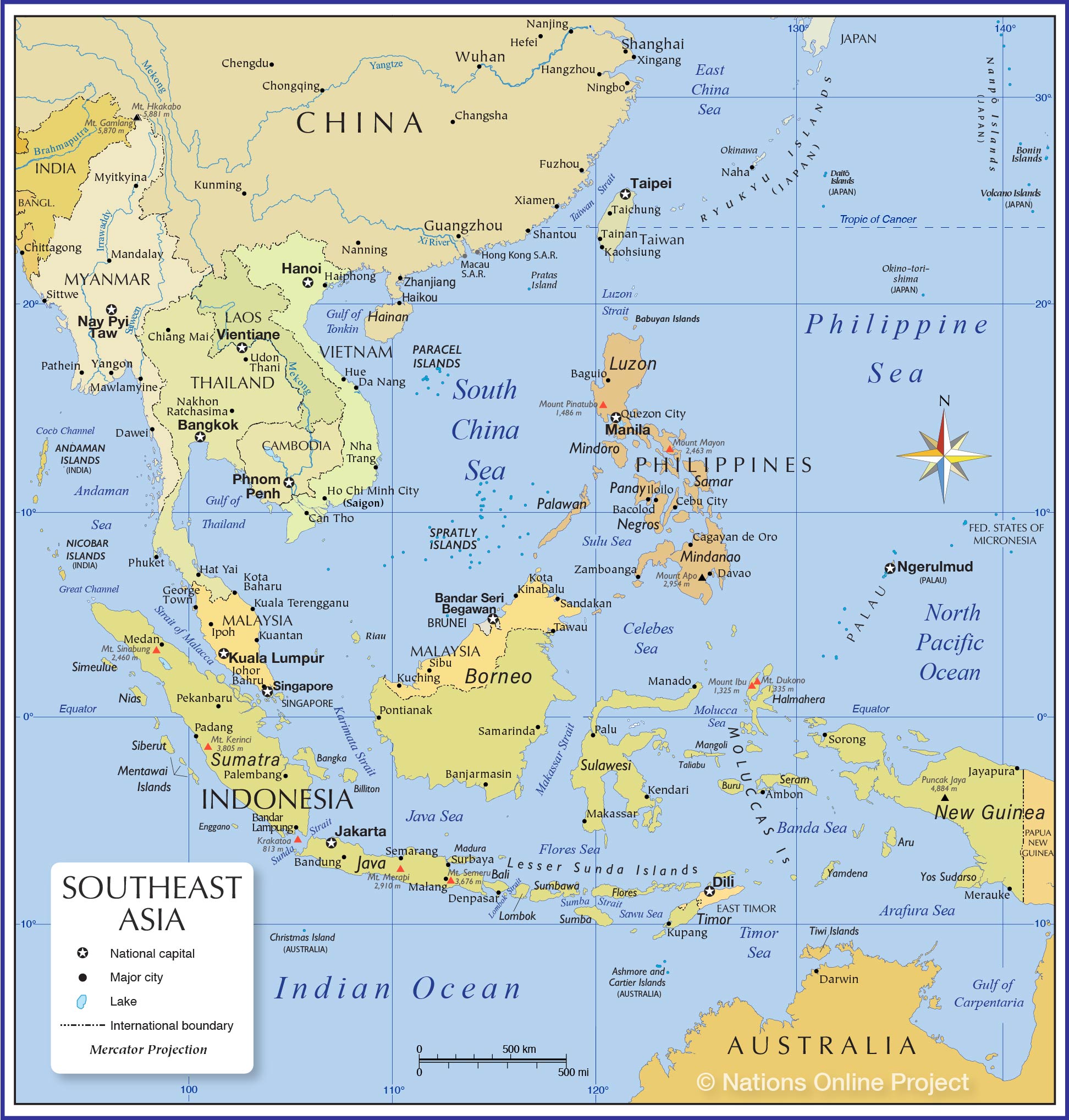
Source: Nations Online — Map of South-East Asia - Nations Online Project · www.nationsonline.org
India-ASEAN Strategic Partnership
World Affairs (International Relations) India
India-ASEAN Relations: From Look East to Act East
India became ASEAN's dialogue partner in 1996 under Look East Policy
India-ASEAN FTA in goods came into force in 2010
Act East Policy (2014) upgraded engagement from economic to strategic
India opted out of RCEP in 2019 citing trade deficit concerns
Evolution of India-ASEAN Ties
%%{init: {"flowchart": {"wrappingWidth": 460}}}%%
flowchart TD
  s1["`**1996: Dialogue Partner**
India joins ASEAN Regional Forum, begins **Look East Policy**`"]
  s2["`**2002: Summit-Level Partnership**
Annual India-ASEAN summits begin, **Comprehensive Partnership** established`"]
  s3["`**2010: FTA in Goods**
**India-ASEAN Trade in Goods Agreement** implemented`"]
  s4["`**2014: Strategic Partnership**
**Act East Policy** launched, deeper defense and connectivity focus`"]
  s5["`**2019: RCEP Exit**
India withdraws from RCEP negotiations over trade concerns`"]
  s1 --> s2
  s2 --> s3
  s3 --> s4
  s4 --> s5
Key India-ASEAN Agreements
Agreement | Year | Scope | Status |
|---|---|---|---|
Trade in Goods Agreement | 2010 | Tariff reduction on 80% goods | Operational |
Services & Investment Agreement | 2015 | Market access in services | Operational |
Connectivity Action Plan | 2016 | Physical & digital connectivity | Under implementation |
Maritime Transport Agreement | 2018 | Shipping and port cooperation | Operational |
Strategic Significance
Trade Volume: India-ASEAN trade reached $87 billion in 2021-22
Connectivity: India building trilateral highway through Myanmar to ASEAN
Defense: Joint naval exercises like SIMBEX (Singapore) and cooperation on maritime security
Counter-China: ASEAN partnership crucial for India's Indo-Pacific strategy and Quad alignment
RCEP & Asia-Pacific Trade Blocs
World Affairs (International Relations)
RCEP vs Other Asia-Pacific Trade Agreements
RCEP signed in 2020, world's largest trade bloc by GDP
Includes ASEAN + 5 partners (China, Japan, South Korea, Australia, New Zealand)
India opted out of RCEP in 2019, USA not part of any mega-regional FTA in Asia
CPTPP is the alternative bloc led by Japan after US withdrew from TPP
Major Asia-Pacific Trade Agreements
Agreement | Members | Key Players | India's Status | US Status |
|---|---|---|---|---|
RCEP | 15 countries | China, Japan, ASEAN | Opted out (2019) | Not member |
CPTPP | 11 countries | Japan, Australia, Canada | Not member | Withdrew (2017) |
ASEAN+1 FTAs | Various bilateral | ASEAN + individual partners | Member (with ASEAN) | Not member |
APEC | 21 economies | US, China, Japan | Member | Founding member |
Asia-Pacific Trade Architecture
# Asia-Pacific Trade
## RCEP Bloc
- ASEAN 10
- China
- Japan
- South Korea
- Australia
- New Zealand
## CPTPP Bloc
- Japan
- Australia
- Canada
- Vietnam
- Singapore
- Malaysia
## Outside Mega-FTAs
- India
- USA
- Thailand
- Indonesia
## Bilateral FTAs
- US-Korea
- India-ASEAN
- Japan-India
- Australia-IndiaTrap: India is NOT in RCEP despite being part of ASEAN+6 framework originally
Trap: USA has NO mega-regional FTA in Asia-Pacific after withdrawing from TPP
Confusion: RCEP vs CPTPP — different membership, China in RCEP but not CPTPP
Date confusion: RCEP signed 2020, came into force 2022 — don't mix up the years