Consider the following in respect of Indian Ocean Naval Symposium (IONS): 1. Inaugural IONS was held in India in 2015 under the chairmanship of the Indian Navy. 2. IONS is a voluntary initiative that seeks to increase maritime co-operation among navies of the littoral states of the Indian Ocean Region. Which of the above statements is/are correct?
Contents17
- A1 only
- B2 only
- CBoth 1 and 2
- DNeither 1 nor 2
Show answer
Answer: (B) 2 only
Statement 1 is incorrect:
The inaugural IONS (Indian Ocean Naval Symposium) was held in New Delhi, India in February 2008 (not 2015), and the Chief of Naval Staff of the Indian Navy served as chairman for the period 2008-2010.
The theme was 'Contemporary Trans-national Challenges – International Maritime Connectivities'.
Statement 2 is correct:
IONS is a voluntary initiative that seeks to increase maritime cooperation among navies of the littoral (coastal) states of the Indian Ocean Region.
It provides an open and inclusive forum for discussion of regionally relevant maritime issues.
There are 35 member navies grouped into four sub-regions:
- South Asian Littorals
- West Asian Littorals
- East African Littorals
- South East Asian and Australian Littorals.
The key fact to remember is that IONS was started in 2008 in India, not 2015.
IONS has gained importance due to growing Chinese naval presence in the Indian Ocean region.
So only statement 2 is correct.
IONS brings together 35 naval forces from four Indian Ocean sub-regions to coordinate maritime security, making it the largest regional naval forum.
China's expanding naval presence in the Indian Ocean through ports in Pakistan, Sri Lanka, and Djibouti has made IONS increasingly strategically important for India.
The question tests specific timeline knowledge - IONS began in 2008, not 2015, which is a common confusion point.
Indian Ocean Naval Symposium (IONS)
World Affairs (International Relations) IONS Indian Ocean Naval Symposium maritime co-operation littoral states
Indian Ocean Naval Symposium (IONS): Structure, Membership & UPSC Facts
Key Facts
IONS inaugurated in New Delhi, February 2008 (not 2015)
35 member navies across 4 sub-regions of Indian Ocean littoral states
Voluntary initiative for maritime cooperation among regional navies
India served as first chairman (2008-2010) under Chief of Naval Staff
What is IONS
IONS is a voluntary multilateral forum that brings together navies of Indian Ocean littoral (coastal) states to enhance maritime cooperation. It operates as an open, inclusive platform for discussing regional maritime challenges and building naval partnerships.
IONS Sub-Regional Structure
Sub-Region | Key Countries | Strategic Importance |
|---|---|---|
South Asian Littorals | India, Pakistan, Bangladesh, Sri Lanka, Maldives | Core IOR naval powers |
West Asian Littorals | Iran, UAE, Oman, Saudi Arabia | Gulf security & energy routes |
East African Littorals | Kenya, Tanzania, South Africa, Madagascar | Anti-piracy cooperation |
South East Asian & Australian | Australia, Indonesia, Singapore, Thailand | Maritime trade security |
IONS Objectives & Functions
Maritime Domain Awareness: Sharing information on maritime threats and challenges
Capacity Building: Joint training exercises and knowledge exchange programs
Humanitarian Assistance: Coordinated response to natural disasters and maritime emergencies
Anti-Piracy Operations: Collaborative efforts against piracy, especially off Somalia coast
Regional Connectivity: Promoting safe and secure sea lanes for trade
UPSC Connection
This question tested the founding year trap (2008 vs 2015) and understanding of IONS as a voluntary maritime cooperation mechanism. The second statement correctly captures IONS' core purpose among Indian Ocean littoral states.
Founding Year Trap: IONS started in 2008, not 2015 - this is the most tested fact
Membership Confusion: IONS has 35 navies, not all Indian Ocean countries are members
Voluntary Nature: IONS is non-binding cooperation forum, not a military alliance
Chairmanship Rotation: India was first chairman (2008-2010), chairmanship rotates among regions
Indian Ocean Region Geopolitics
World Affairs (International Relations) Indian Ocean Region littoral states
Indian Ocean Region: Strategic Importance & Major Power Competition
Strategic Overview
50% of global container traffic passes through Indian Ocean sea lanes
China's growing naval presence challenging traditional Indian influence
Malacca Strait - critical chokepoint connecting Pacific and Indian Oceans
36 littoral and hinterland states with diverse political systems
Why Indian Ocean Matters
The Indian Ocean is the world's third-largest ocean, connecting Asia, Africa, and Australia. It carries over 80% of global seaborne oil trade and serves as the primary maritime highway between Europe and Asia-Pacific economies.
Strategic Geography
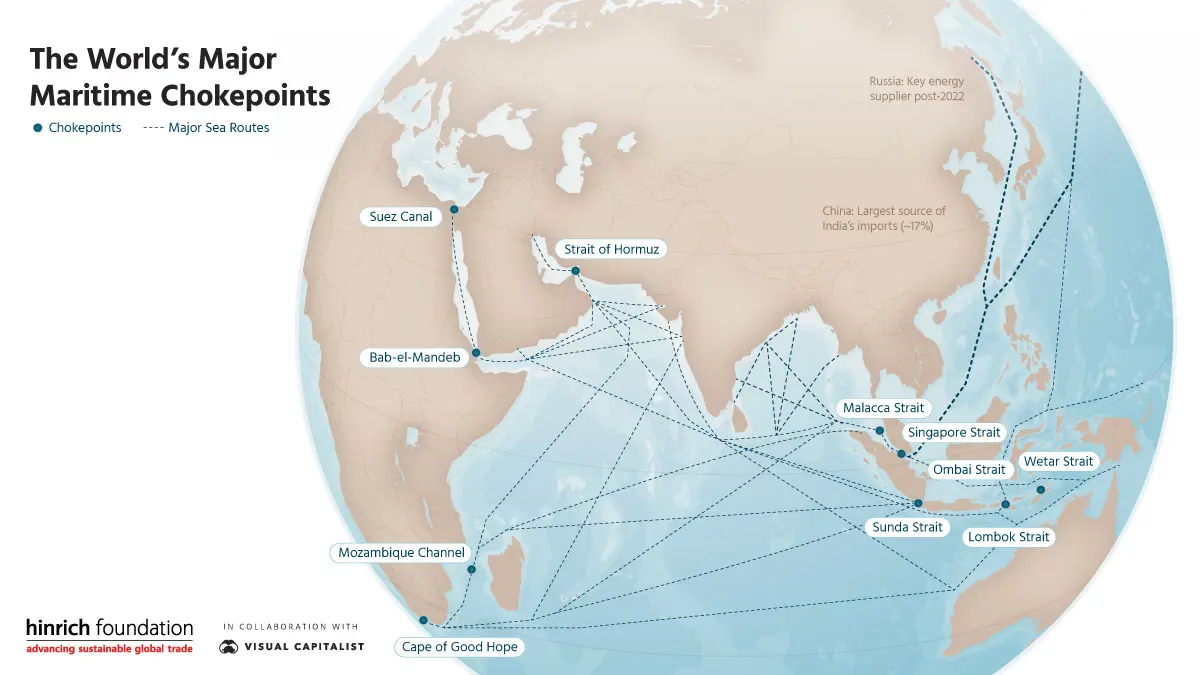
Source: Hinrich Foundation — The World's Major Maritime Chokepoints | Infographic ... · www.hinrichfoundation.com
Major Powers & Strategies
# Indian Ocean Competition
## **India's Strategy**
- SAGAR Policy
- Maritime Security Cooperation
- IONS Leadership
- Quad Partnership
## **China's Presence**
- String of Pearls
- Djibouti Naval Base
- Gwadar Port
- Debt-trap Diplomacy
## **US Involvement**
- Diego Garcia Base
- Indo-Pacific Strategy
- Quad Alliance
- Freedom of Navigation
## **Regional Players**
- Australia (Cocos Islands)
- France (Reunion)
- UK (BIOT)
- Japan (Anti-piracy)
Current Challenges
Piracy: Especially off Somalia coast affecting international shipping
Terrorism: Maritime terrorism threats and illegal arms trafficking
Climate Change: Sea level rise threatening small island nations like Maldives
Resource Competition: Fishing rights disputes and seabed mining claims
Great Power Rivalry: US-China competition affecting regional stability
India's Maritime Security Policy
World Affairs (International Relations)
India's Maritime Security Policy: SAGAR to Blue Economy
Policy Framework
SAGAR Policy (2015): Security and Growth for All in the Region
Mission SAGAR: Humanitarian assistance during COVID-19 to IOR countries
7,500 km coastline with 1,382 islands requiring comprehensive security
Blue Economy: ₹4 trillion target by 2025 from ocean resources
Strategic Vision
India's maritime policy aims to become the 'net security provider' in the Indian Ocean Region while promoting cooperative security architecture. The approach balances military modernization with diplomatic engagement through platforms like IONS.
Key Maritime Initiatives
Initiative | Launch Year | Objective | Key Features |
|---|---|---|---|
SAGAR Policy | 2015 | Regional maritime leadership | Cooperative security, capacity building |
Mission SAGAR | 2020 | COVID-19 assistance | Medical supplies to IOR nations |
Sagarmala Project | 2015 | Port modernization | ₹6 trillion infrastructure investment |
P-75I Submarine Project | 2019 | Underwater capability | 6 advanced submarines with AIP |
Coastal Security Scheme | 2005 (revised 2018) | Coastal protection | Marine police, radar network |
Maritime Security Architecture
%%{init: {"flowchart": {"wrappingWidth": 460}}}%%
flowchart TD
  s1["`****National Level****
National Security Council Secretariat coordinates policy`"]
  s2["`****Service Level****
Indian Navy leads maritime operations and doctrine`"]
  s3["`****Regional Level****
Naval Commands (Western, Eastern, Southern) execute missions`"]
  s4["`****Coastal Level****
Coast Guard and Marine Police ensure coastal security`"]
  s5["`****International Level****
IONS, Quad, bilateral naval exercises for cooperation`"]
  s1 --> s2
  s2 --> s3
  s3 --> s4
s4 --> s5SAGAR vs Mission SAGAR: Policy (2015) vs COVID mission (2020) - different contexts
Navy vs Coast Guard: Navy handles external threats, Coast Guard handles coastal security
Blue Economy confusion: Often mixed with Blue Revolution (fisheries development)
IONS role: India was founding member and first chairman, but it's multilateral forum