The North Eastern Council (NEC) was established by the North Eastern Council Act, 1971. Subsequent to the amendment of NEC Act in 2002, the Council comprises which of the following members? 1. Governor of the Constituent State 2. Chief Minister of the Constituent State 3. Three Members to be nominated by the President of India 4. The Home Minister of India Select the correct answer using the code given below:
Contents11
- A1, 2 and 3 only
- B1, 3 and 4 only
- C2 and 4 only
- D1, 2, 3 and 4
Show answer
Answer: (A) 1, 2 and 3 only
Correct Answer: (a) 1, 2 and 3 only.
After the 2002 amendment, the North Eastern Council comprises:
- Governors of the 8 NE states — ✓ CORRECT (Statement 1).
- Chief Ministers of the 8 NE states — ✓ CORRECT (Statement 2).
- Three members nominated by the President — ✓ CORRECT (Statement 3).
The Home Minister is NOT a member of the NEC — Statement 4 is ✗ WRONG.
The 8 NE states are:
- Assam
- Arunachal Pradesh
- Manipur
- Meghalaya
- Mizoram
- Nagaland
- Tripura
- Sikkim.
The Chairman is nominated by the President.
The NEC acts as a regional planning body.
The North Eastern Council is the constitutional body for regional planning and development coordination across the 8 northeastern states, making it crucial for understanding India's federal structure.
The 2002 amendment specifically removed the Home Minister from NEC membership, shifting it from central control to a more state-centric composition with Governors, Chief Ministers, and Presidential nominees.
UPSC is testing whether students can distinguish between the original 1971 composition versus the amended 2002 structure, particularly the exclusion of central ministers.
North Eastern Council - Composition & Members
Indian Polity North Eastern Council NEC 2002 Governor Chief Minister President Home Minister
North Eastern Council: Composition After 2002 Amendment
NEC has Governors + Chief Ministers of 8 NE states + 3 President-nominated members
Home Minister is NOT a member — this is the key trap
Established by NEC Act 1971, amended in 2002
Acts as regional planning body for Northeast development
What is NEC
The North Eastern Council is a statutory regional planning body for India's northeastern states. Established in 1971 and restructured in 2002, it coordinates development across the region.
NEC Membership After 2002
Member Category | Details | Number |
|---|---|---|
Governors | Of all 8 NE constituent states | 8 |
Chief Ministers | Of all 8 NE constituent states | 8 |
Nominated Members | Appointed by President of India | 3 |
Chairman | Nominated by President of India | 1 |
Home Minister | NOT a member ❌ | 0 |
8 NE Constituent States
Assam, Arunachal Pradesh, Manipur, Meghalaya
Mizoram, Nagaland, Tripura, Sikkim
All 8 states' Governors and Chief Ministers are automatic members
Sikkim was added as the 8th state later
The Chairman coordinates between state and central governments
Why This Was Tested
This question tests precise knowledge of statutory body composition after amendments. The Home Minister trap catches students who assume central ministers are automatically members of regional bodies.
Trap: Home Minister inclusion — students assume central ministers are members, but NEC is state-centric
Confusion: Pre vs Post-2002 — the 2002 amendment changed the structure significantly
Numbers confusion — exactly 3 nominated members, not 2 or 4
State count — all 8 NE states are included, including Sikkim
Statutory Bodies vs Constitutional Bodies
Indian Polity statutory constitutional Act
Constitutional vs Statutory Bodies: Key Differences
Statutory bodies created by Parliamentary Acts (like NEC Act 1971)
Constitutional bodies mentioned directly in Constitution
Parliament can modify statutory bodies by amending the Act
Constitutional bodies need constitutional amendment to change
Body Types Comparison
Aspect | Constitutional Bodies | Statutory Bodies |
|---|---|---|
Source | Constitution itself | Parliamentary Act |
Examples | Election Commission, CAG, UPSC | NEC, CBI, CVC |
Modification | Constitutional Amendment | Amend the Act |
Status | Higher constitutional protection | Can be dissolved by Parliament |
Creation | Came with Constitution (1950) | Created later as needed |
Why This Distinction Matters
NEC is statutory — created by NEC Act 1971, amended in 2002
UPSC frequently tests which bodies are constitutional vs statutory
Statutory bodies can be restructured easily (like NEC in 2002)
Constitutional bodies have greater independence from government interference
Northeast India - Regional Development Framework
Indian Polity North Eastern regional planning
Northeast Regional Development: Special Framework
8 NE states get special development attention due to strategic location
NEC coordinates regional planning across state boundaries
Most NE states have special constitutional provisions under Article 371
High central funding due to special category status
NE Development Architecture
# Northeast Development
## Planning Bodies
- **NEC** (Regional coordination)
- State Planning Boards
- District Planning Committees
## Special Provisions
- **Article 371A-371I**
- Sixth Schedule (Tribal areas)
- Inner Line Permit system
## Funding Mechanisms
- **Special Category grants**
- NEC allocations
- Border Area Development
## Key Challenges
- Connectivity issues
- Insurgency concerns
- Cross-border trade
Northeast States Map
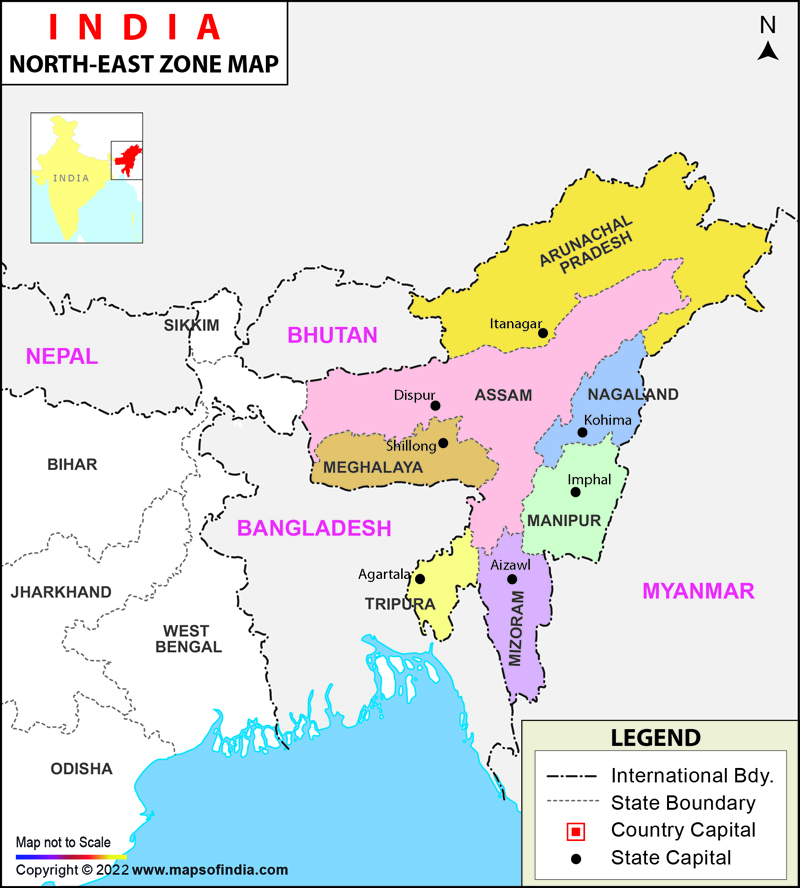
Source: India Map — North-East India States · www.mapsofindia.com
Sikkim confusion — often forgotten as NE state due to separate geographic location
Special Category vs Union Territory — NE states are special category states, not UTs
Article 371 variations — different NE states have different sub-articles (371A for Nagaland, 371F for Sikkim, etc.)