Which one of the following statements best describes the role of B cells and T cells in the human body?
Contents13
- AThey protect the body from environmental allergens.
- BThey alleviate the body's pain and inflammation.
- CThey act as immunosuppressants in the body.
- DThey protect the body from the diseases caused by pathogens.
Show answer
Answer: (D) They protect the body from the diseases caused by pathogens.
The answer is (D) They protect the body from diseases caused by pathogens.
B cells and T cells are two types of white blood cells (lymphocytes) that form the core of your body's ADAPTIVE immune system — the part that specifically fights disease-causing organisms (pathogens).
How they work together:
B cells: Produce ANTIBODIES — special proteins that recognize and neutralize specific pathogens in your blood (antibody-mediated immunity)
T cells: Directly attack infected cells and also HELP B cells produce antibodies (cell-mediated immunity)
Together, they provide "acquired immunity" — your body learns to fight specific germs and remembers them for future attacks.
Why other options are wrong:
(A) Allergen response involves different cells (mast cells, IgE antibodies)
(B) Pain and inflammation are managed by different mechanisms (prostaglandins, NSAIDs)
(C) They are immune ACTIVATORS, not immunosuppressants
B cells and T cells are the core components of adaptive immunity, which creates specific responses against pathogens and immunological memory.
COVID-19 vaccines rely heavily on B cell antibody production and T cell responses, making this immunology concept highly relevant during the pandemic period.
The question tests whether students can distinguish adaptive immunity (B and T cells fighting pathogens) from other immune functions like allergy responses or inflammation control.
Adaptive Immune System Components
Science And Technology B cells T cells lymphocytes
Adaptive Immune System: B Cells & T Cells Functions
B cells produce antibodies that neutralize pathogens in blood and body fluids
T cells directly attack infected cells and coordinate immune responses
Both are lymphocytes (white blood cells) forming the adaptive immune system
They provide acquired immunity - body learns and remembers specific pathogens
B cells and T cells are specialized white blood cells that form the backbone of your body's adaptive immune system. Unlike innate immunity that responds generally to all threats, these cells learn to recognize specific pathogens and mount targeted attacks.
B Cells vs T Cells
Cell Type | Primary Function | How They Work | Type of Immunity |
|---|---|---|---|
B Cells | Produce antibodies | Release antibodies into blood that bind to and neutralize pathogens | Antibody-mediated (Humoral) |
T Cells | Direct cellular attack | Kill infected cells directly & help coordinate immune response | Cell-mediated |
T Cell Subtypes
# T Cells
## Helper T Cells (CD4+)
- Activate B cells
- Coordinate immune response
- Target of HIV virus
## Killer T Cells (CD8+)
- Directly kill infected cells
- Attack cancer cells
- Cytotoxic function
## Memory T Cells
- Remember past infections
- Enable faster future response
- Long-term immunity
Why They Matter for Disease Protection
Specificity: Each B cell produces antibodies against ONE specific pathogen
Memory: Once exposed, memory cells remember the pathogen for years or lifetime
Amplification: Helper T cells boost B cell antibody production by 1000x
Vaccination principle: Vaccines work by training B and T cells without causing disease
Trap: B and T cells do NOT fight allergens - that's mast cells and IgE antibodies
Trap: They do NOT reduce pain/inflammation - that's prostaglandins and anti-inflammatory drugs
Trap: They are immune activators, not immunosuppressants (which reduce immune activity)
Memory aid: B = Blood antibodies, T = Target infected cells directly
Innate vs Adaptive Immunity
Science And Technology pathogens diseases
Two-Layer Immune Defense: Innate vs Adaptive
Innate immunity responds immediately but non-specifically to all threats
Adaptive immunity responds slowly but specifically, creating memory
Both systems work together - innate alerts adaptive system
Innate vs Adaptive Immunity
Feature | Innate Immunity | Adaptive Immunity |
|---|---|---|
Speed | Immediate (minutes to hours) | Slow (days to weeks) |
Specificity | General response to all pathogens | Specific to each pathogen |
Memory | No memory | Strong memory |
Key Components | Skin, mucus, neutrophils, macrophages | B cells, T cells, antibodies |
Duration | Short-term | Long-term (years to lifetime) |
How Immune Response Works
%%{init: {"flowchart": {"wrappingWidth": 460}}}%%
flowchart TD
  s1["`**Pathogen Invasion**
Bacteria, virus, or other pathogen enters body`"]
  s2["`**Innate Response**
Skin, mucus barriers; neutrophils & macrophages attack immediately`"]
  s3["`**Antigen Presentation**
Dendritic cells capture pathogen pieces and present to T cells`"]
  s4["`**Adaptive Activation**
Helper T cells activate B cells; Killer T cells attack infected cells`"]
  s5["`**Antibody Production**
B cells produce specific antibodies; Memory cells form`"]
  s6["`**Pathogen Elimination**
Combined innate + adaptive response clears infection`"]
  s1 --> s2
  s2 --> s3
  s3 --> s4
  s4 --> s5
s5 --> s6Common confusion: Students think innate = weak, adaptive = strong. Both are essential - innate buys time for adaptive to activate
UPSC loves this: Vaccines work on adaptive immunity (memory), not innate immunity
Terminology trap: 'Acquired immunity' = 'Adaptive immunity' = same thing
Antibody Structure & Function
Science And Technology antibodies
Antibodies: The Body's Guided Missiles
Antibodies are Y-shaped proteins that bind specifically to pathogen parts
Each antibody recognizes only one specific antigen (lock-and-key fit)
They neutralize pathogens and mark them for destruction
Antibodies (also called immunoglobulins) are Y-shaped protein molecules produced by plasma cells (activated B cells). Each antibody has two identical binding sites that recognize and attach to specific parts of pathogens called antigens.
Major Antibody Types
Antibody | Location | Function | UPSC Relevance |
|---|---|---|---|
IgG | Blood, tissues | Main blood antibody, crosses placenta | Provides immunity to newborns |
IgM | Blood | First antibody made in infection | Early infection marker |
IgA | Saliva, tears, breast milk | Protects mucosal surfaces | Breastfeeding immunity |
IgE | Tissues | Allergic reactions | NOT involved in B/T cell pathogen defense |
IgD | B cell surface | Helps B cells recognize antigens | Research significance |
How Antibodies Destroy Pathogens
Neutralization: Block pathogen from entering healthy cells
Opsonization: Mark pathogen for destruction by macrophages
Complement activation: Trigger protein cascade that destroys pathogen cell walls
Agglutination: Clump pathogens together for easier elimination
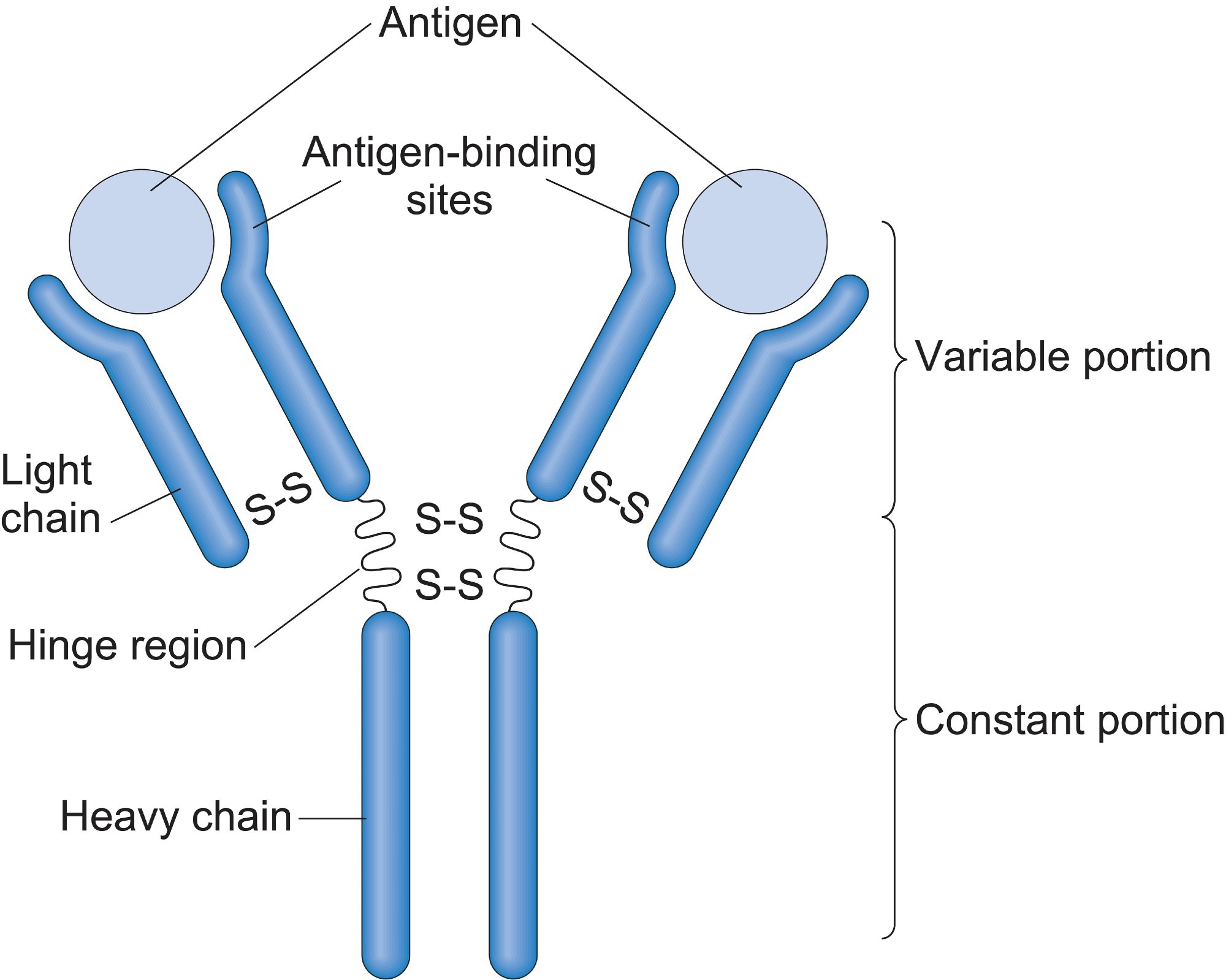
Source: News-Medical.Net — The Structure of an Antibody · www.news-medical.net
Critical trap: IgE antibodies cause allergies - they're NOT the B cell antibodies that fight pathogens (that's mainly IgG and IgM)
Terminology: Immunoglobulins = Antibodies = same thing
Memory trick: IgG = General pathogen fighter, IgE = Enemy allergen trigger
Immune System Disorders & Dysfunctions
Science And Technology immunosuppressants
When Immunity Goes Wrong: Disorders & Treatments
Autoimmune diseases: Immune system attacks body's own cells
Immunodeficiency: Immune system too weak (HIV/AIDS example)
Immunosuppressants reduce immune activity - used in organ transplants
Types of Immune Disorders
Disorder Type | What Goes Wrong | Examples | Treatment Approach |
|---|---|---|---|
Autoimmune | Immune system attacks own body | Diabetes Type 1, Rheumatoid arthritis | Immunosuppressive drugs |
Immunodeficiency | Immune system too weak | HIV/AIDS, SCID | Boost immunity, avoid infections |
Hypersensitivity | Overreaction to harmless substances | Food allergies, asthma | Antihistamines, avoid triggers |
Transplant rejection | Immune system attacks transplanted organ | Kidney, heart transplant rejection | Immunosuppressants |
Immunosuppressants - When Less Immunity Helps
Purpose: Deliberately reduce immune system activity
Main use: Prevent organ transplant rejection
Examples: Cyclosporine, Tacrolimus, Corticosteroids
Side effect: Increased infection risk due to weakened immunity
Major trap: B and T cells ACTIVATE immunity - they are NOT immunosuppressants
Opposite roles: B/T cells = immune activators, Immunosuppressant drugs = immune reducers
Context matters: Immunosuppressants are drugs, not natural cells