With reference to the Genetically Modified mustard (GM mustard) developed in India, consider the following statements: 1. GM mustard has the genes of a soil bacterium that give the plant the property of pest-resistance to a wide variety of pests. 2. GM mustard has the genes that allow the plant cross-pollination and hybridization. 3. GM mustard has been developed jointly by the IARI and Punjab Agricultural University. Which of the statements given above is/are correct?
Contents16
- A1 and 3 only
- B2 only
- C2 and 3 only
- D1, 2 and 3
Show answer
Answer: (B) 2 only
Correct Answer: (b) 2 only
Statement 1 is WRONG:
GM mustard does NOT have genes from a mustard plant.
It uses genes from a SOIL BACTERIUM (Bacillus amyloliquefaciens).
These bacterial genes help the mustard plant produce hybrid seeds more efficiently than traditional methods.Statement 2 is CORRECT:
GM mustard uses the barnase-barstar gene system from soil bacteria.
The barnase gene makes one parent line male-sterile (cannot produce pollen),
and the barstar gene in the other parent line restores fertility.
This makes hybridization (cross-breeding) easier and more efficient.Statement 3 is WRONG:
GM mustard was NOT developed by a private company.
It was developed by the Centre for Genetic Manipulation of Crop Plants at Delhi University,
led by Professor Deepak Pental.
It is a publicly funded research effort, not a private sector product.
REMEMBER:
GM Mustard = genes from soil BACTERIA (not another mustard plant).
Developed by DELHI UNIVERSITY (public institution, not private).
Uses barnase-barstar system for better hybridization.
GM mustard uses the barnase-barstar gene system from soil bacteria to create male-sterile plants that enable easier hybrid seed production, making it fundamentally different from pest-resistant GM crops.
GM mustard approval was a major controversy in 2016-2017 with environmental groups opposing it, making the technical details behind this hybridization technology exam-relevant.
The question tests whether students can distinguish between pest-resistance GM technology (like Bt cotton) versus hybridization-enabling GM technology used in mustard.
GM Mustard in India
Science And Technology GM mustard Genetically Modified mustard
GM Mustard in India: Barnase-Barstar System & UPSC Traps
GM mustard uses barnase-barstar gene system from soil bacteria for hybrid seed production
Developed by Centre for Genetic Manipulation of Crop Plants, Delhi University (not IARI or private company)
Purpose is hybridization efficiency, not pest resistance
Uses genes from Bacillus amyloliquefaciens (soil bacterium)
What is GM Mustard
GM mustard (DMH-11) is India's first genetically modified food crop developed for hybridization, not pest control. It uses bacterial genes to create a male-sterile female parent that can cross-pollinate more efficiently than traditional breeding methods.
GM Mustard vs Traditional Mustard
Aspect | GM Mustard | Traditional Mustard |
|---|---|---|
Gene Source | Bacillus amyloliquefaciens (soil bacteria) | Natural mustard genes only |
Primary Purpose | Hybridization efficiency | Direct cultivation |
Male Sterility | Barnase gene creates male-sterile plants | Self-fertile plants |
Fertility Restoration | Barstar gene restores fertility | Not applicable |
Hybrid Vigor | Enhanced through controlled cross-pollination | Limited hybrid production |
Barnase-Barstar Mechanism
%%{init: {"flowchart": {"wrappingWidth": 460}}}%%
flowchart TD
  s1["`**Parent A (Female)**
Contains **barnase gene** → produces enzyme that destroys pollen → becomes **male-sterile**`"]
  s2["`**Parent B (Male)**
Contains **barstar gene** → produces inhibitor protein → remains **fertile**`"]
  s3["`**Cross-Pollination**
Male-sterile Parent A can only accept pollen from Parent B → **controlled hybridization**`"]
  s4["`**Hybrid Seeds**
Resulting seeds contain **both genes** → can restore fertility when needed`"]
  s1 --> s2
  s2 --> s3
  s3 --> s4
Development & Approval Status
Developed by Centre for Genetic Manipulation of Crop Plants, Delhi University under Prof. Deepak Pental
Public sector research project, not private company initiative
Approved by Genetic Engineering Appraisal Committee (GEAC) in 2017 but implementation stalled
Designed to increase mustard oil production through better hybrid varieties
Trap: Statement 1 confuses GM mustard with Bt crops - GM mustard is for hybridization, not pest resistance
Trap: Statement 3 wrongly credits IARI and Punjab Agricultural University - actually developed by Delhi University
Common confusion: Bacterial genes ≠ pest resistance - Bacillus amyloliquefaciens genes here are for reproductive control, not toxin production
Key distinction: GM mustard uses barnase-barstar system, while Bt crops use Cry proteins from different bacteria
Barnase-Barstar Gene System
Science And Technology barnase barstar cross-pollination hybridization
Barnase-Barstar System: Controlled Plant Hybridization
Barnase creates male-sterile plants, barstar restores fertility
Derived from Bacillus amyloliquefaciens soil bacterium
Enables controlled cross-pollination for hybrid seed production
Molecular Mechanism
The barnase-barstar system is a molecular switch for plant fertility. Barnase is a bacterial enzyme that destroys RNA, making plants male-sterile when expressed in pollen-producing tissues. Barstar is its natural inhibitor protein that can restore fertility by blocking barnase activity.
Barnase vs Barstar Functions
Gene | Protein Function | Effect on Plant | Role in Hybridization |
|---|---|---|---|
Barnase | RNase enzyme - destroys cellular RNA | Creates male-sterile plants (no viable pollen) | Female parent - can only receive pollen |
Barstar | Inhibitor protein - blocks barnase enzyme | Restores fertility in hybrid offspring | Male parent - provides viable pollen |
Both together | Balanced inhibition system | Controlled fertility in F1 hybrids | Enables large-scale hybrid production |
Applications in Crop Breeding
Hybrid vigor (heterosis): Cross-bred plants often outperform parent varieties in yield and quality
Commercial advantage: Farmers must buy new hybrid seeds each season (cannot save and replant)
Breeding efficiency: Eliminates need for manual emasculation (removal of male parts) in traditional hybridization
Quality control: Ensures 100% hybrid seeds with no self-pollinated plants contaminating the batch
System Visualization
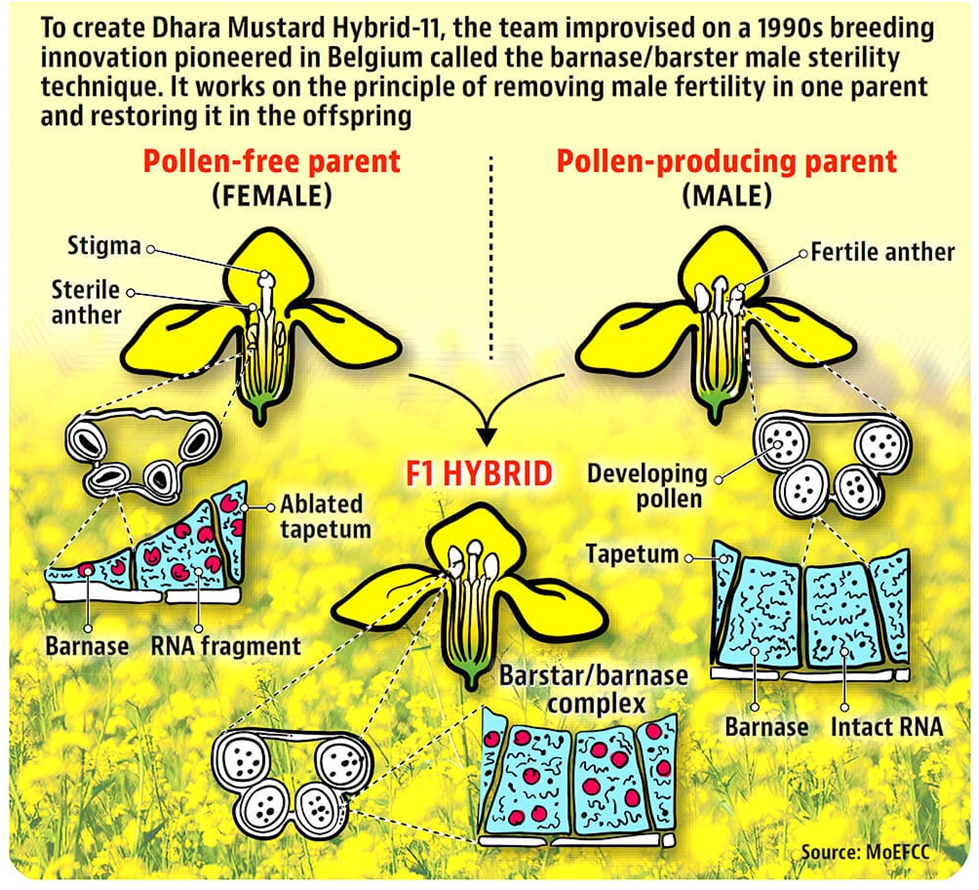
Source: Fotis Edu — Genetically Modified (GM) mustard – Barnase-barstar technology ... · fotisedu.com
Bt Crops vs Other GM Crops
Science And Technology pest-resistance soil bacterium
Bt Crops vs GM Mustard: Different Bacterial Genes, Different Purposes
Bt crops use genes from Bacillus thuringiensis for pest resistance
GM mustard uses genes from Bacillus amyloliquefaciens for hybridization
Both use soil bacteria genes but for completely different purposes
GM Crop Types Comparison
GM Crop Type | Source Bacterium | Key Genes | Primary Purpose | Examples in India |
|---|---|---|---|---|
Bt Crops | Bacillus thuringiensis | Cry proteins (Cry1Ac, Cry2Ab) | Insect resistance - produces toxins deadly to pests | Bt Cotton, Bt Brinjal (banned) |
GM Mustard | Bacillus amyloliquefaciens | Barnase-Barstar system | Hybridization - controls plant fertility for breeding | DMH-11 mustard |
HT Crops | Various bacteria | EPSPS enzyme variants | Herbicide tolerance - survives weedkiller application | Not approved in India yet |
Bt Crops in India
Bt Cotton: Only GM crop commercially grown in India since 2002
Cry proteins: Bacterial toxins that kill bollworm larvae when they eat the plant
Bt Brinjal: Developed but banned for commercial cultivation due to safety concerns
GEAC approval: Required for all GM crop trials and commercial release in India
Major trap: All soil bacteria genes ≠ pest resistance - GM mustard uses bacteria for fertility control
Source confusion: Bacillus thuringiensis (Bt crops) vs Bacillus amyloliquefaciens (GM mustard)
Purpose mix-up: Bt = pest killing, GM mustard = breeding efficiency
India status: Only Bt Cotton is commercially approved, GM mustard approval is stalled
Agricultural Research Institutions
Science And Technology IARI Punjab Agricultural University
Key Agricultural Research Institutions in India
IARI (Indian Agricultural Research Institute) - premier agricultural research under ICAR
Centre for Genetic Manipulation of Crop Plants, Delhi University - developed GM mustard
State Agricultural Universities - region-specific crop research and extension
Major Agricultural Research Bodies
Institution | Type | Key Focus | Notable Achievements |
|---|---|---|---|
IARI, New Delhi | ICAR institute | Crop varieties, plant breeding, soil science | High-yielding wheat varieties, Green Revolution |
Centre for Genetic Manipulation, DU | University research centre | Plant biotechnology, genetic engineering | GM Mustard (DMH-11) development |
Punjab Agricultural University | State agricultural university | Wheat and rice research for Punjab | Green Revolution varieties for Northwest India |
ICRISAT, Hyderabad | International research institute | Dryland crops (millets, pulses) | Drought-resistant crop varieties |
ICAR System Structure
# ICAR (Indian Council of Agricultural Research)
## Central Institutes
- IARI New Delhi
- IIMR Hyderabad
- CTRI Rajahmundry
- IIVR Varanasi
## National Research Centres
- NRCS (Safflower)
- NRCG (Groundnut)
- NRCP (Pomegranate)
## State Agricultural Universities
- Punjab Agricultural University
- Tamil Nadu Agricultural University
- Acharya NG Ranga Agricultural University
## Deemed Universities
- NDRI Karnal
- IVRI Bareilly
- NIFTEM SonipatInstitution trap: GM mustard developed by Delhi University, not IARI or Punjab Agricultural University
Sector confusion: Delhi University centre is public research, not private company
ICAR vs University: IARI is under ICAR, but genetic engineering centres can be in regular universities too