Consider the following activities: 1. Identification of narcotics on passengers at airports or in aircraft 2. Monitoring of precipitation 3. Tracking the migration of animals In how many of the above activities can the radars be used?
Contents12
- AOnly one
- BOnly two
- CAll three
- DNone
Show answer
Answer: (B) Only two
Correct Answer: (b) Only two — monitoring precipitation and tracking animal migration.
Radar can monitor precipitation — weather radar sends electromagnetic waves that bounce off rain, snow, and hail, showing their location and intensity. ✓ CORRECT.
Radar can track animal migration — radar detects the movement of bird flocks and insect swarms over large distances. ✓ CORRECT.
Radar CANNOT identify narcotics on passengers — this requires specialised scanners (X-ray, CT, chemical detectors, sniffer dogs), not radar. ✗ WRONG.
Key concept: Radar is great at detecting movement and objects at a distance, but it can't identify the chemical composition of substances.
Radar technology detects objects and movement by bouncing electromagnetic waves, but cannot identify chemical composition of materials like narcotics.
UPSC is testing whether students confuse radar with airport security scanners - radar detects motion and precipitation, while X-ray and chemical detectors identify substances.
Radar Technology Applications
Science And Technology radars identification of narcotics monitoring of precipitation tracking the migration
Radar Technology: Applications & Limitations in Detection
Radar detects objects using electromagnetic waves that bounce back
Weather radar monitors precipitation (rain, snow, hail) effectively
Radar cannot identify chemical composition or narcotics
Radar tracks animal migration patterns over long distances
Radar (Radio Detection and Ranging) works by sending electromagnetic waves and analyzing the signals that bounce back from objects. It excels at detecting movement, location, and distance but has clear limitations in identifying specific materials or substances.
Radar Applications Analysis
Activity | Radar Capability | Status | Alternative Technology |
|---|---|---|---|
Narcotics identification | Cannot detect chemical composition | Not possible | X-ray scanners, CT scans, chemical detectors |
Precipitation monitoring | Detects rain, snow, hail particles | Fully capable | Weather satellites (complementary) |
Animal migration tracking | Detects moving flocks/swarms | Fully capable | GPS tags, satellite tracking |
How Weather Radar Works
Doppler radar sends electromagnetic pulses that bounce off precipitation particles
Return signal intensity indicates precipitation density and type
Doppler shift reveals wind speed and direction within storm systems
Modern weather radar can detect particles as small as 0.1 mm
Radar in Animal Migration Studies
Bird migration radar detects flocks flying at altitudes up to 6 km
Insect swarms create distinctive radar signatures during seasonal movements
Military radar stations often contribute data to migration research
Radar reveals nocturnal migrations invisible to visual observation
Trap: Confusing radar with X-ray — radar uses radio waves, X-ray uses high-energy electromagnetic radiation
Trap: Assuming radar can detect all objects — it struggles with non-metallic, stationary small objects
Trap: Mixing up detection vs identification — radar detects presence but cannot identify chemical composition
Airport Security Technologies
Science And Technology identification of narcotics passengers at airports
Airport Security: Technologies for Contraband Detection
X-ray scanners are primary technology for baggage screening at airports
Body scanners use millimeter waves or backscatter X-rays
Chemical detectors identify traces of explosives and narcotics
Multi-layered security combines multiple detection technologies
Airport Security Technologies
Technology | Detection Method | Primary Use | Limitation |
|---|---|---|---|
X-ray scanners | High-energy electromagnetic radiation | Baggage screening | Cannot identify specific chemicals |
CT scanners | 3D X-ray imaging | Advanced baggage screening | Slower processing |
Millimeter wave | Non-ionizing radio waves | Body scanning | Privacy concerns |
Ion scanners | Chemical trace detection | Explosive/drug residue | Requires contact/swabbing |
Sniffer dogs | Biological detection | Narcotics and explosives | Limited working hours |
Chemical Detection Methods
Ion Mobility Spectrometry (IMS) detects trace amounts of narcotics and explosives
Mass spectrometry identifies specific chemical signatures
Swab testing collects samples from luggage and passengers for analysis
Trained detection dogs can identify over 19,000 different odor signatures
The question specifically asks about narcotics identification — this requires technologies that can determine chemical composition, not just detect physical presence. Airport security uses a layered approach combining multiple detection methods, but radar is not among them because it cannot identify what substances are made of.
Weather Radar Systems
Science And Technology monitoring of precipitation radars
Weather Radar: Precipitation Monitoring & Forecasting
Weather radar is essential for monitoring precipitation patterns
Doppler radar measures both precipitation and wind speed
India uses S-band and C-band radar for weather monitoring
Radar provides real-time data for cyclone and storm tracking
Weather Radar Operation
%%{init: {"flowchart": {"wrappingWidth": 460}}}%%
flowchart TD
  s1["`**Electromagnetic pulse transmission**
Radar sends radio waves toward atmosphere`"]
  s2["`**Wave interaction with precipitation**
Waves bounce off rain, snow, hail particles`"]
  s3["`**Return signal analysis**
Computer analyzes reflected wave intensity and frequency`"]
  s4["`**Weather map generation**
Data converted to visual precipitation intensity maps`"]
  s1 --> s2
  s2 --> s3
  s3 --> s4
Types of Weather Radar
Radar Type | Frequency Band | Range | Primary Use |
|---|---|---|---|
S-band radar | 2-4 GHz | Up to 400 km | Long-range weather surveillance |
C-band radar | 4-8 GHz | Up to 200 km | Regional weather monitoring |
X-band radar | 8-12 GHz | Up to 100 km | Local precipitation detection |
Dual-polarization | Multiple | Varies | Precipitation type identification |
India's Weather Radar Network
IMD operates over 30 Doppler radar stations across India
Coastal radars provide crucial cyclone tracking for Bay of Bengal and Arabian Sea
S-band radars in Mumbai, Chennai, Kolkata cover major metropolitan areas
Integration with satellite data enhances forecast accuracy
Doppler Radar Display
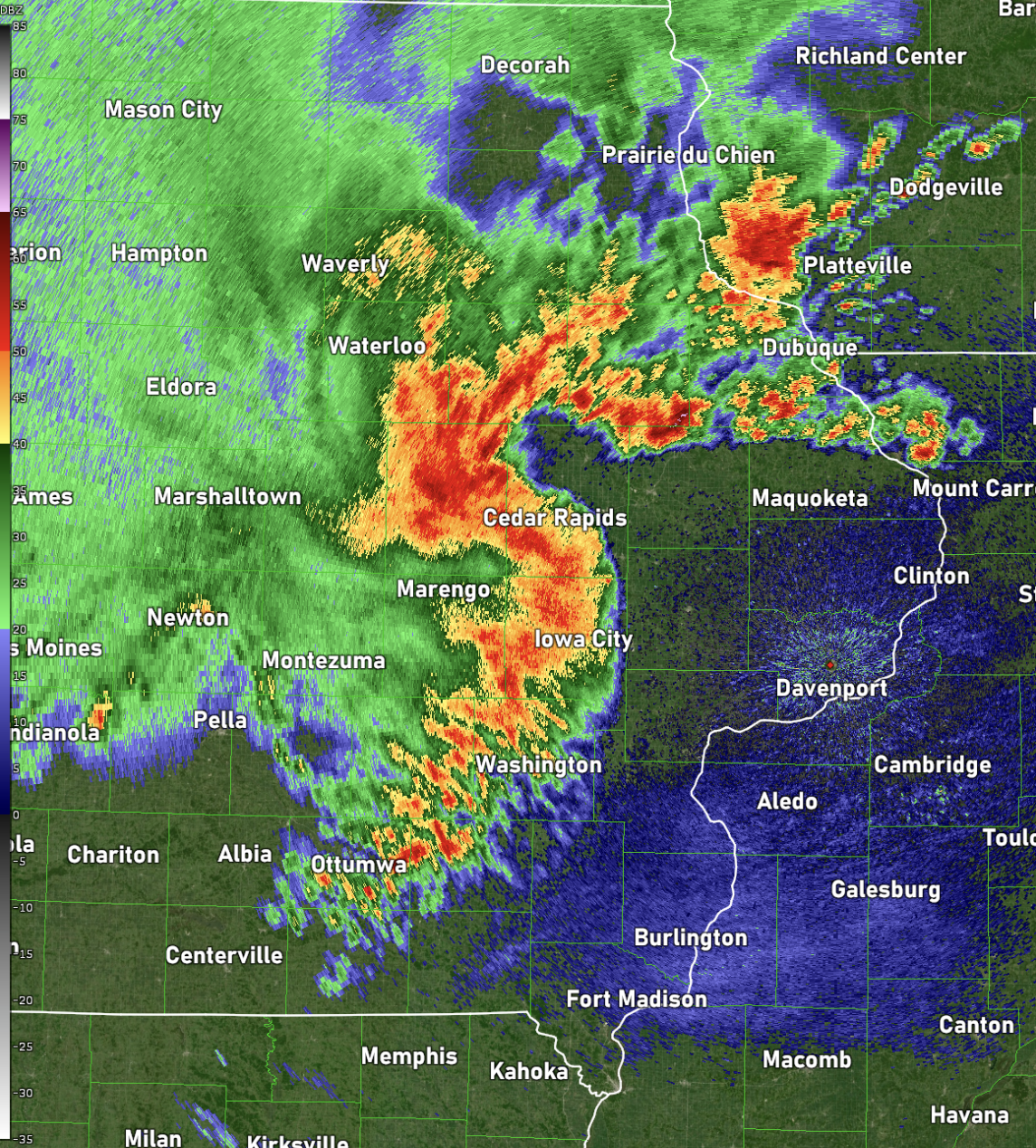
Source: Rain Viewer — How to Read Weather Radar Images | Rain Viewer Blog · www.rainviewer.com