Recently, the term 'pumped-storage hydropower' is actually and appropriately discussed in the context of which one of the following?
Contents19
- AIrrigation of terraced crop fields
- BLift irrigation of cereal crops
- CLong duration energy storage
- DRainwater harvesting system
Show answer
Answer: (C) Long duration energy storage
Correct Answer: (c) Long duration energy storage.
Pumped-storage hydropower works like a giant rechargeable battery:
When excess electricity is available (e.g., at night or from renewables), water is pumped UP to a higher reservoir.
When electricity is needed, water flows DOWN through turbines to generate power.
This makes it a form of long-duration energy storage — it can store energy for hours or even days.
It has nothing to do with irrigation, lift irrigation, or rainwater harvesting — those are about water use, not electricity storage.
Pumped-storage is currently the largest form of grid-scale energy storage in the world.
Pumped-storage hydropower is the world's largest form of grid-scale energy storage, working like a giant rechargeable battery that can store electricity for hours or days.
India has been actively promoting pumped storage projects in recent years as renewable energy expansion creates need for large-scale storage solutions to handle intermittent solar and wind power.
The question tests whether students understand energy storage mechanisms versus traditional water management systems like irrigation.
Pumped-Storage Hydropower
Science And Technology pumped-storage hydropower
Pumped-Storage Hydropower: Grid-Scale Energy Storage
Works like a giant rechargeable battery using water and gravity
Largest form of grid-scale energy storage globally
Stores energy for hours to days (long-duration storage)
Uses two reservoirs at different elevations
Basic Concept
Pumped-storage hydropower (PSH) is a grid-scale energy storage technology that uses water and gravity. It functions as a massive rechargeable battery for the electricity grid, storing excess power when available and releasing it when needed.
How It Works
%%{init: {"flowchart": {"wrappingWidth": 460}}}%%
flowchart TD
  s1["`**Excess electricity available**
During low demand or high renewable generation`"]
  s2["`**Water pumped UP**
Electric motors pump water to upper reservoir`"]
  s3["`**Energy stored as potential energy**
Water at height stores gravitational potential energy`"]
  s4["`**Electricity needed**
During peak demand periods`"]
  s5["`**Water flows DOWN**
Through turbines to generate electricity`"]
  s6["`**Power supplied to grid**
Stored energy converted back to electricity`"]
  s1 --> s2
  s2 --> s3
  s3 --> s4
  s4 --> s5
  s5 --> s6
System Diagram
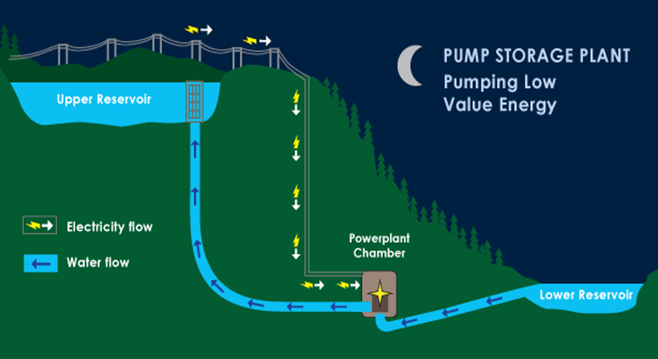
Source: TC Energy — TC Energy — Canyon Creek Pumped Hydro Energy Storage Project · www.tcenergy.com
Key Advantages
Long-duration storage capability (6-20+ hours)
High efficiency (70-85% round-trip efficiency)
Grid stability services like frequency regulation
Proven technology with decades of operational experience
Large scale storage capacity (hundreds of MW to GW)
Connection to Question
The question tests understanding that PSH is fundamentally about energy storage, not water management. Options A, B, and D all relate to agricultural water use, which is the classic UPSC trap - confusing water-based technology with water supply applications.
Trap: Confusing PSH with irrigation systems because both use water - PSH is about electricity storage, not crop watering
Trap: Thinking 'hydropower' always means river dams - PSH uses artificial reservoirs specifically for energy storage
Trap: Missing that PSH requires two reservoirs at different elevations, unlike regular hydropower
Trap: Confusing with rainwater harvesting - PSH recycles the same water between reservoirs
Energy Storage Technologies
Science And Technology long duration energy storage
Energy Storage Technologies: Grid-Scale Solutions
Grid-scale storage essential for renewable energy integration
Duration classifications: short (minutes), medium (hours), long (days)
Pumped hydro dominates global storage capacity
Why Storage Matters
Energy storage is critical for modern grids, especially with variable renewable sources like solar and wind. It balances supply-demand mismatches and provides grid stability services.
Major Storage Technologies
Technology | Duration | Scale | Key Application |
|---|---|---|---|
Pumped Hydro | Hours to days | GW scale | Grid balancing, peak shaving |
Lithium-ion Batteries | Minutes to hours | MW to GW | Frequency regulation, backup |
Compressed Air (CAES) | Hours to days | MW to GW | Load shifting, grid support |
Hydrogen Storage | Days to months | MW to GW | Long-term seasonal storage |
Flywheel | Seconds to minutes | kW to MW | Power quality, UPS systems |
Grid Storage Applications
Peak shaving - reducing maximum demand charges
Load shifting - moving energy from low to high demand periods
Frequency regulation - maintaining grid stability
Renewable integration - smoothing variable solar/wind output
Backup power - emergency supply during outages
Trap: Confusing storage duration with capacity - PSH has long duration but may have lower power capacity than batteries
Trap: Thinking all storage is batteries - pumped hydro still dominates global installed capacity
Trap: Missing that storage serves multiple grid functions beyond just storing excess renewable energy
Renewable Energy Integration Challenges
Science And Technology
Renewable Energy Integration: Grid Challenges & Solutions
Variability of solar and wind creates grid balancing challenges
Storage systems essential for high renewable penetration
Grid flexibility needed to manage supply-demand mismatches
The Challenge
Variable renewable energy (VRE) like solar and wind generates electricity when nature provides, not when demand requires it. This creates supply-demand mismatches that traditional grids struggle to handle.
Integration Challenges
# VRE Integration Challenges
## Variability
- Weather dependent
- Daily cycles
- Seasonal patterns
## Grid Stability
- Frequency fluctuations
- Voltage regulation
- System inertia
## Economic
- Market price volatility
- Stranded assets
- Investment uncertainty
## Technical
- Transmission congestion
- Forecasting accuracy
- Ramping requirements
Solution Technologies
Energy storage - pumped hydro, batteries for supply-demand balancing
Smart grids - demand response and real-time management
Flexible generation - gas plants that can ramp up/down quickly
Grid interconnections - sharing resources across wider areas
Forecasting systems - predicting renewable generation patterns
India Context
India aims for 500 GW renewable capacity by 2030. The government has launched schemes for grid-scale storage and is developing Green Energy Corridors to integrate renewable power from resource-rich states.
Trap: Thinking renewables only need more capacity - the real challenge is grid integration and balancing
Trap: Confusing installed capacity with actual generation - renewables have lower capacity factors than thermal plants
Trap: Missing that storage is not just for excess energy - also provides grid stability services
Water Usage: Irrigation vs Energy Applications
Science And Technology irrigation lift irrigation
Water Systems: Irrigation vs Energy Applications
Irrigation systems move water for crop watering
Energy systems use water for electricity generation/storage
Purpose determines classification - not the presence of water
Key Distinction
UPSC often creates confusion by mixing water-based technologies. The purpose determines the category - irrigation systems deliver water to crops, while energy systems use water as a medium for power generation or storage.
Water Applications Comparison
System Type | Primary Purpose | End Product | Example Technologies |
|---|---|---|---|
Irrigation | Crop watering | Agricultural productivity | Drip irrigation, sprinklers, lift irrigation |
Energy Generation | Electricity production | Electrical power | Hydroelectric dams, run-of-river plants |
Energy Storage | Grid balancing | Stored electricity | Pumped-storage hydropower |
Water Management | Water conservation | Water supply | Rainwater harvesting, check dams |
Common UPSC Traps
Lift irrigation - pumps water UP for crops, but it's still irrigation, not energy storage
Terraced fields - stepped agriculture for water management, not electricity
Rainwater harvesting - collects and stores water for use, not for power generation
Hydropower vs PSH - regular hydro generates from flowing rivers, PSH stores energy using artificial reservoirs
Trap: Seeing 'pump' in both lift irrigation and pumped storage - one pumps water to crops, other pumps water to store energy
Trap: Thinking all water-related technology is irrigation - focus on the end purpose
Trap: Confusing water storage (for supply) with energy storage (using water as a medium)