With reference to radioisotope thermoelectric generators (RTGs), consider the following statements: 1. RTGs are miniature fission reactors. 2. RTGs are used for powering the onboard systems of spacecrafts. 3. RTGs can use Plutonium-238, which is a by-product of weapons development. Which of the statements given above are correct?
Contents17
- A1 and 2 only
- B2 and 3 only
- C1 and 3 only
- D1, 2 and 3
Show answer
Answer: (B) 2 and 3 only
Correct Answer: (b) Statements 2 and 3 only.
Statement 1: RTGs are miniature fission reactors — ✗ WRONG.
RTGs do NOT involve fission (splitting atoms).
They work by converting the heat from natural radioactive decay of Plutonium-238 into electricity using thermocouples.
No chain reaction occurs.
Statement 2: RTGs power spacecraft systems — ✓ CORRECT.
They're used on deep-space missions (like Voyager, Curiosity rover) where solar panels aren't practical.
Statement 3: RTGs use Plutonium-238, a by-product of weapons development — ✓ CORRECT.
Pu-238 is produced as part of nuclear fuel processing.
Key distinction:
- Fission reactor = controlled chain reaction (like a nuclear power plant).
- RTG = heat from natural radioactive decay (no chain reaction).
RTGs are simpler and more reliable for space missions.
RTGs convert heat from radioactive decay directly into electricity without any fission reaction, making them ideal for long-duration space missions where solar power is insufficient.
NASA's Perseverance rover landing on Mars in 2021 and ongoing deep space missions have kept RTG technology in focus for space exploration discussions.
The question tests whether students can distinguish between fission reactors (controlled chain reactions) and RTGs (simple radioactive decay heat conversion).
Radioisotope Thermoelectric Generators (RTGs)
Science And Technology RTGs Plutonium-238 spacecrafts
RTGs: Working Principle, Applications & UPSC Traps
RTGs convert heat from radioactive decay (not fission) into electricity
Used to power deep-space missions like Voyager and Mars rovers
Primary fuel is Plutonium-238, a nuclear weapons by-product
No chain reaction involved - simpler than nuclear reactors
RTGs are nuclear-powered batteries that convert radioactive decay heat into electricity. Unlike nuclear reactors, they involve no fission chain reactions - making them ideal for remote applications where reliability matters more than efficiency.
How RTGs Work
%%{init: {"flowchart": {"wrappingWidth": 460}}}%%
flowchart TD
  s1["`**Plutonium-238 undergoes natural radioactive decay**
Alpha particles released, generating heat continuously`"]
  s2["`**Heat flows from hot radioactive core to cooler outer surface**
Temperature difference created across the device`"]
  s3["`**Thermocouples convert temperature difference to electricity**
Seebeck effect - no moving parts required`"]
  s4["`**Electricity powers spacecraft systems**
Reliable power for decades in space`"]
  s1 --> s2
  s2 --> s3
  s3 --> s4
RTGs vs Nuclear Reactors
Aspect | RTGs | Nuclear Reactors |
|---|---|---|
Process | Radioactive decay (natural) | Nuclear fission (controlled chain reaction) |
Control needed | No control required | Complex control systems |
Power output | Low (few hundred watts) | High (megawatts) |
Reliability | Extremely reliable | Requires maintenance |
Applications | Space missions, remote sensors | Power plants, submarines |
Space Applications
Deep-space missions beyond Jupiter where solar panels are ineffective
Mars rovers (Curiosity, Perseverance) - dust storms block solar panels
Voyager 1 & 2 - still powered by RTGs after 40+ years
New Horizons mission to Pluto used RTG power
Provide continuous power regardless of sunlight availability
RTG Structure

Source: ScienceDirect.com — Thermoelectric Generator - an overview | ScienceDirect Topics · www.sciencedirect.com
Plutonium-238 Fuel
Pu-238 produces heat through alpha decay - relatively safe radiation
By-product of nuclear weapons and reactor fuel processing
Half-life of 87.7 years - provides decades of power
Very expensive - costs millions per kilogram to produce
Different from Pu-239 used in weapons (which is fissile)
Trap: Statement 1 calls RTGs 'fission reactors' - they use decay, not fission
Confusion: RTGs vs nuclear reactors - RTGs have no chain reaction
Mix-up: Pu-238 (RTG fuel) vs Pu-239 (weapons material) - different isotopes
False assumption: RTGs need active control - they're passive heat sources
Nuclear Fission vs Radioactive Decay
Science And Technology fission miniature fission reactors
Nuclear Processes: Fission vs Natural Decay
Nuclear fission requires splitting heavy nuclei in a chain reaction
Radioactive decay is spontaneous breakdown of unstable nuclei
Fission needs critical mass and control systems
Decay is uncontrollable but predictable via half-life
Fission vs Decay Comparison
Process | Nuclear Fission | Radioactive Decay |
|---|---|---|
Mechanism | Neutron splits heavy nucleus | Spontaneous breakdown of unstable nucleus |
Chain reaction | Yes - one fission triggers more | No - each nucleus decays independently |
Control needed | Critical - must control neutron flux | None - happens at fixed rate |
Energy release | Sudden burst when triggered | Continuous low-level heat |
Predictability | Controllable if managed properly | Predictable via half-life calculations |
Examples | Nuclear power plants, weapons | RTGs, medical isotopes |
Nuclear Fission Chain Reaction
%%{init: {"flowchart": {"wrappingWidth": 460}}}%%
flowchart TD
  s1["`**Neutron hits heavy nucleus (U-235 or Pu-239)**
Nuclear absorption occurs`"]
  s2["`**Nucleus becomes unstable and splits**
Fission products + 2-3 new neutrons released`"]
  s3["`**New neutrons hit other nuclei**
Chain reaction propagates`"]
  s4["`**Massive energy released rapidly**
Controlled in reactors, uncontrolled in bombs`"]
  s1 --> s2
  s2 --> s3
  s3 --> s4
Key Distinctions for UPSC
Fission materials: U-235, Pu-239 (weapons-grade, fissile)
Decay materials: Pu-238, Co-60, Sr-90 (heat sources, not fissile)
Critical mass concept applies only to fission, not decay
Nuclear reactors = controlled fission; RTGs = uncontrolled decay
Power output: Fission (megawatts), Decay (watts to kilowatts)
Common error: Calling any nuclear device a 'reactor' - RTGs are not reactors
Isotope confusion: Pu-238 (decay) vs Pu-239 (fission) - different purposes
Process mixing: All nuclear = fission assumption - decay is separate process
Spacecraft Power Systems
Science And Technology onboard systems spacecrafts
Power Systems for Space Missions
Solar panels work well in inner solar system missions
RTGs essential for deep-space and long-duration missions
Power choice depends on distance from Sun and mission duration
Space Power Technologies
Power Source | Best For | Limitations | Examples |
|---|---|---|---|
Solar Panels | Inner solar system missions | Weak beyond Mars, dust accumulation | ISS, most satellites |
RTGs | Deep space, long missions | Expensive, radioactive fuel | Voyager, Curiosity rover |
Fuel Cells | Short-term manned missions | Limited fuel supply | Apollo missions |
Batteries | Emergency backup power | Limited capacity | All spacecraft as backup |
Why RTGs for Deep Space
Solar intensity drops with square of distance - weak at Jupiter/Saturn
Dust storms on Mars can block solar panels for months
Mission duration - RTGs work for decades without degradation
Reliability - no moving parts, immune to radiation damage
Continuous power - works in shadow, during eclipses
Famous RTG Missions
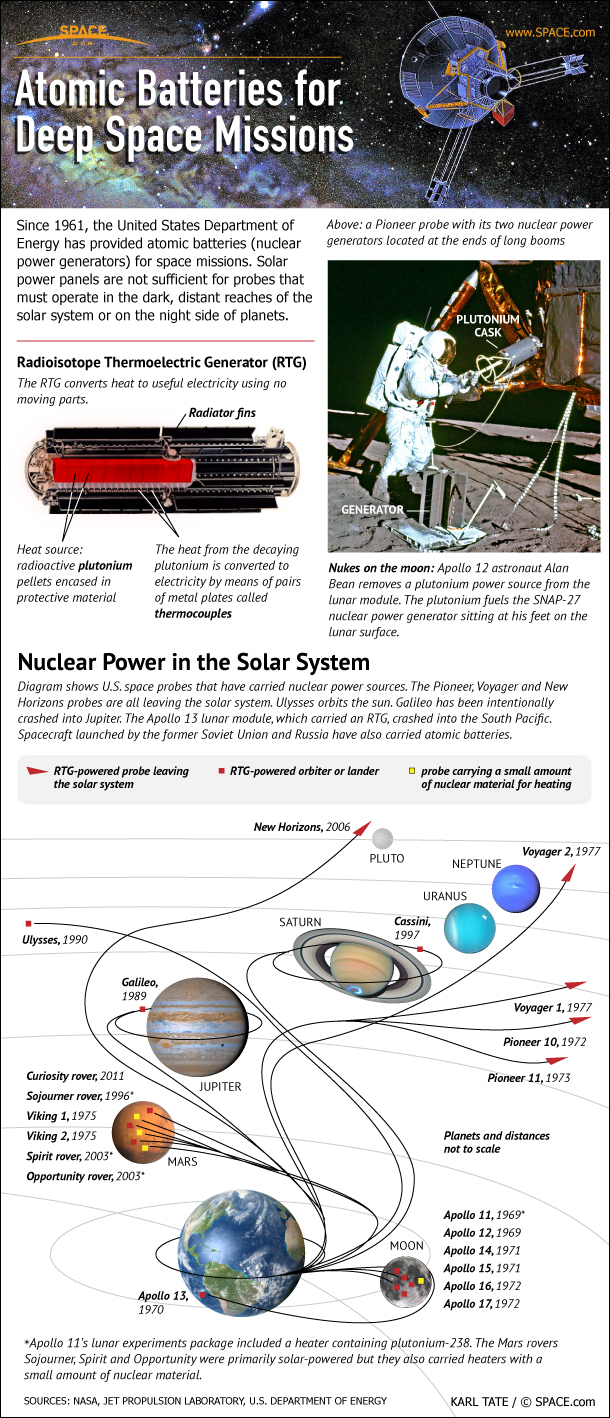
Source: Space — Nuclear Generators Power NASA Deep Space Probes (Infographic) | Space · www.space.com
Plutonium Isotopes & Nuclear Applications
Science And Technology Plutonium-238 weapons development
Plutonium-238 vs Plutonium-239: Critical Differences
Pu-238 is used in RTGs - heat source, not weapons
Pu-239 is weapons-grade fissile material
Both are by-products of nuclear reactor operations
Plutonium Isotope Comparison
Property | Plutonium-238 | Plutonium-239 |
|---|---|---|
Half-life | 87.7 years | 24,100 years |
Decay type | Alpha decay (heat) | Alpha decay (slow) |
Fissile | No - cannot sustain chain reaction | Yes - weapons/reactor fuel |
Heat output | High - 0.56 watts/gram | Low - 0.002 watts/gram |
Primary use | RTGs, heat sources | Nuclear weapons, reactor fuel |
Production | By-product of reactor fuel processing | Created in nuclear reactors from U-238 |
Nuclear Fuel Cycle Connection
Pu-238 production: Made by irradiating Neptunium-237 in reactors
Weapons connection: Produced in facilities that also make Pu-239
Dual-use concern: Same infrastructure can produce both isotopes
Supply shortage: Limited global production capacity for Pu-238
Strategic material: Critical for space missions, tightly controlled
Isotope confusion: Pu-238 (RTG fuel) vs Pu-239 (weapons) - different uses
False equivalence: 'Weapons by-product' doesn't mean 'weapons material'
Half-life trap: Pu-238's shorter half-life makes it better for RTGs