Consider the following: 1. Battery storage 2. Biomass generators 3. Fuel cells 4. Rooftop solar photovoltaic units How many of the above are considered 'Distributed Energy Resources'?
Contents16
- AOnly one
- BOnly two
- COnly three
- DAll four
Show answer
Answer: (D) All four
Correct Answer: (d) All four.
Distributed Energy Resources (DER) are small-scale energy generation or storage units located close to where energy is consumed (on the consumer's side of the meter).
All four qualify:
- Battery storage — stores electricity for later use
- Biomass generators — produce energy from organic matter
- Fuel cells — convert chemical energy (like hydrogen) to electricity
- Rooftop solar PV — generates electricity from sunlight
Other examples of DERs include small wind turbines, combined heat and power systems, and EV batteries.
Distributed Energy Resources are small-scale energy units located close to consumers, becoming crucial as India pushes decentralized renewable energy to reduce grid dependence.
India's National Solar Mission and rooftop solar policies have made DER a key policy focus, with government incentives for distributed generation systems.
The question tests whether students understand that DER is defined by location and scale, not by the type of technology - both generation and storage qualify.
Distributed Energy Resources (DER)
Science And Technology Distributed Energy Resources Battery storage Biomass generators Fuel cells Rooftop solar photovoltaic units
Distributed Energy Resources: Definition & Classification
DER = small-scale energy units located close to consumers (consumer side of meter)
All four options qualify: battery storage, biomass generators, fuel cells, rooftop solar PV
Includes both generation (solar, biomass) and storage (batteries) technologies
DERs reduce transmission losses and improve grid resilience
What Makes DER Different
Distributed Energy Resources are small-scale energy units positioned close to the point of consumption rather than at large centralized power plants. The key is location — they sit on the consumer's side of the meter and can operate independently or feed excess power back to the grid.
DER Technologies Breakdown
Technology | Function | Energy Source | Typical Scale |
|---|---|---|---|
Battery Storage | Stores electricity for later use | Grid electricity/renewables | Residential to commercial |
Biomass Generators | Produces electricity from organic matter | Agricultural waste, wood pellets | Small to medium scale |
Fuel Cells | Converts chemical energy to electricity | Hydrogen, natural gas | Residential to industrial |
Rooftop Solar PV | Generates electricity from sunlight | Solar radiation | Rooftop installations |
Other Common DER Examples
Small wind turbines — residential or community-scale wind power
Combined Heat & Power (CHP) systems — generate electricity and useful heat simultaneously
Electric vehicle batteries — can feed power back to grid (Vehicle-to-Grid technology)
Micro-hydropower systems — small-scale water-based generation
Geothermal heat pumps — ground-source heating and cooling systems
Question Connection
This question tested the definition scope of DER — students might have assumed only solar panels qualify as 'distributed' or confused DER with only renewable sources. The trap was excluding battery storage (thinking it's not generation) or biomass/fuel cells (thinking they're too industrial).
Trap: Thinking DER means only renewable sources — fuel cells using natural gas still qualify if small-scale and distributed
Trap: Excluding battery storage because it doesn't 'generate' — storage is explicitly part of DER definition
Trap: Assuming biomass generators are too large-scale — small biomass units qualify as DER
Common confusion: DER vs grid-scale renewables — size and location matter, not just the technology type
Battery Energy Storage Systems
Science And Technology Battery storage
Battery Storage: Types & Grid Applications
Battery storage stores electrical energy for later use during peak demand or outages
Lithium-ion batteries dominate due to high energy density and falling costs
Applications: grid balancing, renewable integration, backup power
Battery Storage Applications
Application | Scale | Purpose | Example |
|---|---|---|---|
Residential | 5-20 kWh | Backup power, solar storage | Tesla Powerwall, home solar systems |
Commercial | 100 kWh - 1 MWh | Peak shaving, demand management | Office buildings, shopping centers |
Grid-scale | 10+ MWh | Frequency regulation, load balancing | Utility-scale battery farms |
Electric Vehicles | 40-100 kWh | Transportation, V2G services | Car batteries feeding back to grid |
Key Benefits for Grid
Load shifting — store cheap off-peak power, use during expensive peak hours
Renewable firming — smooth out solar/wind intermittency by storing excess generation
Grid stability — provide instant response to frequency fluctuations
Backup power — maintain supply during outages or equipment failures
Battery Storage Integration
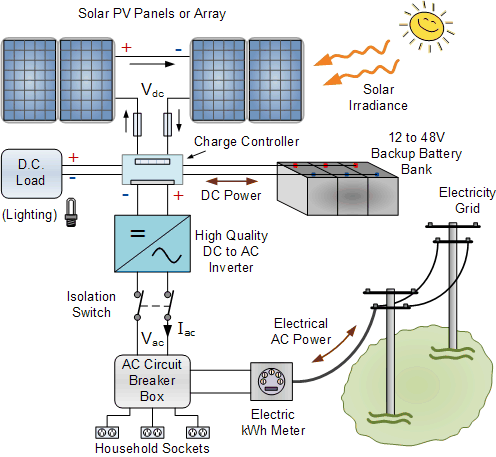
Source: Alternative Energy Tutorials — Grid Connected PV System connects PV panels to the grid · www.alternative-energy-tutorials.com
Fuel Cell Technology
Science And Technology Fuel cells
Fuel Cells: Electrochemical Energy Conversion
Fuel cells convert chemical energy (hydrogen, natural gas) directly into electricity
No combustion involved — electrochemical process with water as main byproduct
Higher efficiency than combustion engines (40-60% vs 25-35%)
How Fuel Cells Work
%%{init: {"flowchart": {"wrappingWidth": 460}}}%%
flowchart TD
  s1["`**Fuel Input**
**Hydrogen** (or hydrogen-rich fuel) enters anode side`"]
  s2["`**Electrochemical Reaction**
Hydrogen splits into **protons and electrons** at catalyst`"]
  s3["`**Current Generation**
**Electrons flow** through external circuit creating electricity`"]
  s4["`**Water Formation**
Protons combine with oxygen at cathode, forming **water vapor**`"]
  s1 --> s2
  s2 --> s3
  s3 --> s4
Fuel Cell Types & Uses
Type | Fuel | Operating Temp | Main Applications |
|---|---|---|---|
PEM (Proton Exchange) | Pure hydrogen | 60-80°C | Vehicles, portable devices |
SOFC (Solid Oxide) | Hydrogen, natural gas | 700-1000°C | Stationary power, industrial |
MCFC (Molten Carbonate) | Natural gas, biogas | 600-700°C | Large-scale power generation |
PAFC (Phosphoric Acid) | Hydrogen from reformed fuel | 150-200°C | Commercial buildings, buses |
Trap: Confusing fuel cells with batteries — fuel cells need continuous fuel supply, batteries store energy
Trap: Thinking all fuel cells use only pure hydrogen — some can use natural gas or other hydrogen-rich fuels
Common error: Assuming fuel cells combust fuel — they use electrochemical conversion, not burning
India's Renewable Energy Initiatives
Science And Technology
India's DER & Renewable Energy Framework
India targets 500 GW renewable capacity by 2030 (currently ~180 GW installed)
Rooftop solar target: 40 GW by 2022, extended timeline due to slow progress
PM-KUSUM scheme promotes distributed solar for farmers
Key DER Policies & Schemes
Grid-Connected Rooftop Solar Programme — subsidies for residential and institutional rooftop installations
PM-KUSUM (Pradhan Mantri Kisan Urja Suraksha) — solar pumps, grid-connected solar, and solarization of feeders
Net Metering Policy — allows consumers to feed excess solar power back to grid and get credits
Green Energy Corridors — transmission infrastructure to integrate renewable energy
National Hydrogen Mission — promote fuel cell technology and hydrogen economy
India's Renewable Targets vs Achievement
Technology | 2022 Target | Current Status | 2030 Vision |
|---|---|---|---|
Solar | 100 GW | ~70 GW | 280 GW |
Wind | 60 GW | ~70 GW | 140 GW |
Rooftop Solar | 40 GW | ~11 GW | Part of 280 GW solar |
Biomass/Biogas | 10 GW | ~10 GW | Expanded capacity |
Total Renewable | 175 GW | ~180 GW | 500 GW |
Policy Challenges
Rooftop solar has lagged significantly behind targets due to high upfront costs, complex approval processes, and limited awareness. Battery storage adoption remains slow due to high costs, though PLI schemes for battery manufacturing are expected to boost domestic production and reduce prices.