The word ‘Denisovan’ is sometimes mentioned in media in reference to
Contents12
- Afossils of a kind of dinosaurs
- Ban early human species
- Ca cave system found in North-East India
- Da geological period in the history of Indian subcontinent
Show answer
Answer: (B) an early human species
The correct answer is (B) — an early human species.
Denisovans are an extinct species of early humans discovered in 2008 from fossils found in the Denisova Cave in Siberia, Russia.
They are closely related to Neanderthals and modern humans.
A Denisovan jawbone was later found in Tibet, showing they lived at high altitudes about 1,60,000 years ago.
Tip:
- Denisovans = ancient human cousins
- Discovered in a Siberian cave
- Related to Neanderthals
Denisovans are an extinct early human species discovered from fossils in Siberia's Denisova Cave in 2008, closely related to Neanderthals and modern humans.
Major paleogenetic discoveries about early human species like Denisovans frequently appear in science news, making them a recurring topic for UPSC to test general awareness of scientific developments.
The question tests whether students can distinguish between different types of prehistoric discoveries - human fossils versus dinosaur fossils versus geological formations.
Denisovans: Extinct Human Species
Science And Technology Denisovan
Denisovans: The Siberian Human Cousins & Their Discovery
Denisovans are an extinct human species discovered in 2008 from Siberian cave fossils
Closely related to Neanderthals and modern humans, lived 160,000 years ago
Found in Denisova Cave, Siberia and later in Tibet at high altitudes
Identified through ancient DNA analysis, not complete skeletons
What Are Denisovans
Denisovans are an extinct species of early humans discovered through DNA analysis of ancient bone fragments. Unlike other human ancestors known from complete skeletons, Denisovans were identified primarily through genetic material extracted from tiny bone pieces and teeth.
Key Discovery Facts
Aspect | Details |
|---|---|
Discovery Year | 2008 |
Discovery Location | Denisova Cave, Siberia, Russia |
Age | Lived approximately 160,000 years ago |
Relationship | Sister group to Neanderthals |
Later Findings | Jawbone found in Tibet (2019) |
Identification Method | Ancient DNA sequencing |
Denisova Cave Location
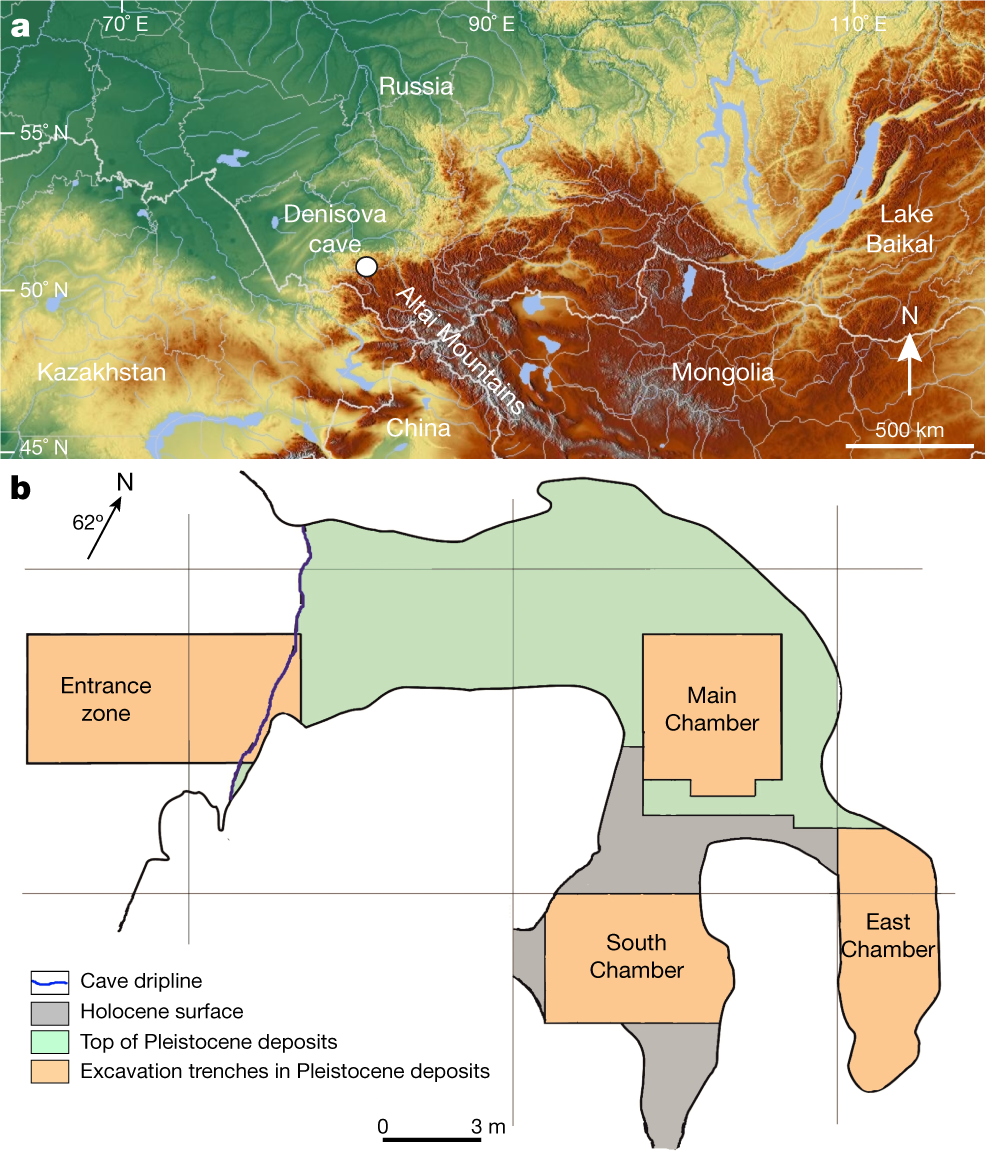
Source: Nature — Timing of archaic hominin occupation of Denisova Cave in southern ... · www.nature.com
Significance in Human Evolution
Genetic legacy: Modern humans carry 1-6% Denisovan DNA, especially in Melanesian and Aboriginal populations
High-altitude adaptation: Tibetan populations inherited genes for high-altitude living from Denisovans
Advanced DNA techniques: First human species discovered through ancient DNA rather than complete fossils
Interbreeding evidence: Shows early humans interbred with multiple archaic species
Trap: Confusing Denisovans with dinosaurs — Denisovans are recent (160,000 years) human relatives, dinosaurs died 65 million years ago
Trap: Mixing up discovery location — found in Siberian cave, not North-East India
Trap: Geological period confusion — Denisovans lived during Pleistocene epoch, not a geological period of Indian subcontinent
Human Evolution & Extinct Species
Science And Technology
Major Extinct Human Species & Evolutionary Timeline
Three main groups of recent human relatives: Neanderthals, Denisovans, and Homo sapiens
All three species interbred, leaving genetic traces in modern humans
Neanderthals lived in Europe/West Asia, Denisovans in Asia, Homo sapiens spread globally
Recent Human Species Comparison
Species | Time Period | Geographic Range | Key Features | Modern DNA Legacy |
|---|---|---|---|---|
Homo sapiens | 300,000 years ago - present | Global | Advanced tools, art, language | Base human genome |
Neanderthals | 400,000 - 40,000 years ago | Europe, West Asia | Robust build, cold adaptation | 1-3% in non-African populations |
Denisovans | 300,000 - 50,000 years ago | Asia (Siberia to Tibet) | High-altitude adaptation | 1-6% in Melanesian populations |
Homo erectus | 2 million - 100,000 years ago | Africa, Asia | First to leave Africa | No direct DNA legacy |
Human Species Discovery Methods
%%{init: {"flowchart": {"wrappingWidth": 460}}}%%
flowchart TD
  s1["`**Traditional Method**
Find **complete skeletons** → study bone structure → classify species`"]
  s2["`**Modern Method (Denisovans)**
Find **tiny bone fragments** → extract ancient DNA → sequence genome`"]
  s3["`**Genetic Analysis**
Compare DNA with modern humans and Neanderthals → identify new species`"]
  s4["`**Population Genetics**
Study modern human DNA → trace **interbreeding events** and migrations`"]
  s1 --> s2
  s2 --> s3
s3 --> s4Trap: All human ancestors are extinct — only Homo sapiens survives today
Trap: Ancient DNA can survive up to 400,000 years in cold conditions, enabling Denisovan discovery
Trap: Modern humans are not descended from Neanderthals/Denisovans — we are sister species that interbred
Ancient DNA Technology
Science And Technology
Ancient DNA Extraction & Analysis in Archaeology
Ancient DNA (aDNA) can survive thousands of years in cold, dry conditions
Used to discover new species, trace migrations, and study evolutionary relationships
PCR amplification and next-generation sequencing enable analysis of degraded DNA
DNA Preservation
Ancient DNA degrades over time, but can survive up to 400,000 years in optimal conditions. Cold temperatures (like Siberian caves) and low oxygen environments preserve DNA best. Most aDNA comes from bones, teeth, and hair rather than soft tissues.
Ancient DNA Analysis Process
%%{init: {"flowchart": {"wrappingWidth": 460}}}%%
flowchart TD
  s1["`**Sample Collection**
Extract bone powder from **ancient specimens** in sterile conditions`"]
  s2["`**DNA Extraction**
Use chemical methods to isolate **degraded DNA fragments**`"]
  s3["`**Contamination Check**
Remove modern human DNA contamination using **amino acid racemization**`"]
  s4["`**Amplification**
Use **PCR** to multiply tiny amounts of ancient DNA`"]
  s5["`**Sequencing**
**Next-generation sequencing** reconstructs partial genomes`"]
  s6["`**Analysis**
Compare with modern species to identify **evolutionary relationships**`"]
  s1 --> s2
  s2 --> s3
  s3 --> s4
  s4 --> s5
  s5 --> s6
Applications in Archaeology
Species identification: Discovered Denisovans from tiny bone chips when morphology was unclear
Migration patterns: Track ancient human movements across continents through DNA
Interbreeding events: Prove that different human species mated and had fertile offspring
Disease evolution: Study how pathogens like plague evolved over millennia