"3D printing" has applications in which of the following? 1. Preparation of confectionery items 2. Manufacture of bionic ears 3. Automotive industry 4. Reconstructive surgeries 5. Data processing technologies Select the correct answer using the code given below:
Contents15
- A1, 3 and 4 only
- B2, 3 and 5 only
- C1 and 4 only
- D1, 2, 3, 4 and 5
Show answer
Answer: (D) 1, 2, 3, 4 and 5
Correct Answer: (d) 1, 2, 3, 4 and 5
ALL five areas use 3D printing technology:
Confectionery items — YES: 3D printers can create chocolates, candies, and decorative food items in custom shapes. Companies like Hershey's have experimented with this.
Bionic ears — YES: Researchers at Princeton University created a 3D-printed bionic ear that can hear frequencies beyond normal human hearing. 3D printing is widely used in medical prosthetics.
Automotive industry — YES: Car manufacturers use 3D printing for prototyping parts, custom components, and even entire car bodies. Companies like BMW, Audi, and Local Motors use this technology.
Reconstructing fossils — YES: Paleontologists use 3D printing to create replicas of fragile fossils for study and display without risking damage to the originals.
Replication of tissues and organs — YES: Bio-printing is a cutting-edge application where living cells are used as 'ink' to print tissue structures. Scientists have successfully printed skin, cartilage, and simple organ structures.
REMEMBER: 3D printing is used in almost EVERY field — food, medicine, automobiles, science, art, construction, aerospace. If a UPSC question asks 'which fields use 3D printing,' the answer is almost always 'ALL of the above.' It's a versatile technology.
3D printing technology is now used across virtually every major industry from food manufacturing to medical prosthetics to automotive parts.
By 2018, 3D printing had matured enough that UPSC could test students on its widespread applications rather than just basic concepts.
The question tests whether students understand 3D printing as a universal manufacturing technique, not just a niche technology for one or two fields.
3D Printing Technology Fundamentals
Science And Technology 3D printing
3D Printing: Technology Basics & UPSC Context
3D printing creates physical objects from digital files by adding material layer-by-layer
Also called additive manufacturing — opposite of traditional subtractive methods
Uses various materials: plastics, metals, ceramics, food, living cells
Applications span ALL major industries — food, medicine, automotive, aerospace, construction
3D printing or additive manufacturing builds objects by depositing material layer-by-layer from a digital design. Unlike traditional manufacturing that cuts away material, 3D printing only adds what's needed.
3D Printing Process
%%{init: {"flowchart": {"wrappingWidth": 460}}}%%
flowchart TD
  s1["`**Digital Design**
Create 3D model using CAD software`"]
  s2["`**Slicing**
Software divides model into thin horizontal layers`"]
  s3["`**Printing**
Printer deposits material layer-by-layer following the pattern`"]
  s4["`**Post-Processing**
Remove support structures, cure, or finish the object`"]
  s1 --> s2
  s2 --> s3
  s3 --> s4
Key Technologies
FDM (Fused Deposition Modeling) — melts plastic filament, most common type
SLA (Stereolithography) — uses laser to cure liquid resin, high precision
SLS (Selective Laser Sintering) — laser fuses powder materials like metal or nylon
Bioprinting — uses living cells as 'bio-ink' to print tissue structures
UPSC Trap: When asked 'which fields use 3D printing,' the answer is almost always ALL options — it's used everywhere
Don't assume 3D printing is only for plastics — it works with metals, ceramics, food, living cells
Bioprinting is real technology, not science fiction — organs and tissues are being printed today
3D Printing in Food Industry
Science And Technology confectionery items
Food 3D Printing: Confectionery & Culinary Applications
Food 3D printing creates edible items using ingredients like chocolate, sugar, dough as 'ink'
Applications: custom chocolates, candies, pasta, decorative cake elements
Major companies like Hershey's, Barilla have commercial food printers
Food 3D printing uses edible materials as printing medium to create custom-shaped food items. This technology is commercially viable and already used by major food companies.
Food 3D Printing Applications
Food Type | Material Used | Commercial Examples | Key Benefits |
|---|---|---|---|
Chocolates | Melted chocolate | Hershey's 3D printer | Custom shapes, personalization |
Confectionery | Sugar paste, fondant | Wedding cake decorations | Intricate designs impossible by hand |
Pasta | Flour-based dough | Barilla pasta printer | Complex geometries, custom nutrition |
Pizza | Dough, sauce, cheese | NASA space food research | Automated food preparation |
Technical Aspects
Extruder-based printing — pushes paste-like food materials through nozzles
Temperature control critical — materials must flow during printing but solidify after
Food safety requires special hygiene protocols and food-grade materials
Nutritional customization possible by mixing different ingredient ratios
Medical & Biomedical 3D Printing
Science And Technology bionic ears reconstructive surgeries
3D Printing in Medicine: From Prosthetics to Bioprinting
Medical 3D printing creates prosthetics, surgical models, implants, and printed tissues
Bioprinting uses living cells to print tissue structures like skin, cartilage, organs
Reconstructive surgery uses patient-specific implants printed from CT/MRI scans
Princeton University successfully created 3D-printed bionic ears with enhanced hearing
Medical 3D Printing Applications
# Medical 3D Printing
## Prosthetics
- Bionic ears
- Limb prosthetics
- Hearing aids
- Dental implants
## Surgical Planning
- Organ models
- Bone replicas
- Practice surgeries
- Custom tools
## Reconstructive Surgery
- Facial reconstruction
- Bone implants
- Joint replacements
- Skull plates
## Bioprinting
- Skin tissues
- Cartilage
- Blood vessels
- Organ prototypes
Key Medical Breakthroughs
Application | Achievement | Institution/Company | Significance |
|---|---|---|---|
Bionic Ears | 3D-printed ear with enhanced hearing frequency | Princeton University | Beyond normal human hearing range |
Skin Printing | Printed skin for burn victims | Wake Forest Institute | Reduces scarring, faster healing |
Bone Implants | Titanium skull and jaw replacements | Multiple hospitals | Perfect fit from patient CT scans |
Heart Valves | 3D-printed heart valve prototypes | Various research labs | Potential for organ replacement |
Reconstructive surgery benefits enormously from 3D printing. Surgeons can create patient-specific implants by scanning the patient's anatomy and printing exact-fit replacements using biocompatible materials like titanium or medical-grade plastics.
Don't dismiss bionic ears as science fiction — Princeton University actually created functional 3D-printed ears
Bioprinting is different from regular 3D printing — uses living cells as printing material, not just plastics
Medical 3D printing includes both non-living implants (titanium bones) and living tissues (printed skin)
3D Printing in Automotive Industry
Science And Technology automotive industry
Automotive 3D Printing: From Prototypes to Production Cars
Major automakers like BMW, Audi, Ford use 3D printing for prototyping and production
Applications: rapid prototyping, custom parts, lightweight components, tooling
Local Motors created world's first 3D-printed car called 'Strati'
The automotive industry was among the first to adopt 3D printing for rapid prototyping. Today it extends to actual production parts, custom components, and even entire vehicle bodies.
Automotive 3D Printing Uses
Application | Companies | Materials Used | Key Benefits |
|---|---|---|---|
Rapid Prototyping | BMW, Ford, Toyota | Plastics, resins | Faster design iterations, cost reduction |
Production Parts | BMW, Audi | Metal alloys, carbon fiber | Lightweight, complex geometries |
Custom Tools | Volkswagen, GM | Plastics, composites | Manufacturing jigs, assembly fixtures |
Entire Vehicles | Local Motors | Carbon fiber composite | First 3D-printed car 'Strati' |
Industry Impact
Faster development — prototypes in days instead of weeks
Weight reduction — 3D-printed parts can have internal lattice structures impossible with traditional manufacturing
Customization — each part can be unique without expensive tooling changes
Supply chain simplification — print parts on-demand instead of storing inventory
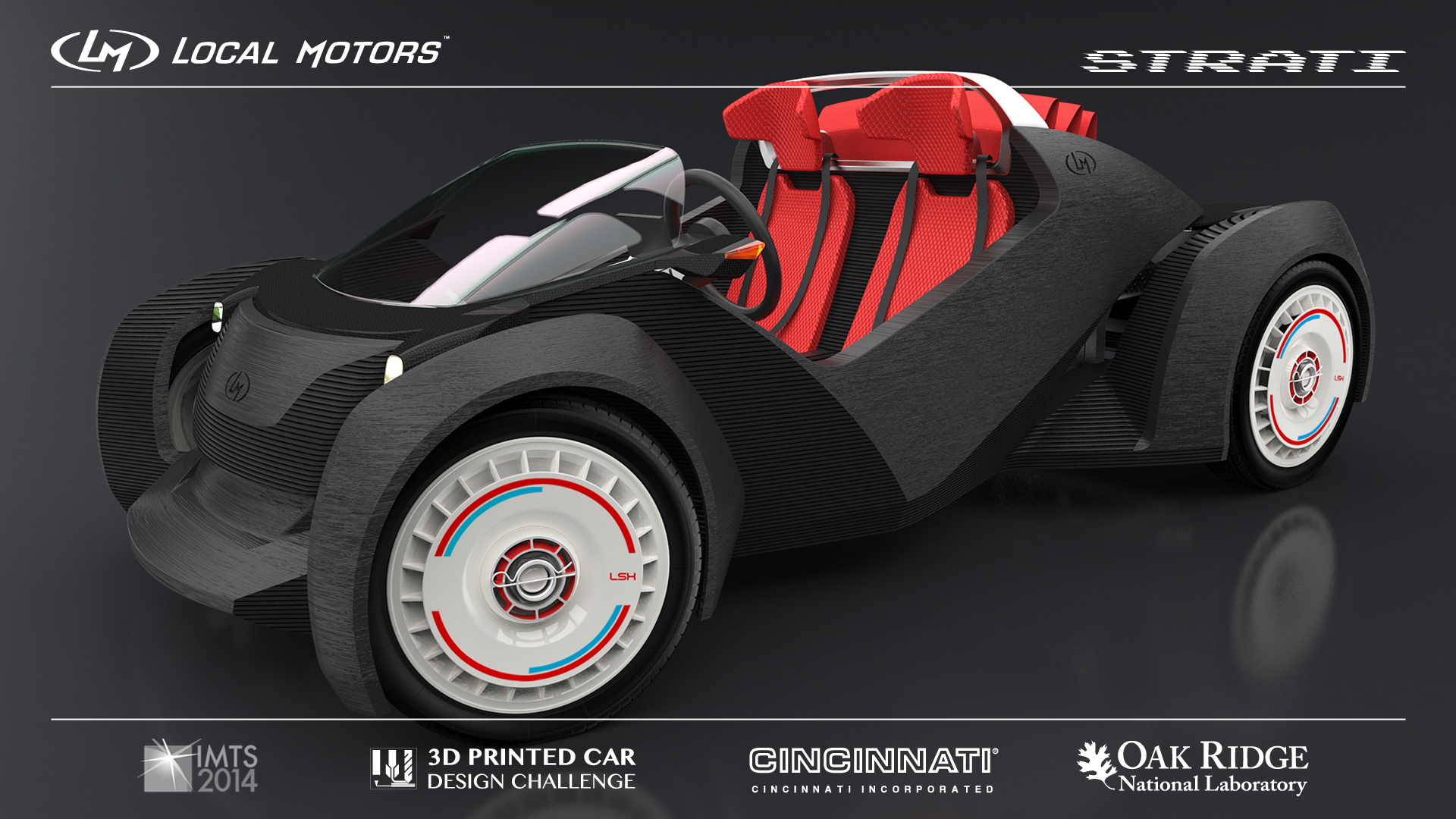
Source: Motor Authority — Local Motors Moving Along With Plans For 3D-Printed Car: Video · www.motorauthority.com
3D Printing in Data Processing
Science And Technology data processing technologies
3D Printing Applications in Data Processing Technologies
3D printing creates custom computer cases, cooling systems, circuit board housings
Used for rapid prototyping of data processing hardware and embedded systems
Conductive filaments allow printing of electronic circuits and components
Data processing technologies benefit from 3D printing through custom hardware components, rapid prototyping of electronic housings, and even printing conductive circuits using special filaments.
Key Applications
Custom computer cases — unique designs for specialized data processing equipment
Heat sinks and cooling systems — complex geometries for better thermal management
Circuit board housings — protective cases for embedded systems and IoT devices
Conductive printing — creating electronic circuits using conductive materials
Rapid prototyping — testing new hardware designs quickly and cost-effectively
Data Processing Components
Component Type | 3D Printing Use | Materials | Advantage |
|---|---|---|---|
Server Cases | Custom cooling designs | ABS plastic, aluminum | Better airflow, space efficiency |
Circuit Housings | Protective enclosures | Engineering plastics | Perfect fit, rapid iteration |
Heat Sinks | Complex cooling fins | Metal alloys | Improved heat dissipation |
Electronic Circuits | Printed conductive traces | Conductive filaments | Integrated electronics in one print |