Organic Light Emitting Diodes (OLEDs) are used to create digital display in many devices. What are the advantages of OLED displays over Liquid Crystal displays? 1. OLED displays can be fabricated on flexible plastic substrates. 2. Roll-up displays embedded in clothing can be made using OLEDs. 3. Transparent displays are possible using OLEDs. Select the correct answer using the code given below:
Contents12
- A1 and 3 only
- B2 only
- C1, 2 and 3
- DNone of the above statements is correct
Show answer
Answer: (C) 1, 2 and 3
All three statements are correct advantages of OLED displays over LCD displays:
(1) OLED displays can be fabricated on flexible plastic substrates: Unlike LCDs which require rigid glass backlighting panels, OLEDs are made of organic compounds that emit light when electric current flows through them.
This allows them to be deposited on flexible plastic substrates, making bendable and curved displays possible.
(2) Roll-up displays embedded in clothing can be made using OLEDs: Because OLEDs can be printed onto almost any substrate using inkjet printer technology, they enable revolutionary applications like displays embedded in clothing or roll-up screens.
This is not possible with conventional LCD technology due to its rigid structure and backlight requirement.
(3) Transparent displays are possible using OLEDs: LCDs use a backlight to illuminate pixels, which makes them opaque.
OLEDs generate their own light — each pixel emits light independently.
When the pixels are off, the OLED material can be transparent, enabling see-through displays.
This property is unique to OLED technology.
The key difference to remember: LCDs need a separate backlight layer (making them rigid, thick, and opaque), while OLEDs are self-emissive (each pixel produces its own light), enabling flexibility, thinness, and transparency.
So all three statements (1, 2, and 3) are correct.
OLEDs are self-emissive (each pixel produces its own light) while LCDs require a separate backlight layer, which is the fundamental difference that enables all OLED advantages.
By 2017, flexible OLED displays were becoming commercially viable in smartphones and emerging wearable technology, making this a relevant current technology topic for UPSC.
OLED Display Technology
Science And Technology OLED Organic Light Emitting Diodes
OLED Technology: Structure, Working & Key Properties
OLEDs are self-emissive — each pixel produces its own light using organic compounds
Can be fabricated on flexible plastic substrates unlike rigid LCD panels
Enable transparent displays when pixels are turned off
Support revolutionary applications like roll-up displays and clothing-embedded screens
How OLEDs Work
OLED stands for Organic Light Emitting Diode. The technology uses organic compounds that emit light when electric current flows through them. Unlike other display technologies, each OLED pixel is self-emissive — it generates its own light without needing external illumination.
OLED Light Emission Process
%%{init: {"flowchart": {"wrappingWidth": 460}}}%%
flowchart TD
  s1["`**Electric Current Applied**
Current flows through organic semiconductor layers`"]
  s2["`**Electron-Hole Recombination**
Electrons and holes combine in the emission layer`"]
  s3["`**Photon Emission**
Energy released as visible light photons`"]
  s4["`**Light Output**
Each pixel emits colored light independently`"]
  s1 --> s2
  s2 --> s3
  s3 --> s4
Key OLED Advantages
Flexible substrates: Can be deposited on plastic, enabling bendable displays
No backlight needed: Self-emissive pixels eliminate bulky backlight panels
Transparency possible: When pixels are off, display becomes see-through
Inkjet printing: Can be manufactured using printer-like technology
Thin form factor: Much thinner than LCD due to simpler structure
All three statements in the question are correct — don't second-guess comprehensive options
Flexibility comes from organic materials on plastic, not the light emission itself
Transparency works only when pixels are turned off — not a permanent property
Roll-up displays are possible due to inkjet printing + flexible substrates combined
LCD vs OLED Comparison
Science And Technology LCD Liquid Crystal displays
LCD vs OLED: Structural Differences & Applications
LCD requires backlight — makes it rigid, thick, and opaque
OLED is self-emissive — enables flexibility, thinness, and transparency
Glass substrate limitation makes LCD displays rigid
Technology Comparison
Aspect | LCD (Liquid Crystal Display) | OLED (Organic LED) |
|---|---|---|
Light Source | Backlight panel (LED/fluorescent) | Self-emissive pixels |
Substrate | Rigid glass required | Flexible plastic possible |
Thickness | Thicker due to backlight layers | Ultra-thin structure |
Transparency | Opaque — backlight blocks view | Transparent when pixels off |
Flexibility | Rigid displays only | Bendable & rollable |
Manufacturing | Complex multi-layer assembly | Inkjet printing possible |
Why LCD Cannot Match OLED
Backlight dependency: LCD pixels only filter light, cannot generate it
Glass substrate requirement: Backlight panels need rigid glass support
Layer complexity: Multiple layers (backlight → diffuser → LCD → filter) add thickness
Always opaque: Backlight prevents any see-through capability
Question Context
The question tests understanding that all three OLED advantages are real and significant. Students might doubt that all statements could be correct, but OLED's self-emissive nature genuinely enables flexibility, transparency, and novel applications that LCD's backlight architecture cannot achieve.
Flexible & Transparent Display Applications
Science And Technology flexible plastic substrates Roll-up displays Transparent displays
Revolutionary Display Applications Enabled by OLED
Flexible displays possible due to organic materials on plastic substrates
Roll-up screens achieved through inkjet printing on flexible materials
Transparent displays work when OLED pixels are turned off
Clothing-embedded displays represent next-generation wearable technology
OLED Applications
# OLED Display Applications
## Flexible Displays
- Curved smartphones
- Bendable tablets
- Rollable TVs
- Foldable laptops
## Transparent Displays
- Smart windows
- Car windshields
- Store displays
- AR glasses
## Wearable Displays
- Smart clothing
- Flexible watches
- Health monitors
- Sports gear
## Novel Form Factors
- Roll-up screens
- Paper-thin displays
- Conformable surfaces
- Embedded electronics
Technical Enablers
Inkjet printing: OLEDs can be 'printed' like ink on various substrates
Plastic substrates: Flexible plastic replaces rigid glass backplanes
Organic semiconductors: Bendable organic materials vs brittle silicon
Self-emission: No separate light source needed — simplifies structure
Flexible OLED Concept
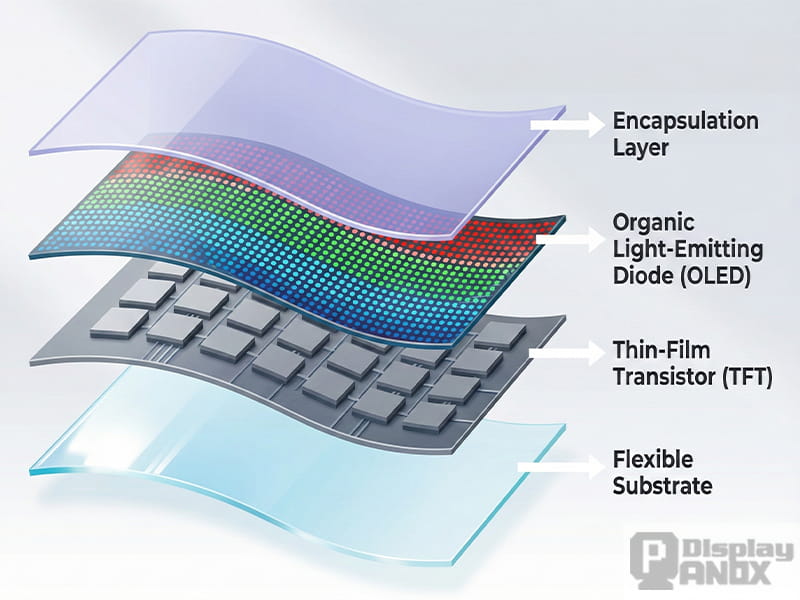
Source: Panox Display — Flexible OLED Display: How Bendable Screens Are Reshaping ... · www.panoxdisplay.com
Roll-up displays are real technology, not science fiction — enabled by inkjet manufacturing
Transparent displays need pixels to be turned off — they're not always transparent
Flexibility comes from plastic substrates + organic materials, not just thin design
Clothing displays are technically feasible but still emerging applications