With reference to 'Global Climate Change Alliance', which of the following statements is/are correct? 1. It is an initiative of the European Union. 2. It provides technical and financial support to targeted developing countries to integrate climate change into their development policies and budgets. 3. It is coordinated by World Resources Institute (WRI) and World Business Council for Sustainable Development (WBCSD). Select the correct answer using the code given below:
Contents17
- A1 and 2 only
- B3 only
- C2 and 3 only
- D1, 2 and 3
Show answer
Answer: (A) 1 and 2 only
Statement 1 is correct:
The Global Climate Change Alliance (GCCA) was established by the European Union (EU) in 2007 to strengthen dialogue and cooperation with developing countries, especially Least Developed Countries (LDCs) and Small Island Developing States (SIDS).
Statement 2 is correct:
Under one of its pillars, the GCCA acts as a source of technical and financial support for the world's most climate-vulnerable countries, helping them integrate climate change into their development policies and budgets.
Statement 3 is incorrect:
This is a common trap. The World Resources Institute (WRI) and World Business Council for Sustainable Development (WBCSD) work together on the Greenhouse Gas Protocol (GHGP), which helps companies measure and manage their carbon emissions — this is a completely different initiative and has nothing to do with GCCA.
So only statements 1 and 2 are correct.
The Global Climate Change Alliance is the EU's flagship climate diplomacy program, launched in 2007 to help the world's most vulnerable developing countries adapt to climate change.
UPSC created a trap by mixing up two different climate initiatives - students often confuse the EU's GCCA with the corporate-focused Greenhouse Gas Protocol run by WRI and WBCSD.
The question tests whether students can distinguish between government-led climate aid programs versus private sector emission measurement tools.
Global Climate Change Alliance (GCCA)
Environment Global Climate Change Alliance GCCA European Union
Global Climate Change Alliance: EU's Climate Support Initiative
GCCA is an EU initiative launched in 2007 to support climate-vulnerable developing countries
Provides technical and financial support to integrate climate change into development policies
Not coordinated by WRI or WBCSD — that's the Greenhouse Gas Protocol
Focuses on LDCs and SIDS as primary beneficiaries
What is GCCA
The Global Climate Change Alliance is the European Union's flagship climate diplomacy initiative, established in 2007 to strengthen cooperation with the world's most climate-vulnerable developing nations.
GCCA Key Details
Aspect | Details |
|---|---|
Initiator | European Union (2007) |
Primary Focus | LDCs and Small Island Developing States |
Core Function | Technical & financial support for climate integration |
Target Areas | Development policies, budgets, climate adaptation |
Coordination | EU institutions, not WRI/WBCSD |
GCCA Support Mechanisms
Technical assistance for climate vulnerability assessments and adaptation planning
Financial support to integrate climate considerations into national development budgets
Capacity building for climate-resilient development strategies
Policy dialogue between EU and partner countries on climate issues
Question Context
This PYQ tests whether students can distinguish between EU's GCCA and other international climate initiatives. The trap lies in Statement 3, which incorrectly attributes GCCA coordination to organizations that actually run a different program.
Trap: Statement 3 swaps GCCA coordination with Greenhouse Gas Protocol — WRI and WBCSD coordinate GHGP, not GCCA
Confusion: Students mix up EU climate initiatives with UN or other multilateral programs
Common error: Assuming all climate finance comes from UN bodies rather than regional organizations like EU
Greenhouse Gas Protocol (GHGP)
Environment World Resources Institute WRI World Business Council for Sustainable Development WBCSD
Greenhouse Gas Protocol: Corporate Carbon Accounting Standard
GHGP is coordinated by WRI and WBCSD for corporate carbon measurement
Provides accounting standards for companies to measure and manage GHG emissions
Different initiative from GCCA — focuses on corporate reporting, not country-level support
What is GHGP
The Greenhouse Gas Protocol is the world's most widely used accounting standard for measuring and managing greenhouse gas emissions from corporate operations and value chains.
GHGP vs GCCA Comparison
Initiative | Coordinators | Focus | Target Audience |
|---|---|---|---|
GHGP | WRI + WBCSD | Corporate carbon accounting | Companies & organizations |
GCCA | European Union | Climate-vulnerable country support | LDCs & SIDS |
GHGP Functions
Corporate Standard: Framework for companies to account for their GHG emissions
Scope Classification: Defines Scope 1, 2, and 3 emissions categories
Sector Guidance: Specific accounting guidance for different industries
Verification Protocols: Standards for third-party verification of emissions data
Key Trap: UPSC swapped GHGP coordinators (WRI+WBCSD) with GCCA coordination — these are separate initiatives
Remember: WRI and WBCSD = corporate carbon accounting, EU = country climate support
EU Climate Diplomacy & Initiatives
Environment European Union
European Union's Climate Leadership & International Initiatives
EU is a major climate finance provider through multiple initiatives including GCCA
European Green Deal is EU's flagship domestic climate policy framework
EU has legally binding climate targets and supports Paris Agreement implementation
EU Climate Leadership
The European Union positions itself as a global climate leader through domestic action, international climate finance, and diplomatic initiatives supporting developing countries' climate resilience.
EU Climate Architecture
# EU Climate Action
## Domestic Policy
- European Green Deal
- Fit for 55 Package
- EU ETS
- Climate Law
## International Support
- GCCA
- Climate Finance
- Technical Assistance
- Capacity Building
## Target Countries
- LDCs
- SIDS
- African Countries
- Vulnerable Nations
EU Climate Diplomacy Features
Climate Finance: EU and member states are among the largest providers of international climate finance
Paris Agreement: Strong supporter of global climate agreements and enhanced ambition
Green Diplomacy: Uses climate action as a tool for international cooperation and development
Climate Vulnerable Country Categories
Environment LDCs Small Island Developing States SIDS developing countries
LDCs & SIDS: Priority Recipients of Climate Support
LDCs and SIDS are priority recipients of international climate finance due to high vulnerability
SIDS face existential threat from sea level rise and extreme weather events
These countries have limited adaptive capacity despite contributing least to global emissions
Climate Vulnerable Country Categories
Category | Key Vulnerabilities | Examples | Climate Challenges |
|---|---|---|---|
LDCs | Low adaptive capacity, poverty | Bangladesh, Chad, Madagascar | Extreme weather, droughts, floods |
SIDS | Sea level rise, isolation | Maldives, Tuvalu, Marshall Islands | Coastal erosion, saltwater intrusion |
Why These Countries Need Support
High exposure: Geographically vulnerable to climate impacts like sea level rise and extreme weather
Low adaptive capacity: Limited financial and technological resources for climate resilience
Development constraints: Climate impacts threaten to reverse development gains
Equity principle: Least responsible for emissions but most affected by climate change
Global Climate Vulnerability
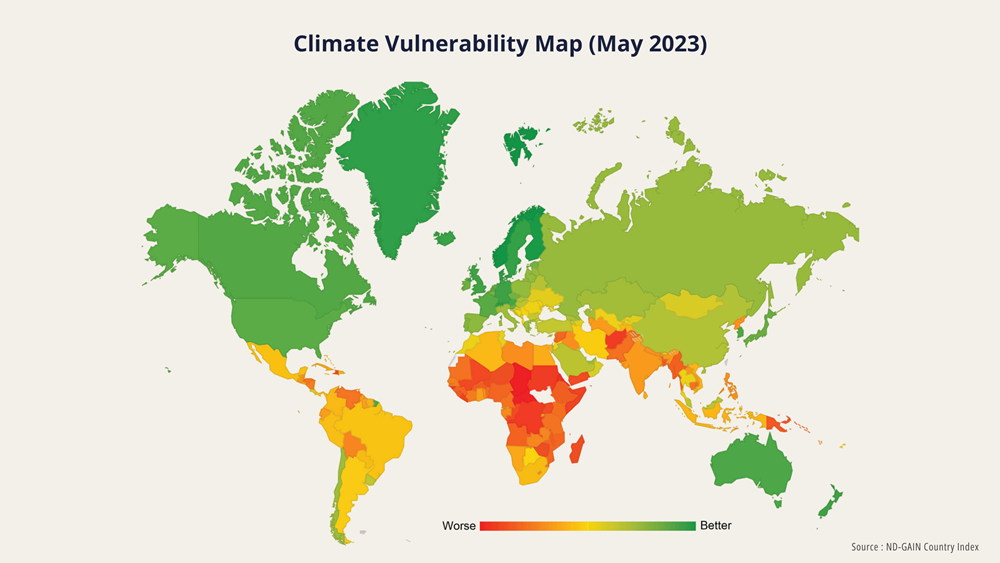
Source: Sunhak Peace Prize — What are Countries Vulnerable to Climate Change? - Peace Issue ... · sunhakpeaceprize.org