With reference to the 'National Intellectual Property Rights Policy', consider the following statements: 1. It reiterates India's commitment to the Doha Development Agenda and the TRIPS Agreement. 2. Department of Industrial Policy and Promotion is the nodal agency for regulating intellectual property rights in India. Which of the above statements is/are correct?
Contents17
- A1 only
- B2 only
- CBoth 1 and 2
- DNeither 1 nor 2
Show answer
Answer: (C) Both 1 and 2
Both statements are correct.
Statement 1 is correct:
The National IPR Policy was approved by the Union Cabinet in 2016 and it explicitly recognizes that India has a well-established TRIPS-compliant (Trade-Related Aspects of Intellectual Property Rights) legislative, administrative, and judicial framework.
The policy reiterates India's commitment to the Doha Development Agenda and the TRIPS Agreement, while also utilizing the flexibilities provided in the international regime (such as compulsory licensing) to address India's developmental concerns.
This is significant because it reassures trading partners that India respects international IP commitments while also protecting its right to use TRIPS flexibilities for public health and other developmental needs.
Statement 2 is correct:
The Department of Industrial Policy and Promotion (DIPP), under the Ministry of Commerce and Industry, was designated as the nodal department to coordinate, guide, and oversee the implementation and future development of IPRs in India.
DIPP (now renamed as Department for Promotion of Industry and Internal Trade — DPIIT) is responsible for administering patents, trademarks, industrial designs, and geographical indications through various IP offices under its control.
So both statements 1 and 2 are correct.
India's National IPR Policy was approved in 2016 to balance international IP commitments with domestic development needs, particularly for public health access.
The policy became important around 2016-17 as India faced international pressure over patent policies while defending its right to use TRIPS flexibilities for affordable medicines.
UPSC is testing whether students know both the international diplomatic aspect (TRIPS/Doha commitments) and the domestic administrative structure (DIPP as nodal agency).
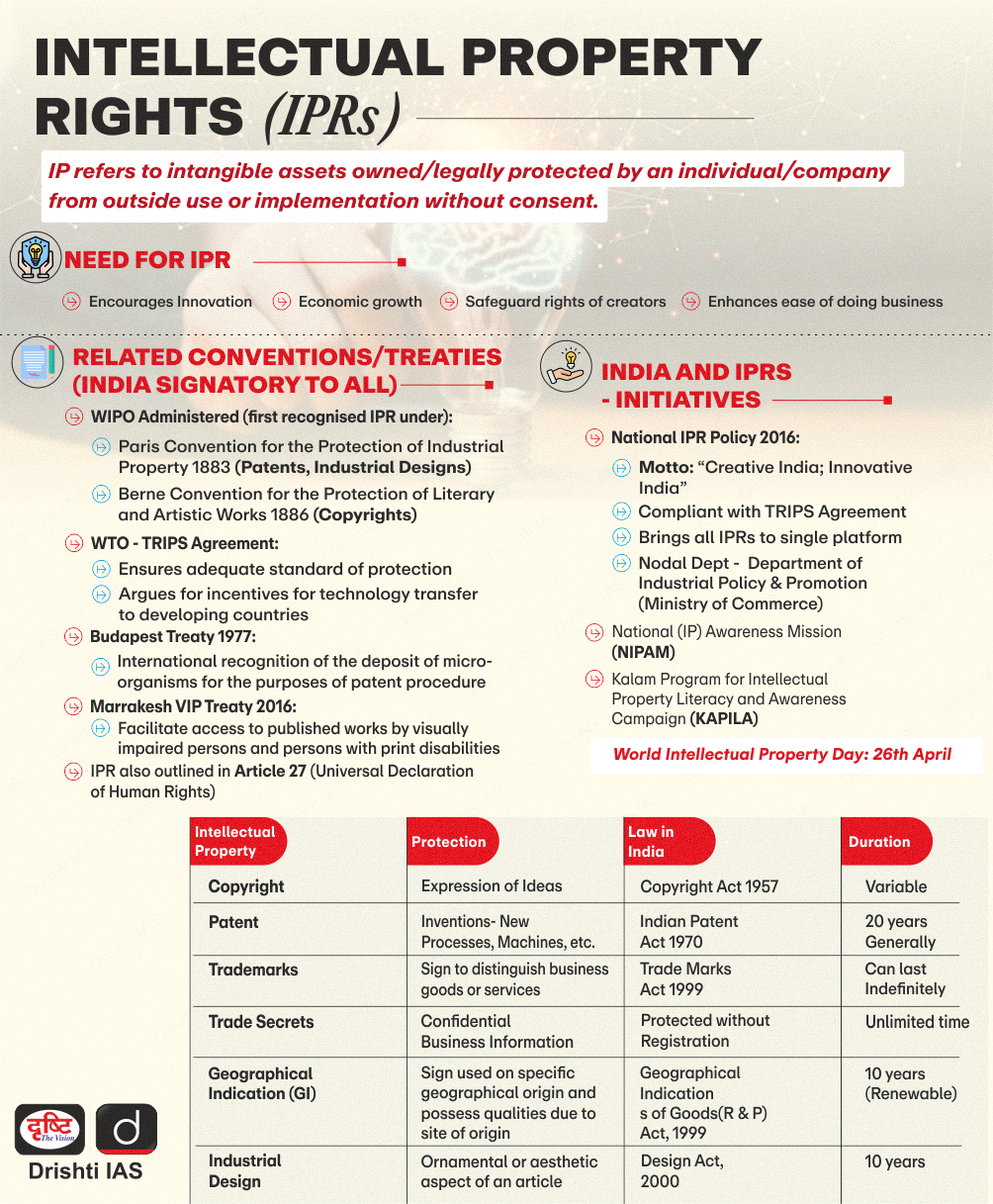
National IPR Policy 2016
Science And Technology National Intellectual Property Rights Policy
National IPR Policy 2016: Framework, Objectives & Implementation
National IPR Policy approved by Union Cabinet in May 2016 - first comprehensive IP policy
DIPP (now DPIIT) is the nodal agency for IP regulation and coordination
Policy reiterates TRIPS Agreement compliance while using flexibilities for development
Covers patents, trademarks, copyrights, designs, geographical indications comprehensively
Policy Context
India's National IPR Policy 2016 was the country's first comprehensive framework to strengthen intellectual property governance. The policy balances international commitments with developmental needs, emphasizing innovation while ensuring public interest protection.
Key Policy Pillars
Pillar | Focus Area | Key Objective |
|---|---|---|
Legal & Legislative Framework | TRIPS compliance | Strengthen IP laws and enforcement |
Administration & Management | Institutional setup | Streamline IP offices and procedures |
Commercialization | IP monetization | Promote licensing and technology transfer |
Enforcement & Adjudication | Rights protection | Fast-track IP dispute resolution |
Awareness & Outreach | IP literacy | Educate stakeholders on IP benefits |
Human Capital Development | Skill building | Train IP professionals and examiners |
International Commitments
Doha Development Agenda compliance - recognizes developing country concerns in IP regime
TRIPS Agreement adherence - maintains India's legislative and judicial framework alignment
TRIPS flexibilities utilization - compulsory licensing for public health and development needs
WTO commitments - balances international obligations with national policy space
DIPP vs DPIIT: Department renamed in 2019 but same functions - both answers accepted
Policy vs Law: This is a policy framework, not legislation - doesn't create new IP rights
TRIPS flexibilities: Policy supports using flexibilities, doesn't abandon TRIPS compliance
DIPP/DPIIT IP Administration
Science And Technology Department of Industrial Policy and Promotion
DIPP/DPIIT: Nodal Agency for Intellectual Property Administration
DIPP designated as nodal department for IP coordination and oversight in India
Renamed to DPIIT in 2019 - Department for Promotion of Industry and Internal Trade
Under Ministry of Commerce & Industry - coordinates all IP offices and policies
Administrative Structure
The Department of Industrial Policy and Promotion (DIPP), renamed as DPIIT in 2019, serves as India's nodal agency for intellectual property governance. It coordinates policy implementation across multiple IP offices and ensures unified administration.
DPIIT IP Administration Structure
# DPIIT (Nodal Department)
## Patent Office
- 4 branches: Delhi, Mumbai, Chennai, Kolkata
- Patent examination & grants
- Patent opposition proceedings
## Trade Marks Registry
- 5 offices across India
- Trademark registration
- Geographical indications
## Design Wing
- Industrial design registration
- Design examination
- Design renewals
## Copyright Office
- Under Ministry of Education
- Coordinated by DPIIT
- Copyright registration
Key Functions of DPIIT
Function | Scope | Key Activities |
|---|---|---|
Policy Coordination | National level | Implement IPR Policy, inter-ministerial coordination |
Administrative Oversight | IP offices | Supervise Patent Office, TMR, Design Wing operations |
Legislative Support | Law making | Draft IP amendments, rules, and regulations |
International Relations | Global IP | WIPO coordination, bilateral IP agreements |
Capacity Building | Human resources | Train IP examiners, awareness programs |
DIPP = DPIIT: Same department, just renamed in 2019 - both terms correct in exams
Ministry confusion: Under Commerce & Industry, not Science & Technology Ministry
Copyright exception: Copyright Office under Education Ministry but coordinated by DPIIT
TRIPS Agreement & Doha Development Agenda
Science And Technology TRIPS Agreement Doha Development Agenda
TRIPS Agreement & Doha Development Agenda: International IP Framework
TRIPS Agreement (1995) - WTO's comprehensive intellectual property rules
Doha Development Agenda (2001) - addresses developing country concerns in IP
TRIPS flexibilities allow compulsory licensing for public health emergencies
India maintains TRIPS compliance while using development-friendly flexibilities
International IP Framework
The TRIPS Agreement under WTO sets minimum IP protection standards globally. The Doha Development Agenda recognized that TRIPS should support development goals, not hinder access to essential medicines or technology transfer to developing countries.
TRIPS vs Doha Development Agenda
Aspect | TRIPS Agreement (1995) | Doha Development Agenda (2001) |
|---|---|---|
Primary Focus | Minimum IP protection standards | Development-friendly interpretation of TRIPS |
Patent Terms | 20 years minimum for all WTO members | Flexibility in implementation for LDCs |
Compulsory Licensing | Allowed under strict conditions | Clarified for public health emergencies |
Pharmaceutical Patents | Product patents mandatory | Transition periods for developing countries |
Technology Transfer | Through IP protection incentives | Emphasis on actual transfer to developing countries |
Implementation | Binding obligations | Policy space for development priorities |
TRIPS Flexibilities for Development
Compulsory licensing - government can license patents without owner consent for public interest
Parallel imports - import patented products from cheaper markets legally
Research exemption - use patented inventions for research without infringement
Transition periods - extended time for least developed countries to implement TRIPS
Public health exception - override patents during health emergencies
India's TRIPS Compliance
Source: Drishti IAS — 3O Years of TRIPS · www.drishtiias.com
TRIPS vs TPP: TRIPS is WTO agreement, TPP was separate trade deal - don't confuse
Doha Round vs Agenda: Doha Development Agenda is broader than just trade negotiations
Compulsory licensing abuse: India uses it legally under TRIPS, not violation of IP rights
Types of Intellectual Property Rights
Science And Technology
Types of Intellectual Property Rights: Classification & Protection
Five main IP types in India: patents, trademarks, copyrights, designs, geographical indications
Patents protect inventions for 20 years, copyrights protect creative works for lifetime + 60 years
Trademarks protect brands indefinitely with renewals, designs protect appearance for 15 years
IP Classification Overview
Intellectual property rights protect different types of human creativity and innovation. India's IP system covers technical inventions, creative expressions, brand identities, product designs, and geographical specialties through distinct legal frameworks.
Types of Intellectual Property Rights
IP Type | What it Protects | Duration | Registration Office | Key Example |
|---|---|---|---|---|
Patents | Technical inventions & processes | 20 years | Patent Office (4 branches) | Pharmaceutical formulations |
Trademarks | Brand names, logos, slogans | 10 years (renewable) | Trade Marks Registry | Coca-Cola logo |
Copyrights | Literary, artistic, musical works | Lifetime + 60 years | Copyright Office | Books, films, software |
Industrial Designs | Appearance, shape, pattern | 10+5 years | Design Wing (Patent Office) | Mobile phone design |
Geographical Indications | Regional specialty products | 10 years (renewable) | GI Registry (Chennai) | Darjeeling Tea, Basmati Rice |
Trade Secrets | Confidential business info | Indefinite (if secret) | No registration | Coca-Cola formula |
Patent Categories in India
# Patents
## By Type
- Ordinary Patents
- Convention Applications
- PCT National Phase
- Divisional Applications
## By Field
- Pharmaceutical
- Biotechnology
- Engineering
- Software (limited)
- Chemical processes
## Exclusions
- Mathematical formulas
- Business methods
- Computer programs per se
- Traditional knowledgeSoftware patents: Limited protection in India - algorithms excluded, but technical applications allowed
GI vs Trademark: GI protects regional products, trademarks protect specific brands
Patent term: Always 20 years from filing date, not from grant date