According to the Wildlife (Protection) Act, 1972, which of the following animals cannot be hunted by any person except under some provisions provided by law? 1. Gharial 2. Indian wild ass 3. Wild buffalo Select the correct answer using the code given below:
Contents14
- A1 only
- B2 and 3 only
- C1 and 3 only
- D1, 2 and 3
Show answer
Answer: (D) 1, 2 and 3
All three animals are listed under Schedule I of the Wildlife (Protection) Act, 1972, which provides the highest level of legal protection:
(1) Gharial (Gavialis gangeticus) — a critically endangered crocodilian found mainly in the Chambal, Girwa, and Gandak rivers.
(2) Indian Wild Ass (Equus hemionus khur) — an endangered species found primarily in the Rann of Kutch, Gujarat (Little Rann of Kutch Wild Ass Sanctuary).
(3) Wild Buffalo (Bubalus arnee) — an endangered species with small populations in Assam, Chhattisgarh, and a few other states.
Under Schedule I, hunting of these animals is absolutely prohibited except under very special circumstances provided by law (such as when an animal becomes a danger to human life, or for scientific research with specific permission).
The penalties for offences involving Schedule I species are the most severe under the Act.
Some students may doubt whether all three are under Schedule I, but the key insight is that all three are endangered or critically endangered species, which makes it logical that they would receive the highest protection.
When in doubt in such questions, if all listed species are clearly threatened, choosing 'all of the above' is often the safer bet.
So all three (1, 2, and 3) are correct.
Schedule I of the Wildlife Protection Act, 1972 gives absolute protection to India's most endangered species with severe penalties for hunting them.
All three animals - Gharial, Indian Wild Ass, and Wild Buffalo - are critically endangered or endangered species, making their Schedule I status logical.
The question tests whether students can identify which specific animals receive the highest legal protection under Indian wildlife laws.
Wildlife Protection Act 1972
Environment Wildlife (Protection) Act, 1972
Wildlife (Protection) Act 1972: Schedules & Key Provisions
Schedule I provides highest protection - absolute hunting prohibition except under special legal provisions
Enacted in 1972, most comprehensive wildlife protection law in India
6 Schedules classify species by protection level - I (highest) to VI (vermin)
WLPA covers hunting, trade, habitat protection, and establishment of protected areas
The Wildlife (Protection) Act, 1972 is India's primary law for conserving wildlife and controlling hunting. It classifies species into six schedules based on their conservation status and threat level, with Schedule I offering absolute protection to the most endangered species.
WLPA Schedule Classification
Schedule | Protection Level | Species Examples | Hunting Status |
|---|---|---|---|
Schedule I | Absolute Protection | Tiger, Elephant, Gharial, Indian Wild Ass | Completely prohibited except under special provisions |
Schedule II | High Protection | Leopard, Himalayan Bear, Pangolin | Prohibited with strict penalties |
Schedule III & IV | Protected | Hyena, Nilgai, Chital, Wild Boar | Prohibited but lesser penalties |
Schedule V | Vermin | Common Crow, Fruit Bats, Rats | Can be hunted freely |
Schedule VI | Cultivation | Specified plants | Cultivation restricted/prohibited |
Key Legal Provisions
Central Wildlife Board (now National Board for Wildlife) established as apex advisory body
State Wildlife Boards mandatory in all states for policy implementation
Wildlife Wardens appointed with powers of arrest and prosecution
Protected Areas - National Parks, Wildlife Sanctuaries, Conservation Reserves, Community Reserves
Trade regulation through CITES compliance and licensing system
Trap: Assuming only tiger/elephant are in Schedule I - many other species like Gharial, Indian Wild Ass, Wild Buffalo also get absolute protection
Confusion: Schedule V species are vermin (can be hunted) vs Schedule I (absolute protection) - opposite ends
Common error: Thinking 'some provisions provided by law' means hunting is allowed - it refers to emergency situations only (human-animal conflict, scientific research)
UPSC trick: When all options are clearly endangered species, answer is usually 'all of the above'
Schedule I Protected Species
Environment Gharial Indian wild ass Wild buffalo
Schedule I Species: Absolute Protection Examples
Gharial - critically endangered crocodilian, found in Chambal, Girwa, Gandak rivers
Indian Wild Ass - endangered equid, endemic to Little Rann of Kutch, Gujarat
Wild Buffalo - endangered bovine, small populations in Assam, Chhattisgarh
All three get absolute hunting prohibition under Schedule I protection
Question Species Details
Species | Scientific Name | Status | Primary Habitat | Key Threat |
|---|---|---|---|---|
Gharial | Gavialis gangeticus | Critically Endangered | Chambal, Girwa, Gandak rivers | Habitat loss, fishing nets |
Indian Wild Ass | Equus hemionus khur | Endangered | Little Rann of Kutch, Gujarat | Habitat degradation, industrial development |
Wild Buffalo | Bubalus arnee | Endangered | Assam, Chhattisgarh grasslands | Hybridization with domestic buffalo |
Other Notable Schedule I Species
Big Cats: Tiger, Asiatic Lion, Leopard, Snow Leopard, Clouded Leopard
Primates: All apes and monkeys including Hoolock Gibbon, Lion-tailed Macaque
Marine: Whale Shark, Dugong, Sea Turtle species
Birds: Great Indian Bustard, Forest Owlet, Himalayan Quail
Total: Over 400 species across mammals, birds, reptiles, amphibians
Gharial Conservation

Source: Roundglass Sustain — Gharial: Champion for the Chambal · roundglasssustain.com
Memory trap: Don't confuse Wild Buffalo (Bubalus arnee) with domestic water buffalo - wild species is endangered
Location confusion: Indian Wild Ass is only in Gujarat (Little Rann of Kutch) - not found elsewhere in India
Species mix-up: Gharial vs Crocodile - Gharial has narrow snout, only eats fish; crocodiles have broad snouts
UPSC pattern: When question lists endangered species, check if all are in same schedule before eliminating options
Indian Endangered Species Hotspots
Environment
India's Key Habitats for Endangered Species
Western Ghats - 325+ endangered species, highest endemism in India
Northeast India - biodiversity hotspot with unique primate species
Gangetic Plains - critical for Gharial, Ganges River Dolphin
Thar Desert - specialized ecosystem for Great Indian Bustard, Indian Wild Ass
Regional Endangered Species Distribution
# India's Endangered Species Regions
## Western Ghats
- Lion-tailed Macaque
- Nilgiri Tahr
- Malabar Large-spotted Civet
- Great Indian Hornbill
## Northeast
- Hoolock Gibbon
- Red Panda
- Clouded Leopard
- White-winged Wood Duck
## Gangetic Plains
- Gharial
- Ganges River Dolphin
- Swamp Deer
- Bengal Florican
## Thar Desert
- Great Indian Bustard
- Indian Wild Ass
- Desert Fox
- Chinkara
## Central India
- Tiger
- Wild Buffalo
- Hard-ground Barasingha
- Indian Wolf
Critical Conservation Areas
Protected Area | State | Key Endangered Species | Conservation Status |
|---|---|---|---|
Kaziranga NP | Assam | One-horned Rhino, Wild Buffalo, Tiger | World Heritage Site |
Little Rann of Kutch | Gujarat | Indian Wild Ass (only habitat) | Wildlife Sanctuary |
Chambal Sanctuary | UP-MP-Rajasthan | Gharial, Ganges River Dolphin | National Chambal Sanctuary |
Silent Valley NP | Kerala | Lion-tailed Macaque, Nilgiri Langur | National Park |
Manas NP | Assam | Tiger, Elephant, Golden Langur | World Heritage Site |
Biodiversity Hotspots Map
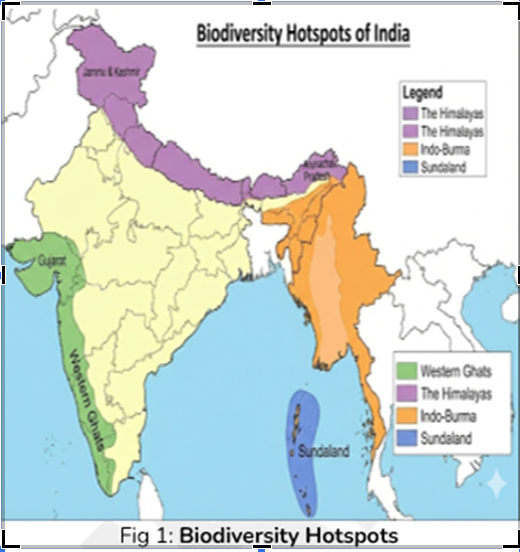
Source: Ensure IAS — What are Biodiversity Hotspots? What are the different factors leading to biodiversity loss in these hotspots in India? · www.ensureias.com
Geographic trap: Indian Wild Ass habitat is Little Rann, not Great Rann of Kutch
Confusion: Kaziranga is famous for rhinos but also has Wild Buffalo - don't miss the connection
River mix-up: Gharial in Chambal (cleanest), Ganges River Dolphin in Ganges (polluted) - different aquatic endangered species
Hotspot number: India has 2 biodiversity hotspots (Western Ghats, Northeast), not more
CITES and International Protection
Environment
CITES: International Wildlife Trade Regulation
CITES - Convention on International Trade in Endangered Species, signed 1973
3 Appendices based on threat level - I (trade banned), II (regulated), III (national protection)
183 countries are parties, India member since 1976
Wildlife Crime Control Bureau implements CITES in India
CITES (Convention on International Trade in Endangered Species of Wild Fauna and Flora) is the global treaty that regulates international wildlife trade. It works through import/export permits and complements national laws like India's Wildlife Protection Act.
CITES Appendix System
Appendix | Threat Level | Trade Status | Examples from Question | Other Examples |
|---|---|---|---|---|
Appendix I | Extinction threatened | Commercial trade banned | Gharial | Tiger, Asian Elephant, Rhino |
Appendix II | May become threatened | Trade regulated with permits | Indian Wild Ass | Leopard, Python, Crocodiles |
Appendix III | National protection | Trade regulated by specific countries | Wild Buffalo (some populations) | American Alligator, Cedar |
India's CITES Implementation
Wildlife Crime Control Bureau (WCCB) - nodal agency for CITES implementation under MoEF&CC
Export/Import permits required for Appendix II species trade
Scientific Authority - determines if trade will harm species survival
Management Authority - issues permits after scientific clearance
Enforcement through customs, forest departments, and specialized wildlife crime units
CITES vs National law: Species may be in different categories - Gharial in CITES Appendix I AND WLPA Schedule I
Appendix confusion: Appendix I = complete trade ban, Appendix II = regulated trade - don't mix up
Implementation body: WCCB implements CITES, NBWL advises on wildlife policy - different roles
Trade vs hunting: CITES regulates international trade, national laws regulate hunting within country