Consider the following statements in respect of Trade Related Analysis of Fauna and Flora in Commerce (TRAFFIC): 1. TRAFFIC is a bureau under United Nations Environment Programme (UNEP). 2. The mission of TRAFFIC is to ensure that trade in wild plants and animals is not a threat to the conservation of nature. Which of the above statements is/are correct?
Contents12
- A1 only
- B2 only
- CBoth 1 and 2
- DNeither 1 nor 2
Show answer
Answer: (B) 2 only
Statement 1 is incorrect:
TRAFFIC is NOT a bureau under the United Nations Environment Programme (UNEP).
TRAFFIC is a non-governmental organization (NGO) that was established in 1976 jointly by IUCN (International Union for Conservation of Nature) and WWF (World Wide Fund for Nature).
It is the world's leading wildlife trade monitoring network.
While TRAFFIC works closely with CITES (Convention on International Trade in Endangered Species) and various UN agencies, it is an independent NGO, not a UN bureau.
Statement 2 is correct:
TRAFFIC's mission is exactly to ensure that trade in wild animals and plants is not a threat to the conservation of nature.
It works globally on trade in wild animals and plants in the context of both biodiversity conservation and sustainable development.
TRAFFIC monitors wildlife trade, researches trade routes and volumes, identifies illegal trade patterns, and provides data and expertise to governments and international bodies like CITES to help regulate wildlife trade effectively.
The key facts to remember:
- TRAFFIC = founded by IUCN + WWF in 1976
- = wildlife trade monitoring network
- = NOT a UN body.
It is important not to confuse TRAFFIC with UNEP (which is a UN programme) or CITES (which is an international treaty/convention).
TRAFFIC is the world's leading wildlife trade monitoring network, established jointly by IUCN and WWF in 1976 to track illegal wildlife trafficking globally.
UPSC tests confusion between independent NGOs like TRAFFIC and actual UN bodies - students often assume major environmental organizations are UN agencies when many are independent.
TRAFFIC - Wildlife Trade Monitoring Network
Environment TRAFFIC Trade Related Analysis of Fauna and Flora in Commerce
TRAFFIC: Structure, Mission & UPSC Confusions
TRAFFIC = NGO founded by IUCN + WWF in 1976
Mission: ensure wildlife trade doesn't threaten nature conservation
World's leading wildlife trade monitoring network
NOT a UN bureau - independent organization
TRAFFIC stands for Trade Related Analysis of Fauna and Flora in Commerce. It is the world's leading wildlife trade monitoring network, established to bridge the gap between conservation and trade regulation.
TRAFFIC vs Similar Organizations
Organization | Type | Founded By | Role | Relationship to UN |
|---|---|---|---|---|
TRAFFIC | NGO | IUCN + WWF (1976) | Wildlife trade monitoring | Independent, collaborates with UN |
UNEP | UN Programme | United Nations | Environmental coordination | Part of UN system |
CITES | International Treaty | Member countries | Regulate endangered species trade | UN-administered treaty |
IUCN | International Union | Governments + NGOs | Conservation knowledge | Observer status at UN |
TRAFFIC's Core Functions
Monitors wildlife trade routes and volumes globally
Identifies illegal trade patterns and smuggling networks
Provides data and expertise to CITES and governments
Researches impact of trade on species conservation
Supports enforcement agencies with intelligence
Question Connection
This 2017 PYQ tested whether students knew TRAFFIC's institutional structure. Statement 1 was the trap - confusing TRAFFIC with a UN body when it's actually an independent NGO. Statement 2 was correct - accurately describing TRAFFIC's conservation-focused mission.
Trap: Confusing TRAFFIC with UNEP - TRAFFIC is NOT a UN bureau
Trap: Mixing up CITES (treaty) with TRAFFIC (monitoring NGO)
Trap: Assuming all wildlife organizations are UN bodies - many are independent NGOs
Remember: IUCN + WWF = TRAFFIC founders, not UN
Key International Conservation Organizations
Environment UNEP United Nations Environment Programme
Major International Conservation Bodies: Types & Roles
UNEP = UN's environmental coordination programme
IUCN = global conservation union of governments + NGOs
WWF = world's largest conservation NGO
CITES = treaty regulating endangered species trade
Major Conservation Organizations
Organization | Full Name | Type | Established | Key Role |
|---|---|---|---|---|
UNEP | UN Environment Programme | UN Body | 1972 | Environmental policy coordination |
IUCN | International Union for Conservation of Nature | International Union | 1948 | Conservation knowledge & standards |
WWF | World Wide Fund for Nature | International NGO | 1961 | Species & habitat conservation |
CITES | Convention on International Trade in Endangered Species | International Treaty | 1973 | Regulate wildlife trade |
CBD | Convention on Biological Diversity | International Treaty | 1992 | Biodiversity conservation framework |
Conservation Ecosystem Structure
# International Conservation Architecture
## UN System
- UNEP
- UNDP
- UNESCO
- FAO
## Treaties/Conventions
- CITES
- CBD
- Ramsar Convention
- CMS
## International NGOs
- WWF
- Greenpeace
- Conservation International
## Hybrid Organizations
- IUCN
- TRAFFIC
- UNEP-WCMC
India's Conservation Partnerships
India is a founding member of IUCN and active in all major conventions
Project Tiger receives support from WWF and other international partners
India hosts CITES CoP meetings and chairs various working groups
TRAFFIC India operates as country office monitoring wildlife trade
Don't assume all conservation bodies are UN organizations - many are NGOs or treaties
IUCN is neither pure NGO nor pure government - it's a unique union of both
CITES is a treaty/convention, not an organization with permanent staff
WWF and UNEP are completely different - NGO vs UN programme
International Wildlife Trade & CITES
Environment
CITES Framework & Wildlife Trade Control Mechanisms
CITES controls international trade in 30,000+ species
3 Appendices with different protection levels
Permit system required for legal trade
183 countries are CITES parties
CITES (Convention on International Trade in Endangered Species) is the primary international treaty controlling wildlife trade. It works through a permit system and three-tier classification of species based on extinction risk.
CITES Appendices System
Appendix | Threat Level | Trade Rules | Examples |
|---|---|---|---|
Appendix I | Highest risk | Commercial trade banned, only scientific/educational permits | Tigers, Great Apes, Sea Turtles |
Appendix II | Controlled trade | Permits required, sustainable trade allowed | Sharks, Orchids, Parrots |
Appendix III | National protection | Export permits from listing country only | Species protected by specific countries |
CITES Trade Authorization Process
%%{init: {"flowchart": {"wrappingWidth": 460}}}%%
flowchart TD
  s1["`**Species Assessment**
Check CITES appendix listing`"]
  s2["`**Permit Application**
Apply to national CITES authority`"]
  s3["`**Scientific Review**
Assess impact on wild populations`"]
  s4["`**Permit Issuance**
Export/import permits issued if approved`"]
  s5["`**Border Control**
Customs verify permits at ports`"]
  s1 --> s2
  s2 --> s3
  s3 --> s4
  s4 --> s5
CITES India Context
India joined CITES in 1976 - among early adopters
Wildlife Crime Control Bureau (WCCB) is India's CITES enforcement agency
India hosts Asian Big Cat range countries meetings under CITES
Major challenges: rosewood smuggling, tiger parts trade, live bird trafficking
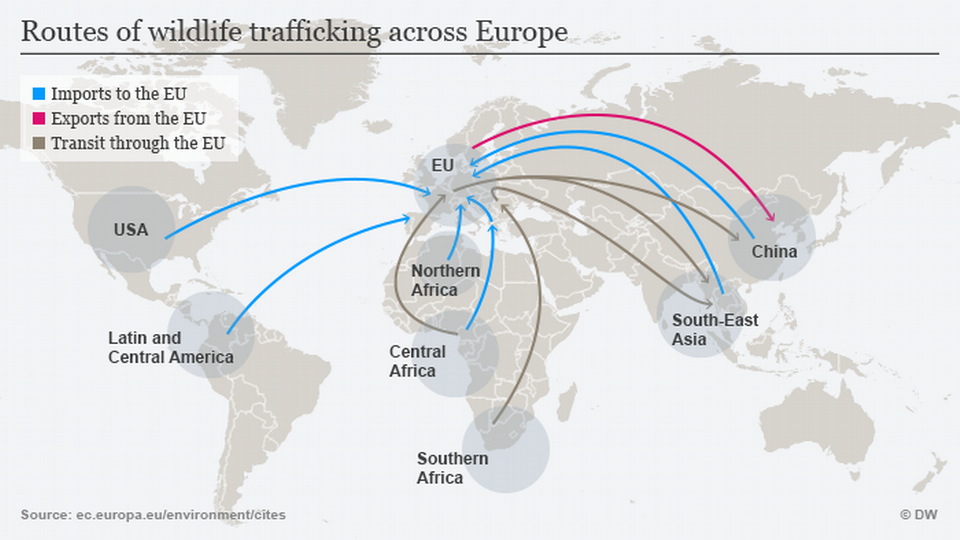
Source: DW.com — Silent wildlife trafficking in Europe · www.dw.com
Appendix I = commercial trade banned, not just regulated
Don't confuse CITES (treaty) with TRAFFIC (monitoring NGO)
CITES covers plants and animals - not just charismatic megafauna
Permits required even for Appendix II species - not free trade