Which of the following leaf modifications occur(s) in the desert areas to inhibit water loss? 1. Hard and waxy leaves 2. Tiny leaves 3. Thorns instead of leaves Select the correct answer using the code given below:
Contents17
- A2 and 3 only
- B2 only
- C3 only
- D1, 2 and 3
Show answer
Answer: (D) 1, 2 and 3
Correct Answer: (d) 1, 2 and 3
All three are correct.
Desert plants (called xerophytes) use various tricks to save water:
Hard and waxy leaves — CORRECT: A thick, waxy coating (called cuticle) on leaves prevents water from evaporating. Think of it like wrapping food in plastic to keep it fresh.
Tiny leaves — CORRECT: Smaller leaves = less surface area = less water loss through evaporation. Some desert plants have needle-like leaves for this reason.
Thorns instead of leaves — CORRECT: Some plants like cactus have completely replaced their leaves with thorns. No leaves means almost no water loss through transpiration (the process by which plants lose water through tiny pores on leaves).
REMEMBER: Desert plants fight water loss in 3 ways — wax coating (hard/waxy leaves), shrink leaves (tiny), or ditch leaves entirely (thorns). All three are valid adaptations.
Desert plants use three main leaf modifications to prevent water loss: waxy coatings to block evaporation, reduced leaf size to minimize surface area, and replacing leaves with thorns to eliminate transpiration entirely.
This tests understanding of xerophytic adaptations, where UPSC expects students to recognize that plants can use multiple simultaneous strategies rather than just one adaptation type.
Xerophyte Adaptations for Water Conservation
Environment desert areas inhibit water loss leaf modifications
Xerophyte Adaptations: How Desert Plants Conserve Water
Xerophytes are desert plants with specialized adaptations to minimize water loss
Three main leaf modifications: waxy coating, reduced size, and replacement with thorns
All modifications target transpiration reduction - water loss through leaf pores
Cuticle is the waxy layer that acts as waterproof barrier on leaves
Why Desert Plants Need Water-Saving Tricks
Xerophytes are plants adapted to extremely dry conditions. In deserts, water is scarce and evaporation rates are high due to intense sunlight and heat. Plants normally lose water through transpiration - water evaporating through tiny pores called stomata on leaves. Desert plants have evolved multiple strategies to minimize this water loss while still performing photosynthesis.
Three Key Leaf Modifications
Modification | Mechanism | Example Plants | Water-Saving Benefit |
|---|---|---|---|
Hard & Waxy Leaves | Thick cuticle (waxy coating) covers leaf surface | Oleander, Desert Marigold | Prevents water evaporation through leaf surface |
Tiny Leaves | Reduced leaf surface area | Rosemary, Desert Sage | Less surface area = less transpiration |
Thorns Instead of Leaves | Leaves completely modified into thorns | Cactus, Barrel Cactus | Eliminates transpiration entirely from leaves |
Question Connection
This question tested whether students know that all three modifications work together in xerophyte adaptation. The trap was thinking only some modifications are valid - but desert plants use multiple strategies simultaneously to maximize water conservation.
Trap: Thinking hard/waxy leaves don't help with water loss - the cuticle is a major water barrier
Trap: Assuming thorns are only for protection - they're actually modified leaves that eliminate transpiration
Confusion: Mixing up xerophytes (dry-adapted) with hydrophytes (water-adapted plants)
Common Error: Forgetting that smaller surface area = less water loss is a basic principle
Cactus Adaptations

Source: LinkedIn — Cacti are succulent plants that live in dry areas (xeric ... · www.linkedin.com
Transpiration and Water Loss in Plants
Environment water loss
Transpiration: How Plants Lose Water & Why It Matters
Transpiration is water loss through tiny pores called stomata on leaves
Stomata open for gas exchange (CO₂ in, O₂ out) but also allow water vapor to escape
Desert plants must balance photosynthesis needs with water conservation
The Plant's Dilemma
Plants face a trade-off: they need to open stomata (tiny pores) to absorb CO₂ for photosynthesis, but this also allows precious water to evaporate out. In water-rich environments, this isn't a problem. But in deserts, every drop of water counts.
How Transpiration Works
%%{init: {"flowchart": {"wrappingWidth": 460}}}%%
flowchart TD
  s1["`**Water Absorption**
Roots absorb water from soil`"]
  s2["`**Water Transport**
Water travels up through **xylem** vessels to leaves`"]
  s3["`**Stomatal Opening**
**Stomata** open to allow **CO₂** in for photosynthesis`"]
  s4["`**Water Loss**
Water vapor escapes through open stomata into atmosphere`"]
  s5["`**Cooling Effect**
Evaporation cools the plant (like sweating in humans)`"]
  s1 --> s2
  s2 --> s3
  s3 --> s4
  s4 --> s5
Factors Affecting Transpiration Rate
Temperature: Higher heat = more evaporation = faster water loss
Humidity: Dry air pulls more water from leaves than humid air
Wind: Moving air carries away water vapor, increasing transpiration
Light intensity: Bright light opens stomata more, increasing water loss
Leaf surface area: Bigger leaves = more stomata = more potential water loss
Don't confuse: Transpiration (water loss from leaves) vs Evaporation (water loss from soil/water bodies)
Remember: Stomata are on leaves, not roots - roots absorb water, leaves lose it
Key fact: Plants lose 90-95% of absorbed water through transpiration
Common Desert Plants and Their Adaptations
Environment desert areas
Desert Plants: Examples & Their Water-Saving Strategies
Cactus stores water in thick stems and uses thorns instead of leaves
Aloe Vera has thick, waxy leaves that store water internally
Desert plants often combine multiple adaptations for maximum water efficiency
Examples of Desert Plant Adaptations
Plant | Leaf Modification | Additional Adaptations | Water Storage |
|---|---|---|---|
Prickly Pear Cactus | Thorns replace leaves entirely | Waxy stem surface, CAM photosynthesis | Thick, fleshy stem |
Aloe Vera | Thick, waxy coating on leaves | Reduced stomata number | Water stored in leaf tissues |
Desert Sage | Small, narrow leaves | Silver-colored leaves reflect heat | Deep root system |
Barrel Cactus | No leaves, only thorns | Ribbed surface expands when storing water | Massive water storage in stem |
Joshua Tree | Sword-like, waxy leaves | Thick bark, slow growth | Water stored in trunk |
Additional Desert Survival Tricks
CAM Photosynthesis: Opens stomata only at night when it's cooler and more humid
Deep/Wide Root Systems: Some roots go 50+ feet deep, others spread wide near surface
Water Storage Tissues: Succulent plants store water in thick stems, leaves, or roots
Reflective Surfaces: Light-colored or silvery leaves reflect heat and reduce water loss
Slow Growth: Growing slowly conserves energy and water resources
Desert Plant Diversity
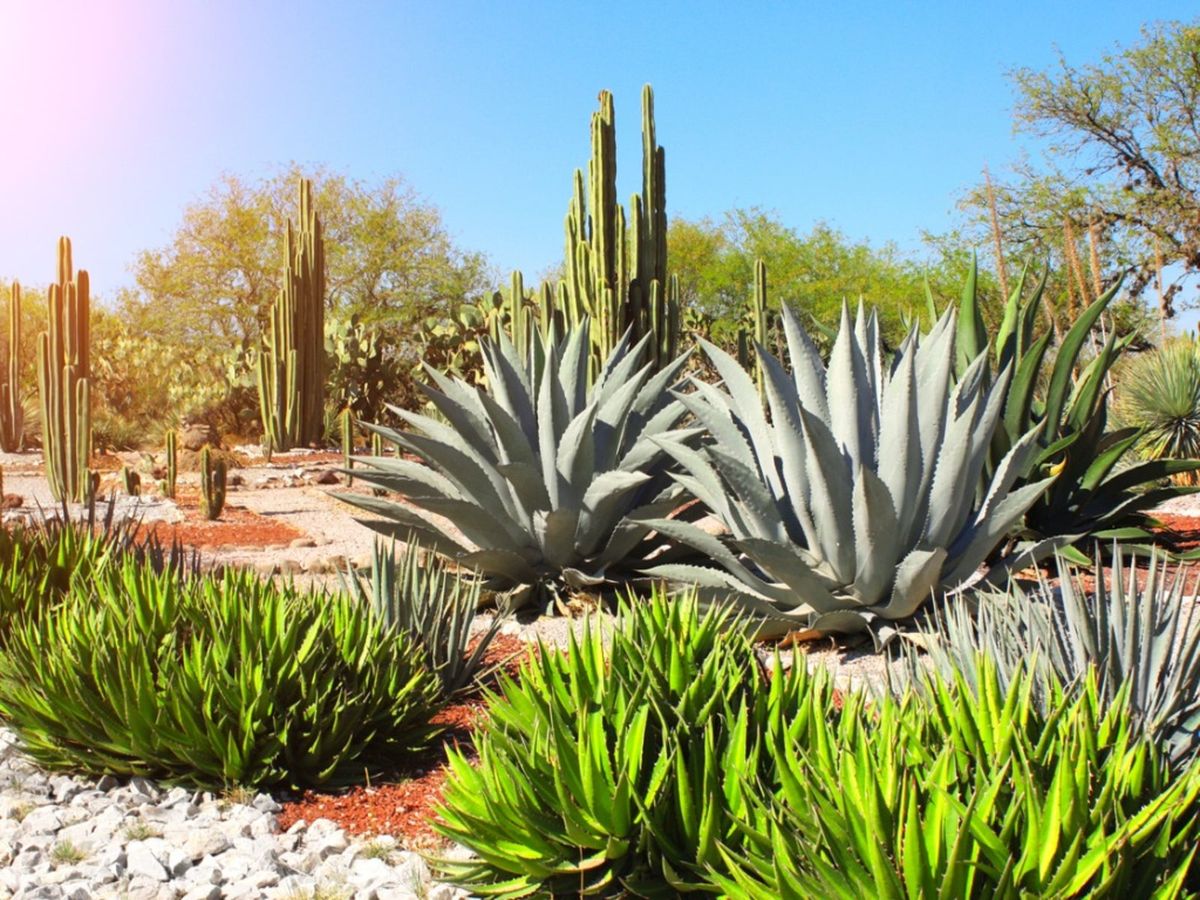
Source: Gardening Know How — What Are Xerophytes - Types Of Xerophytic Plants For The Garden ... · www.gardeningknowhow.com
Desert Plants in India & Conservation
Environment
India's Desert Plants: Thar Desert Flora & Conservation Efforts
Thar Desert in Rajasthan hosts diverse xerophytic plant species
Khejri Tree is the state tree of Rajasthan, adapted to extreme aridity
Many Indian desert plants have medicinal and economic value
India's Arid Zones
India's arid and semi-arid regions cover about 12% of total land area, mainly in Rajasthan, Gujarat, and parts of Haryana. The Thar Desert is India's largest desert, supporting unique plant communities adapted to extreme heat and water scarcity.
Key Indian Desert Plants
Plant Name | Scientific Name | Adaptations | Uses |
|---|---|---|---|
Khejri Tree | Prosopis cineraria | Deep roots, small leaves, drought-deciduous | Fodder, fuel, sacred to Bishnois |
Ker | Capparis decidua | Thorny, leafless branches | Edible berries, traditional food |
Desert Teak | Tecomella undulata | Waxy leaves, water-storing bark | Timber, medicinal uses |
Palash | Butea monosperma | Thick bark, seasonal leaf drop | Dye, medicine, state flower of Jharkhand |
Dhok | Anogeissus pendula | Small leathery leaves | Timber, fuelwood |
Conservation Significance
Desert National Park in Rajasthan protects Thar Desert ecosystem and its flora
Bishnoi Community traditionally protects Khejri trees and desert wildlife
Afforestation Programs: Government initiatives to combat desertification using native species
Medicinal Value: Many desert plants used in Ayurveda and traditional medicine
Economic Importance: Desert plants provide fodder, fuel, and income to local communities
Don't assume all Indian deserts are in Rajasthan - Gujarat also has significant arid areas
Remember: Khejri is sacred to Bishnois, not just economically important
Geography link: Thar Desert extends into Pakistan - it's a transboundary ecosystem