Which of the following statements best describes "carbon fertilization"?
Contents14
- AIncreased plant growth due to increased concentration of carbon dioxide in the atmosphere
- BIncreased temperature of Earth due to increased concentration of carbon dioxide in the atmosphere
- CIncreased acidity of oceans as a result of increased concentration of carbon dioxide in the atmosphere
- DAdaptation of all living beings on Earth to the climate change brought about by the increased concentration of carbon dioxide in the atmosphere
Show answer
Answer: (A) Increased plant growth due to increased concentration of carbon dioxide in the atmosphere
Correct Answer: (a) Increased plant growth due to increased concentration of carbon dioxide in the atmosphere.
Carbon fertilization is a simple concept:
Plants use carbon dioxide (CO2) during photosynthesis to make food and grow.
So when there's MORE CO2 in the atmosphere, plants can potentially grow FASTER and BIGGER — just like giving extra fertilizer to crops.
Think of it this way: CO2 is like food for plants.
More food = more growth.
This effect is called 'carbon fertilization.'
Why the other options are wrong:
- Option B describes the greenhouse effect (global warming), not carbon fertilization.
- Option C describes ocean acidification (CO2 dissolving in oceans makes them more acidic), not carbon fertilization.
- Option D describes climate adaptation, which is a completely different concept.
Important note: While carbon fertilization sounds positive, it has limits. Beyond a certain point, other factors like water, nutrients, and temperature become limiting. Also, increased CO2 causes global warming, which can harm plants in other ways.
REMEMBER: Carbon fertilization = MORE CO2 → MORE plant growth (through enhanced photosynthesis).
Don't confuse with greenhouse effect (warming) or ocean acidification (acidic oceans).
Carbon fertilization refers to enhanced plant growth when atmospheric CO2 levels rise, as plants use CO2 for photosynthesis.
UPSC tests this to see if students can distinguish between different effects of rising CO2 - fertilization (plant growth), greenhouse effect (warming), and ocean acidification.
The question checks conceptual clarity on how the same gas (CO2) can have multiple distinct environmental effects through different mechanisms.
Carbon Fertilization Effect
Environment carbon fertilization increased plant growth carbon dioxide
Carbon Fertilization Effect: Mechanism & Limitations
Carbon fertilization = increased plant growth due to higher atmospheric CO2 levels
Works through enhanced photosynthesis - CO2 is raw material for plant food production
Effect has natural limits - water, nutrients, and temperature become constraining factors
C3 plants (wheat, rice) benefit more than C4 plants (maize, sugarcane)
Carbon fertilization occurs when plants grow faster and larger due to increased atmospheric CO2. Since CO2 is the primary raw material for photosynthesis, higher concentrations can boost plant productivity - similar to adding fertilizer to crops.
How Carbon Fertilization Works
%%{init: {"flowchart": {"wrappingWidth": 460}}}%%
flowchart TD
  s1["`**Higher CO2 in atmosphere**
Atmospheric CO2 levels increase from human activities`"]
  s2["`**Enhanced CO2 uptake**
Plants absorb more CO2 through leaf stomata`"]
  s3["`**Boosted photosynthesis**
More CO2 available for photosynthesis reaction: 6CO2 + 6H2O → C6H12O6 + 6O2`"]
  s4["`**Increased plant growth**
More glucose produced leads to faster growth, larger biomass`"]
  s1 --> s2
  s2 --> s3
  s3 --> s4
Carbon Fertilization vs Related Concepts
Effect | Definition | Mechanism | Result |
|---|---|---|---|
Carbon Fertilization | Plant growth boost from more CO2 | Enhanced photosynthesis | Bigger, faster-growing plants |
Greenhouse Effect | Earth warming from CO2 | CO2 traps heat radiation | Global temperature rise |
Ocean Acidification | Ocean pH decrease from CO2 | CO2 dissolves, forms carbonic acid | More acidic seawater |
Climate Adaptation | Species adjusting to climate change | Evolutionary/behavioral changes | Survival in new conditions |
Important Limitations
Saturation point - beyond optimal CO2 levels, growth benefits plateau or decline
Water limitation - increased growth requires more water, often scarce in many regions
Nutrient constraints - faster growth demands more nitrogen, phosphorus from soil
Temperature stress - global warming from CO2 can offset growth benefits through heat stress
Plant type matters - C3 plants (wheat, rice, soybeans) respond better than C4 plants (corn, sugarcane)
Photosynthesis Process
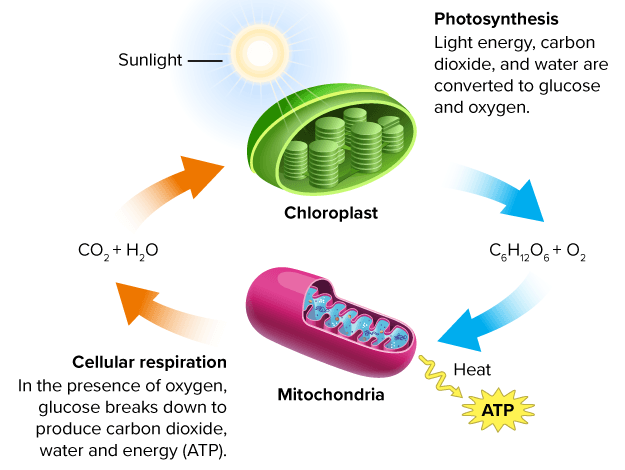
Source: CK12-Foundation — Photosynthesis - Process, Steps and Reaction | CK-12 Foundation · flexbooks.ck12.org
Don't confuse carbon fertilization with greenhouse effect - fertilization helps plants grow, greenhouse effect warms Earth
Trap: Option B describes global warming, not the direct effect on plant growth
Trap: Ocean acidification (Option C) is CO2 dissolving in water, not plant fertilization
Remember: 'Fertilization' in the term refers to growth enhancement, not reproductive fertilization
Greenhouse Effect & Global Warming
Environment increased temperature greenhouse effect
Greenhouse Effect: How CO2 Warms the Earth
Greenhouse effect = Earth warming due to heat-trapping gases like CO2
CO2 allows sunlight in but traps heat radiation trying to escape
Pre-industrial CO2: 280 ppm, Current: 420+ ppm, Target: below 450 ppm
The greenhouse effect explains why increased CO2 causes global warming. CO2 acts like glass in a greenhouse - it lets sunlight reach Earth's surface but prevents heat from escaping back to space.
Greenhouse Effect Process
%%{init: {"flowchart": {"wrappingWidth": 460}}}%%
flowchart TD
  s1["`**Solar radiation enters**
Sun's energy (short-wave radiation) passes through atmosphere`"]
  s2["`**Earth absorbs and heats up**
Land and oceans absorb solar energy, warm up`"]
  s3["`**Earth emits heat radiation**
Warm Earth emits long-wave (infrared) radiation back toward space`"]
  s4["`**CO2 traps outgoing heat**
Greenhouse gases absorb and re-radiate heat back to Earth`"]
  s5["`**Earth gets warmer**
Less heat escapes, more stays trapped, global temperature rises`"]
  s1 --> s2
  s2 --> s3
  s3 --> s4
  s4 --> s5
Major Greenhouse Gases
Gas | Chemical Formula | % of Total Effect | Main Sources | Lifetime in Atmosphere |
|---|---|---|---|---|
Carbon Dioxide | CO2 | 76% | Fossil fuels, deforestation | 300-1000 years |
Methane | CH4 | 16% | Agriculture, livestock, landfills | 12 years |
Nitrous Oxide | N2O | 6% | Agriculture, fossil fuels | 121 years |
Fluorinated Gases | HFCs, PFCs | 2% | Industrial processes, refrigeration | 15-29,000 years |
Key distinction: Greenhouse effect causes temperature rise, carbon fertilization causes plant growth
Don't mix up: Solar radiation comes IN easily, heat radiation going OUT gets trapped
Remember: CO2 is invisible but absorbs infrared (heat) radiation, not visible light
Ocean Acidification
Environment increased acidity of oceans
Ocean Acidification: The Other CO2 Problem
Ocean acidification = oceans becoming more acidic as they absorb excess atmospheric CO2
Ocean pH has dropped from 8.2 to 8.1 since industrial times (30% more acidic)
Threatens coral reefs, shellfish, and entire marine food chains
Ocean acidification occurs when oceans absorb CO2 from the atmosphere. The CO2 dissolves and forms carbonic acid, making seawater more acidic. This is called the 'other CO2 problem' alongside global warming.
Ocean Acidification Process
%%{init: {"flowchart": {"wrappingWidth": 460}}}%%
flowchart TD
  s1["`**CO2 dissolves in seawater**
Atmospheric CO2 absorbed by ocean surface`"]
  s2["`**Forms carbonic acid**
CO2 + H2O → H2CO3 (carbonic acid)`"]
  s3["`**Releases hydrogen ions**
H2CO3 breaks down, releases H+ ions`"]
  s4["`**Ocean pH decreases**
More H+ ions = lower pH = more acidic water`"]
  s5["`**Marine life affected**
Shell formation disrupted, coral bleaching increases`"]
  s1 --> s2
  s2 --> s3
  s3 --> s4
  s4 --> s5
Impacts on Marine Life
Shell-building organisms (oysters, clams, sea snails) struggle to form calcium carbonate shells
Coral reefs experience bleaching and skeleton weakening, threatening entire ecosystems
Fish behavior altered - acidic water affects their sense of smell and navigation
Food chain disruption as phytoplankton and small organisms decline
Cold water regions affected first - CO2 dissolves better in colder water
Terminology trap: 'Acidification' doesn't mean oceans become acidic (pH < 7) - they become less alkaline
Don't confuse with carbon fertilization - this affects marine life, not land plants
Remember: Oceans absorb about 25% of all human CO2 emissions
Climate Change Adaptation
Environment adaptation climate change
Climate Change Adaptation: Natural & Human Responses
Climate adaptation = adjustments by living beings to survive in changing climate conditions
Includes behavioral changes, migration, evolutionary responses, and human interventions
Different from mitigation (reducing emissions) - adaptation is about living with unavoidable change
Climate adaptation refers to adjustments that natural and human systems make to survive and thrive under changing climate conditions. Unlike mitigation (reducing greenhouse gas emissions), adaptation accepts that some climate change is inevitable and focuses on building resilience.
Types of Climate Adaptation
Type | Examples | Timeframe | Effectiveness |
|---|---|---|---|
Behavioral | Migration patterns, breeding timing | Immediate to decades | High for mobile species |
Physiological | Heat tolerance, water efficiency | Decades to centuries | Limited by genetic constraints |
Evolutionary | Genetic changes, natural selection | Centuries to millennia | High but very slow |
Human Intervention | Assisted migration, genetic rescue | Years to decades | High but expensive |
Adaptation Strategies
# Climate Adaptation
## Ecosystem-based
- Forest restoration
- Wetland conservation
- Corridor creation
- Seed banking
## Species-specific
- Assisted migration
- Captive breeding
- Genetic rescue
- Habitat modification
## Human Systems
- Drought-resistant crops
- Flood management
- Heat-resilient cities
- Water conservation
## Natural Responses
- Range shifts
- Phenological changes
- Behavioral plasticity
- Evolutionary adaptationKey distinction: Adaptation is responding to climate change, mitigation is preventing climate change
Don't assume all species can adapt - many face extinction if change is too rapid
Remember: Option D in the question oversimplifies - not all living beings can successfully adapt