With reference to agricultural soils, consider the following statements: 1. A high content of organic matter in soil drastically reduces its water holding capacity. 2. Soil does not play any role in the sulphur cycle. 3. Irrigation over a period of time can contribute to the salinization of some agricultural lands. Which of the statements given above is/are correct?
Contents18
- A1 and 2 only
- B3 only
- C1 and 3 only
- D1, 2 and 3
Show answer
Answer: (B) 3 only
Correct Answer: (b) 3 only
Statement 1 is WRONG:
High organic matter in soil actually INCREASES water-holding capacity, not reduces it.
Organic matter acts like a sponge — it can absorb and hold water.
Soils rich in organic matter (like black soil/humus-rich soil) hold more moisture than sandy or organic-poor soils.
Statement 2 is WRONG:
Soil DOES play an important role in the sulphur cycle.
Sulphur is one of the nutrients cycled between the atmosphere, soil, and living organisms.
Sulphur is released into soil through weathering of rocks and minerals.
Plants and microbes take up sulphate from the soil and convert it into organic compounds.
When organisms die and decompose, sulphur returns to the soil.
So soil is a key component of the sulphur cycle, not separate from it.
Statement 3 is CORRECT:
Irrigation over a long period can lead to salinization of agricultural land.
When water is applied through irrigation, it brings dissolved salts.
As water evaporates, these salts accumulate in the topsoil.
Without proper drainage to wash away excess salts, the soil becomes increasingly saline over time, reducing crop productivity.
This is called secondary salinization and is a major problem in irrigated farmlands across India and the world.
REMEMBER:
Organic matter INCREASES water retention (Statement 1 is opposite).
Soil IS part of the sulphur cycle (Statement 2 is wrong).
Irrigation CAN cause salinization if drainage is poor (Statement 3 is correct).
Answer = only Statement 3 is correct.
Soil salinization affects over 6.7 million hectares of agricultural land in India, making it a major threat to food security and farmer incomes.
UPSC is testing fundamental soil science concepts that students often get wrong - organic matter's role in water retention, soil's participation in nutrient cycles, and irrigation's long-term environmental impacts.
The question combines basic soil chemistry with practical agricultural problems, requiring students to understand both theoretical concepts and real-world farming challenges.
Organic Matter in Soil
Environment organic matter water holding capacity
Organic Matter in Soil: Water Retention & Fertility Benefits
Organic matter INCREASES water-holding capacity — acts like a sponge
Organic matter = humus + decomposed plant/animal remains
Black soils are rich in organic matter and retain more moisture
Organic matter improves soil structure, aeration, and nutrient availability
What is Organic Matter
Organic matter in soil consists of humus (fully decomposed material) plus partially decomposed plant and animal remains. It typically makes up 2-5% of soil volume but has disproportionate impact on soil properties.
Organic Matter Effects
Property | Effect of High Organic Matter | Mechanism |
|---|---|---|
Water Retention | Increases significantly | Acts like sponge — can hold 20x its weight in water |
Soil Structure | Improves aggregation | Binds soil particles into stable clumps |
Nutrient Supply | Slow-release fertilizer | Decomposition releases N, P, K gradually |
Soil Temperature | Moderates extremes | Dark color absorbs heat, organic matter insulates |
Indian Context
Black cotton soils (Deccan region) have high organic matter — excellent water retention for cotton cultivation
Alluvial soils of Ganga plains are fertile due to organic matter deposits from river sediments
Laterite soils (Western Ghats) are poor in organic matter — low water retention, need amendments
Trap: Statement 1 says organic matter reduces water-holding capacity — this is exactly opposite to reality
Remember: Sandy soils (low organic matter) drain quickly, clayey-humus soils (high organic matter) retain water
Don't confuse with waterlogging — organic matter increases retention but doesn't cause stagnation if drainage exists
Sulphur Cycle
Environment sulphur cycle soil
Sulphur Cycle: Soil's Critical Role in Nutrient Cycling
Soil plays a central role in the sulphur cycle — not separate from it
Sulphur enters soil through rock weathering and atmospheric deposition
Plants absorb sulphate (SO₄²⁻) from soil for protein synthesis
Decomposition returns organic sulphur back to soil
Why Soil Matters
Soil is the primary reservoir for sulphur in terrestrial ecosystems. It stores sulphur in both inorganic forms (sulphate minerals) and organic forms (proteins in decomposing matter).
Sulphur Cycle Steps
%%{init: {"flowchart": {"wrappingWidth": 460}}}%%
flowchart TD
  s1["`****Weathering Input****
Rock weathering releases sulphate into soil`"]
  s2["`****Atmospheric Input****
Acid rain and volcanic emissions add sulphur to soil`"]
  s3["`****Plant Uptake****
Roots absorb SO₄²⁻ for amino acid synthesis`"]
  s4["`****Organic Incorporation****
Sulphur becomes part of proteins in living organisms`"]
  s5["`****Decomposition****
Dead organisms release sulphur back to soil`"]
  s6["`****Microbial Processing****
Bacteria convert between different sulphur forms in soil`"]
  s1 --> s2
  s2 --> s3
  s3 --> s4
  s4 --> s5
  s5 --> s6
Soil Functions in S-Cycle
Storage reservoir — holds 95% of terrestrial sulphur in soil organic matter
Chemical transformation — soil bacteria convert sulphur between oxidized/reduced forms
Supply to plants — soil provides sulphate that plants need for protein synthesis
Buffering capacity — soil can absorb excess sulphur from acid rain without immediate ecosystem damage
Trap: Statement 2 claims soil plays no role in sulphur cycle — this is completely false
Don't confuse with atmospheric sulphur (SO₂ pollution) — soil-based sulphur cycling is essential for ecosystems
Remember: Soil microbes are key players in sulphur transformations — soil is not just passive storage
Irrigation-Induced Salinization
Environment irrigation salinization agricultural lands
Irrigation-Induced Salinization: Mechanism & Prevention
Irrigation can cause salinization when drainage is inadequate
Secondary salinization = salt buildup from irrigation water evaporation
Punjab, Haryana face serious irrigation-induced salinity problems
Proper drainage prevents salt accumulation in topsoil
The Problem
Secondary salinization occurs when irrigation water containing dissolved salts evaporates, leaving salt deposits in the topsoil. Unlike primary salinization (natural), this is human-caused and affects productive farmland.
Salinization Process
%%{init: {"flowchart": {"wrappingWidth": 460}}}%%
flowchart TD
  s1["`****Irrigation Water Applied****
Water contains dissolved salts (even fresh water has some)`"]
  s2["`****Crop Water Use****
Plants absorb water but leave most salts behind`"]
  s3["`****Evaporation****
Surface water evaporates, concentrating salts in topsoil`"]
  s4["`****Salt Accumulation****
Repeated cycles build up salt layers in root zone`"]
  s5["`****Crop Stress****
High salinity reduces water uptake by plants`"]
  s6["`****Yield Decline****
Saline soils become unproductive over time`"]
  s1 --> s2
  s2 --> s3
  s3 --> s4
  s4 --> s5
  s5 --> s6
Types of Salinization
Type | Cause | Location | Prevention |
|---|---|---|---|
Primary | Natural salt deposits, coastal areas | Rajasthan, Gujarat coast | Avoid cultivation or use salt-tolerant crops |
Secondary | Irrigation + poor drainage | Punjab, Haryana, UP canal areas | Install drainage, use better water management |
Indian Examples
Punjab-Haryana — Green Revolution areas now face salinity from intensive irrigation
Indira Gandhi Canal (Rajasthan) — poor drainage led to salinization of command area
Tamil Nadu — bore-well irrigation in coastal areas brings up saline groundwater
Maharashtra — sugarcane belt experiences salinity from flood irrigation methods
Salinization Zones
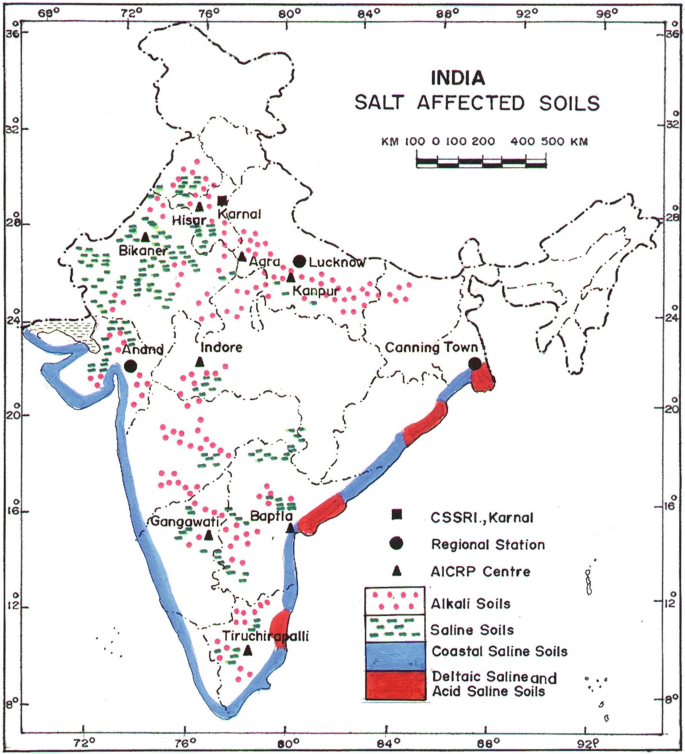
Source: Springer Nature — Nature and Origin of Salts, Classification, Area and Distribution of Salt-affected Soils | Springer Nature Link · link.springer.com
Key fact: Statement 3 is the only correct statement in this question
Don't assume irrigation is always beneficial — poor water management creates soil degradation
Remember: Drainage is crucial — without it, even good irrigation causes problems
Soil in Biogeochemical Cycles
Environment
Soil's Role in Major Biogeochemical Cycles
Soil is central to nitrogen, phosphorus, carbon, and sulphur cycles
Soil microbes drive most biogeochemical transformations
Organic matter decomposition releases nutrients back to soil
Weathering makes rock nutrients available to plants via soil
Soil as Ecosystem Hub
Soil acts as the interface between the geosphere (rocks), biosphere (living organisms), atmosphere (gases), and hydrosphere (water). Most nutrient cycling happens in or through soil.
Soil in Major Cycles
Cycle | Soil's Role | Key Process | Importance |
|---|---|---|---|
Nitrogen | N-fixation, nitrification | Rhizobium bacteria in root nodules | Most limiting nutrient for plants |
Carbon | Organic matter storage | Decomposition releases CO₂ | Largest terrestrial C reservoir |
Phosphorus | P-solubilization | Weathering makes P available | No atmospheric P — soil is main source |
Sulphur | S-transformation | Bacterial oxidation/reduction | Essential for amino acid synthesis |
Soil Cycle Functions
# Soil in Biogeochemical Cycles
## **Storage**
- Organic matter reservoir
- Mineral nutrient pool
- Carbon sequestration
## **Transformation**
- Microbial processing
- Chemical weathering
- Decomposition
## **Supply**
- Nutrient uptake by roots
- Ion exchange
- Solution transport
## **Regulation**
- pH buffering
- Moisture control
- Gas exchangeNever assume soil is passive in any biogeochemical cycle — it's always an active participant
Remember: Statement 2 type questions test whether you know soil's role in lesser-known cycles like sulphur
Phosphorus cycle has NO atmospheric component — soil weathering is the only natural P source