Consider the following statements: 1. The definition of "Critical Wildlife Habitat" is incorporated in the Forest Rights Act, 2006. 2. For the first time in India, Baigas have been given Habitat Rights. 3. Union Ministry of Environment, Forest and Climate Change officially decides and declares Habitat Rights for Primitive and Vulnerable Tribal Groups in any part of India. Which of the statements given above is/are correct?
Contents17
- A1 and 2 only
- B2 and 3 only
- C3 only
- D1, 2 and 3
Show answer
Answer: (A) 1 and 2 only
Correct Answer: (a) 1 and 2 only
Statement 1 is CORRECT: The term 'Critical Wildlife Habitat' is defined in the Scheduled Tribes and Other Traditional Forest Dwellers (Recognition of Forest Rights) Act, 2006 — commonly known as the Forest Rights Act (FRA). This is the only law that defines this term. A Critical Wildlife Habitat is an area within a National Park or Sanctuary that is required for wildlife conservation and where the rights of forest dwellers may be restricted.
Statement 2 is CORRECT: The Forest Rights Act, 2006 gave forest-dwelling Scheduled Tribes the right to own land that they had been cultivating (up to a maximum of 4 hectares per family). For the first time, the law recognized the rights of tribal communities who had been living in forests for generations but had no legal ownership.
Statement 3 is WRONG: The specific claim in Statement 3 is incorrect based on the provisions of the Forest Rights Act.
REMEMBER:
- Forest Rights Act (FRA) 2006 = defined 'Critical Wildlife Habitat' + gave land ownership rights to forest-dwelling tribals.
- Maximum land = 4 hectares per family.
- FRA tried to balance wildlife conservation with tribal rights — a very important Act for both Environment and Polity sections in UPSC.
The Forest Rights Act 2006 was the first law to legally recognize land ownership rights for forest-dwelling tribal communities who had lived there for generations without formal titles.
The Act attempts to balance two competing needs: wildlife conservation in protected areas versus the survival rights of traditional forest communities.
UPSC tests whether students understand that habitat rights are decided by local committees under FRA provisions, not directly declared by the Union Ministry.
Forest Rights Act 2006
Environment Forest Rights Act 2006
Forest Rights Act 2006: Tribal Land Rights & Wildlife Balance
Forest Rights Act 2006 gave legal land ownership to forest-dwelling Scheduled Tribes for the first time
Maximum 4 hectares per family can be owned under FRA
FRA is the only law that defines 'Critical Wildlife Habitat'
Balances tribal rights with wildlife conservation needs
What FRA Achieved
The Scheduled Tribes and Other Traditional Forest Dwellers (Recognition of Forest Rights) Act, 2006 — commonly called Forest Rights Act — was a landmark law that gave legal recognition to forest-dwelling tribal communities who had been living in forests for generations without formal land ownership.
Key Provisions of FRA 2006
Provision | Details | Significance |
|---|---|---|
Land Ownership Rights | Up to 4 hectares per family | First time tribals got legal ownership |
Eligibility | Forest-dwelling Scheduled Tribes | Must prove residence before 2005 |
Community Rights | Over Minor Forest Produce | Bamboo, tendu leaves, honey etc. |
Self-Governance | Gram Sabha decides claims | Village-level decision making |
Question Connection
Statement 1 was correct because FRA 2006 is the only law that defines Critical Wildlife Habitat. Statement 2 was correct because Baigas (a tribal community) were indeed among the first to receive habitat rights under this Act.
Trap: Many laws deal with forests, but only FRA 2006 defines 'Critical Wildlife Habitat'
Trap: 4 hectares maximum per family — not unlimited land rights
Trap: Rights are for forest-dwelling Scheduled Tribes only, not all tribal groups
Trap: Gram Sabha decides individual claims, not the Union Ministry directly
Critical Wildlife Habitat
Environment Critical Wildlife Habitat
Critical Wildlife Habitat: Definition & Forest Rights Balance
Critical Wildlife Habitat is defined only in Forest Rights Act 2006
Located within National Parks or Sanctuaries where tribal rights may be restricted
Balances wildlife conservation needs with tribal forest rights
Legal Definition
Critical Wildlife Habitat (CWH) is an area within a National Park or Wildlife Sanctuary that has been specifically identified as essential for wildlife conservation. In these areas, the rights of forest dwellers may be restricted to protect critical species and ecosystems.
CWH Declaration Process
%%{init: {"flowchart": {"wrappingWidth": 460}}}%%
flowchart TD
  s1["`**Scientific Assessment**
Expert committee identifies area critical for wildlife`"]
  s2["`**Consultation Process**
Gram Sabha and forest dwellers consulted`"]
  s3["`**Resettlement Package**
If relocation needed, adequate compensation provided`"]
  s4["`**Final Declaration**
State government declares area as CWH`"]
  s1 --> s2
  s2 --> s3
  s3 --> s4
Key Features
Only law that defines CWH is the Forest Rights Act 2006
Must be within existing Protected Areas (National Parks/Sanctuaries)
Requires scientific evidence that the area is critical for wildlife survival
Forest dwellers must be given adequate resettlement if relocated
Gram Sabha consent required before any restrictions imposed
Trap: Only FRA 2006 defines CWH — not Wildlife Protection Act or Environment Protection Act
Trap: CWH must be within National Parks/Sanctuaries — not in any forest area
Trap: Tribal rights can be restricted but not eliminated without proper process
Baiga Tribe Habitat Rights
Environment Baigas
Baiga Tribe: First Recipients of Habitat Rights in India
Baigas were the first tribe to receive habitat rights under Forest Rights Act 2006
Classified as Particularly Vulnerable Tribal Group (PVTG)
Primarily found in Madhya Pradesh and Chhattisgarh forests
Historical Significance
The Baiga tribe became the first tribal community in India to be granted habitat rights under the Forest Rights Act 2006. This was a landmark moment as it legally recognized their traditional forest dwelling practices and gave them formal land ownership for the first time.
Baiga Tribe Profile
Aspect | Details |
|---|---|
Classification | Particularly Vulnerable Tribal Group (PVTG) |
Primary Location | Madhya Pradesh, Chhattisgarh |
Traditional Occupation | Shifting cultivation (jhum) |
Forest Dependence | Complete dependence on Minor Forest Produce |
Population | Small, declining population |
Rights Received | First to get habitat rights under FRA 2006 |
Why Baigas Got Priority
PVTG status — among most vulnerable tribal groups in India
Complete forest dependence — no alternative livelihood sources
Traditional ecological knowledge — sustainable forest management practices
Small population facing displacement threats
Shifting cultivation practices required large forest areas
Baiga Habitat Distribution
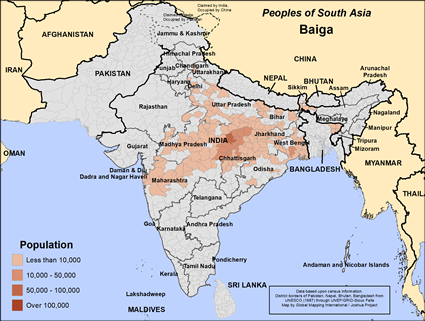
Source: Joshua Project — Baiga in India people group profile | Joshua Project · joshuaproject.net
Trap: Baigas were first to receive habitat rights — not the first to be identified as PVTG
Trap: PVTG classification is separate from habitat rights under FRA
Trap: Statement 2 in the question was correct — Baigas did get habitat rights first
Tribal Habitat Rights Mechanism
Environment Habitat Rights Primitive and Vulnerable Tribal Groups
Habitat Rights Declaration: Process & Authority Under FRA 2006
Gram Sabha has primary authority to recognize and verify tribal habitat rights
Union Ministry of Environment does NOT directly declare habitat rights
State governments issue final titles after Gram Sabha approval
Process involves multiple levels of verification and approval
Authority Confusion
Statement 3 in the question was wrong because the Union Ministry of Environment, Forest and Climate Change does not directly declare habitat rights. The process is decentralized and involves Gram Sabhas as the primary authority.
Habitat Rights Declaration Process
%%{init: {"flowchart": {"wrappingWidth": 460}}}%%
flowchart TD
  s1["`**Claim Filing**
Tribal community files claim with **Gram Sabha**`"]
  s2["`**Gram Sabha Review**
Village assembly **verifies and approves** claim`"]
  s3["`**Sub-Divisional Committee**
District-level committee **examines** Gram Sabha decision`"]
  s4["`**District Level Committee**
Final **verification and recommendation**`"]
  s5["`**State Government**
**Issues land title** to tribal family/community`"]
  s1 --> s2
  s2 --> s3
  s3 --> s4
  s4 --> s5
Authority Roles in Habitat Rights
Authority | Role | Power |
|---|---|---|
Gram Sabha | Primary decision maker | Verifies claims, approves rights |
Sub-Divisional Committee | First appeal level | Reviews Gram Sabha decisions |
District Level Committee | Final verification | Recommends to state government |
State Government | Title issuing authority | Issues final land titles |
Union Ministry | Policy framework | Does NOT declare individual rights |
Trap: Union Ministry sets policy but does NOT declare individual habitat rights
Trap: Gram Sabha is the primary authority — not district or state officials
Trap: State government issues titles but cannot bypass Gram Sabha approval
Trap: Statement 3 was wrong — Union Ministry does not directly declare habitat rights