Consider the following statements about Particularly Vulnerable Tribal Groups (PVTGs) in India: 1. PVTGs reside in 18 States and one Union Territory. 2. A stagnant or declining population is one of the criteria for determining PVTG status. 3. There are 95 PVTGs officially notified in the country so far. 4. Irular and Konda Reddi tribes are included in the list of PVTGs. Which of the statements given above are correct?
Contents15
- A1, 2 and 3
- B2, 3 and 4
- C1, 2 and 4
- D1, 3 and 4
Show answer
Answer: (C) 1, 2 and 4
The correct answer is (C) — 1, 2 and 4.
PVTGs are the most vulnerable among tribal groups.
Statement 1 is correct — they live across 18 States and one Union Territory.
Statement 2 is correct — a declining or stagnant population is one key criterion for PVTG classification, along with pre-agricultural technology and low literacy.
Statement 4 is correct — Irular (Tamil Nadu) and Konda Reddi (Andhra Pradesh) are both PVTGs.
Statement 3 is wrong because there are 75 PVTGs in India, not 95.
Tip: Remember 75 PVTGs across 18 States + 1 UT.
PVTGs are the most vulnerable tribal communities with only 75 groups across 18 states and one union territory, making them a critical focus for welfare schemes.
The criteria for PVTG status include declining population, pre-agricultural technology, and low literacy - distinguishing them from regular Scheduled Tribes.
Students must memorize the exact number 75 PVTGs, as UPSC uses incorrect numbers like 95 as distractors to test precise knowledge.
Particularly Vulnerable Tribal Groups (PVTGs)
Indian Polity PVTGs Particularly Vulnerable Tribal Groups 75 PVTGs
PVTGs: Classification, Criteria & Distribution
75 PVTGs across 18 States + 1 UT in India
Most vulnerable tribal communities with declining population and pre-agricultural technology
Irular (Tamil Nadu) and Konda Reddi (Andhra Pradesh) are PVTGs
Identified by Dhebar Commission recommendations
What are PVTGs
PVTGs are the most vulnerable sub-category among Scheduled Tribes in India. They were identified based on the Dhebar Commission (1960-61) recommendations to provide special focus and protection to tribes facing extinction or severe marginalization.
PVTG Classification Criteria
Criterion | Details |
|---|---|
Population | Stagnant or declining population |
Technology | Pre-agricultural level of technology |
Literacy | Extremely low literacy rates |
Economy | Subsistence level economy |
Key Facts
Total 75 PVTGs officially notified (not 95)
Spread across 18 States and 1 Union Territory
Largest concentration in Odisha (13 PVTGs)
Special development schemes under Ministry of Tribal Affairs
PVTG Distribution Map
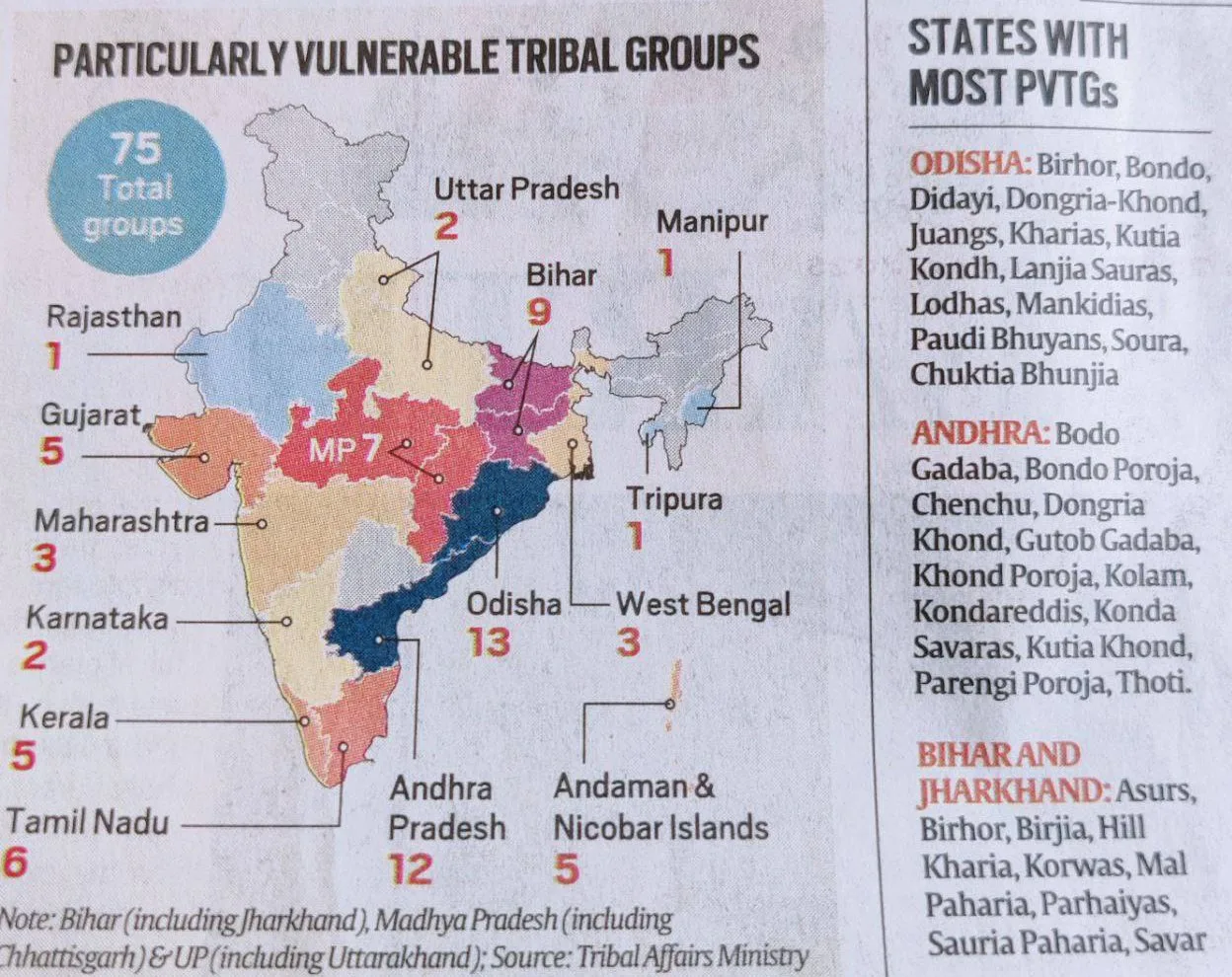
Source: PadhAI.ai — Particularly Vulnerable Tribal Groups (PVTGs) in India · padhai.ai
Trap: 75 PVTGs, not 95 - UPSC tests this exact number
Trap: Declining population is a criterion, not growing population
Trap: 18 States + 1 UT, not just states
Trap: Irular and Konda Reddi are confirmed PVTGs - know specific tribe names
Tribal Classification System in India
Indian Polity Scheduled Tribes tribal groups
India's Tribal Classification: ST to PVTG Hierarchy
Article 342 empowers President to notify Scheduled Tribes
PVTGs are most vulnerable sub-category within STs
Classification enables targeted welfare schemes
Tribal Classification Hierarchy
%%{init: {"flowchart": {"wrappingWidth": 460}}}%%
flowchart TD
  s1["`**All Tribal Communities**
Indigenous communities across India`"]
  s2["`**Scheduled Tribes (STs)**
Notified under Article 342 by President`"]
  s3["`**Primitive Tribal Groups**
Identified by Dhebar Commission (1973)`"]
  s4["`**PVTGs**
Renamed in 2006 - most vulnerable category`"]
  s1 --> s2
  s2 --> s3
  s3 --> s4
ST vs PVTG Comparison
Aspect | Scheduled Tribes | PVTGs |
|---|---|---|
Constitutional Basis | Article 342 | Administrative classification |
Total Numbers | 700+ communities | 75 communities |
Population Trend | Generally growing | Stagnant/declining |
Technology Level | Varied | Pre-agricultural |
Special Schemes | General tribal schemes | Dedicated PVTG schemes |
Dhebar Commission & Tribal Welfare
Indian Polity
Dhebar Commission: Foundation of PVTG Policy
Dhebar Commission (1960-61) recommended identifying most vulnerable tribes
Led to Primitive Tribal Groups classification in 1973
Renamed to PVTGs in 2006 for sensitivity
Commission Background
The Dhebar Commission (1960-61), officially called the Advisory Committee on Revision of Lists of Scheduled Castes and Scheduled Tribes, recommended special attention for the most vulnerable tribal groups facing extinction.
Key Recommendations
Identify tribes with pre-agricultural technology
Focus on groups with declining populations
Provide special development programs
Minimize external interference in their lifestyle
Policy Evolution
%%{init: {"flowchart": {"wrappingWidth": 460}}}%%
flowchart TD
  s1["`**1960-61**
Dhebar Commission recommendations`"]
  s2["`**1973**
Primitive Tribal Groups identified`"]
  s3["`**2006**
Renamed to PVTGs for sensitivity`"]
  s4["`**Current**
75 PVTGs with dedicated schemes`"]
  s1 --> s2
  s2 --> s3
  s3 --> s4
Major PVTG Communities & Examples
Indian Polity Irular Konda Reddi
Notable PVTG Communities Across States
Irular tribe in Tamil Nadu - traditional snake catchers
Konda Reddi tribe in Andhra Pradesh - hill dwelling community
Odisha has highest number with 13 PVTGs
State-wise Notable PVTGs
State | PVTG Examples | Key Characteristics |
|---|---|---|
Tamil Nadu | Irular, Kurumba | Traditional snake catchers, honey collectors |
Andhra Pradesh | Konda Reddi, Chenchu | Hill dwellers, food gatherers |
Odisha | Bonda, Dongria Kondh | Highest concentration - 13 PVTGs |
Kerala | Cholanaikkan, Kadar | Forest dwellers, hunter-gatherers |
Jharkhand | Asur, Birhor | Traditional metalworkers, nomadic |
Characteristics
Irular - skilled in traditional medicine and snake catching
Konda Reddi - practice shifting cultivation in hills
Most PVTGs are forest-dependent communities
Many retain animistic religious practices
Remember: Irular (Tamil Nadu) and Konda Reddi (Andhra Pradesh) are confirmed PVTGs
Don't confuse with general Reddi community - Konda Reddi is the PVTG
Odisha leads in PVTG numbers, not northeastern states