Consider the following statements: 1. Asiatic lion is naturally found in India only. 2. Double-humped camel is naturally found in India only. 3. One-horned rhinoceros is naturally found in India only. Which of the statements given above is/are correct?
Contents19
- A1 only
- B2 only
- C1 and 3 only
- D1, 2 and 3
Show answer
Answer: (A) 1 only
The correct answer is (A) — 1 only.
The Asiatic lion is found ONLY in India, specifically in the Gir National Park in Gujarat.
Statement 2 is wrong because the double-humped (Bactrian) camel is native to Central Asia (Mongolia, China). In India, it is found only in the Nubra Valley of Ladakh, but it is not exclusive to India.
Statement 3 is wrong because the one-horned rhinoceros is found in both India (Kaziranga) and Nepal (Chitwan National Park).
Tip:
- Asiatic lion = India only (Gir).
- Bactrian camel = Central Asia.
- One-horned rhino = India + Nepal.
Asiatic lions exist only in Gujarat's Gir forests with a population of around 500-600 individuals, making it one of the world's most geographically restricted large carnivores.
The question tests whether students confuse regional presence with global exclusivity - double-humped camels live in Ladakh but originate from Central Asia, while one-horned rhinos are shared between India and Nepal.
Asiatic Lion Conservation
Environment Asiatic lion
Asiatic Lion: India's Only Wild Population
Asiatic lions are found ONLY in Gir National Park, Gujarat — nowhere else in the world
Population has recovered from 20 lions (1913) to over 600 lions (2020)
Single location creates extinction risk — Project Lion aims to establish second population
Why India Only
The Asiatic lion (Panthera leo persica) once ranged across West Asia and India but was hunted to near-extinction. Today, the Gir Forest in Gujarat holds the world's last wild population — making India the only country where they naturally occur.
Asiatic vs African Lions
Feature | Asiatic Lion | African Lion |
|---|---|---|
Location | Gir Forest, Gujarat only | Sub-Saharan Africa |
Mane | Less developed, longitudinal fold of skin | Fuller mane |
Size | Slightly smaller | Larger |
Conservation Status | Endangered (IUCN) | Vulnerable |
Conservation Challenges
Single population risk — disease or disaster could wipe out entire species
Human-lion conflict — lions venture into villages, leading to retaliatory killings
Habitat limitation — Gir Forest cannot support infinite population growth
Genetic bottleneck — low genetic diversity due to small founding population
Gir National Park
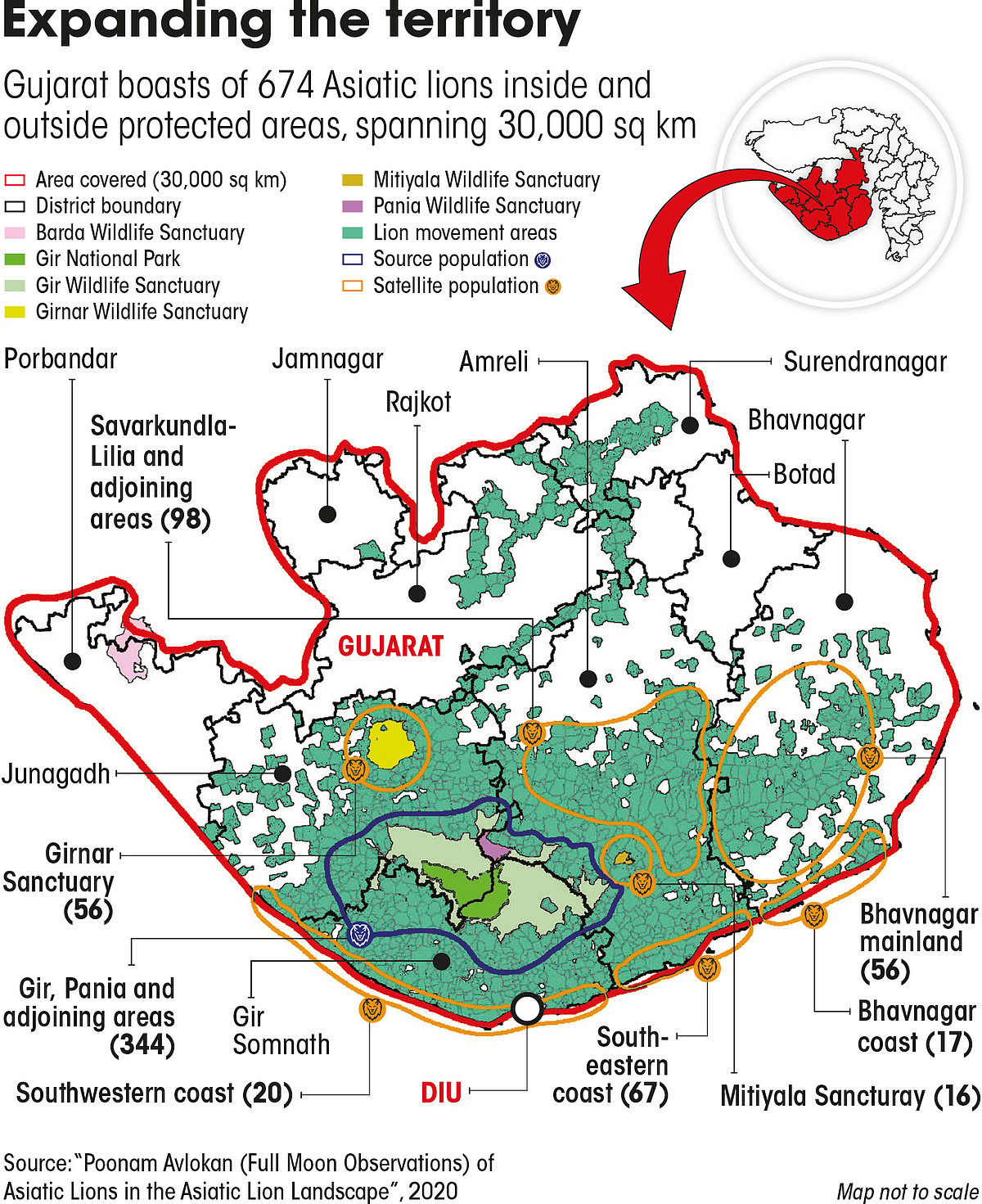
Source: Down To Earth — Asiatic Lions Expansion: New Territory in Diu Raises Conservation ... · www.downtoearth.org.in
Trap: Don't confuse with African lions — Asiatic lions are found ONLY in India
Trap: Location is Gujarat, not Rajasthan or any other desert state
Trap: They are Endangered, not Critically Endangered like some other big cats
Bactrian Camel Distribution
Environment Double-humped camel
Double-Humped Camel: Central Asian Native
Bactrian camels are native to Central Asia (Mongolia, China) — NOT exclusive to India
In India, found only in Nubra Valley, Ladakh in small numbers
Adapted to cold deserts unlike single-humped Arabian camels
Natural Range
The double-humped (Bactrian) camel is native to the cold deserts of Central Asia — primarily Mongolia and northern China. The small population in India's Nubra Valley represents the southwestern edge of their natural range, not an India-exclusive species.
Camel Species Comparison
Feature | Bactrian Camel | Arabian Camel |
|---|---|---|
Humps | Two humps | One hump |
Native Region | Central Asia (Mongolia, China) | Arabian Peninsula |
Climate Adaptation | Cold deserts (-40°C) | Hot deserts (+50°C) |
In India | Nubra Valley, Ladakh | Rajasthan, Gujarat |
Conservation Status | Critically Endangered (wild) | Domesticated |
India Connection
Nubra Valley in Ladakh has small population used for tourism
Brought by traders on ancient Silk Route connecting Central Asia
Can carry 170 kg and survive on minimal water for days
Thick fur coat helps survive sub-zero temperatures
Bactrian Camel Range
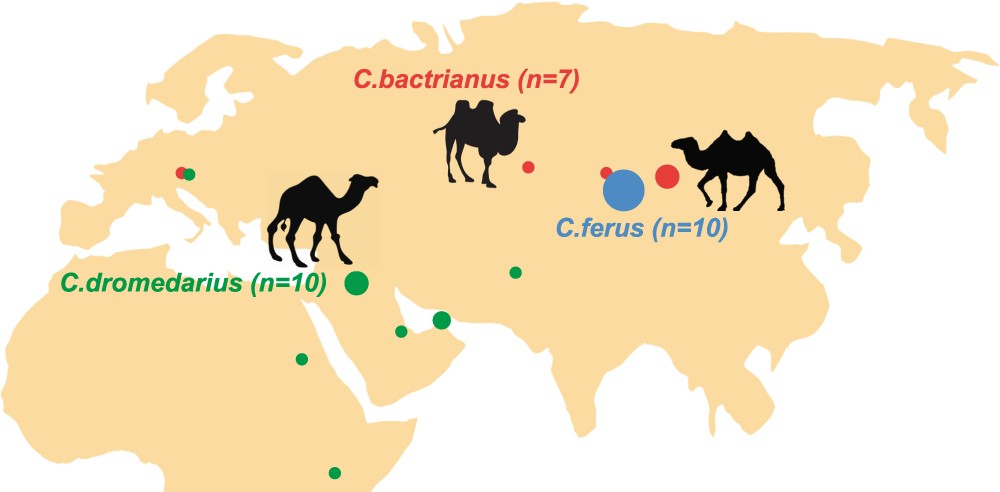
Source: Nature — Mitogenome Sequencing in the Genus Camelus Reveals Evidence for ... · www.nature.com
Trap: NOT exclusive to India — main population is in Mongolia and China
Trap: Found in Ladakh (cold desert), not Rajasthan (hot desert)
Trap: Don't confuse with single-humped Arabian camels common in Indian deserts
One-Horned Rhinoceros Habitat
Environment One-horned rhinoceros
One-Horned Rhinoceros: India-Nepal Species
One-horned rhino is found in India and Nepal — NOT exclusive to India
Kaziranga (Assam) holds 70% of world population, Chitwan (Nepal) has second-largest
Population recovered from 200 (1975) to over 3,500 today
Distribution Pattern
The Greater One-Horned Rhinoceros (Rhinoceros unicornis) is found in both India and Nepal. While India hosts the majority in Kaziranga National Park, Nepal's Chitwan National Park contains the second-largest population, making it a shared species.
Key Populations
Location | Country | Population | Significance |
|---|---|---|---|
Kaziranga National Park | India (Assam) | ~2,400 | 70% of world population |
Chitwan National Park | Nepal | ~600 | Second-largest population |
Pobitora Wildlife Sanctuary | India (Assam) | ~100 | Highest density globally |
Manas National Park | India (Assam) | ~40 | Trans-boundary with Bhutan |
Species Characteristics
Single black horn made of keratin, not bone
Semi-aquatic — loves wallowing in water and mud
Grazer — feeds on tall grasslands and aquatic plants
Can weigh up to 2,700 kg and run at 55 km/h
Rhino Distribution

Source: WWF India — PROTECT THE INDIAN RHINO, SECURE OUR GRASSLANDS | WWF India · www.wwfindia.org
Trap: NOT exclusive to India — significant population exists in Nepal's Chitwan
Trap: Kaziranga is the main habitat, not any park in other states
Trap: Don't confuse with two-horned white/black rhinos found in Africa
Endemic vs Native Species
Environment naturally found India only
Endemic vs Native: UPSC Species Classification
Endemic = found naturally in ONE specific region only
Native = naturally occurring in a region but may exist elsewhere too
UPSC often asks 'naturally found in India only' = testing endemism
Key Distinction
When UPSC asks if a species is 'naturally found in India only', they're testing endemism — whether the species exists nowhere else in the world. This is stricter than being native to India.
Classification Examples
Species | Status | Distribution | Reason |
|---|---|---|---|
Asiatic Lion | Endemic to India | Gir Forest only | Extinct elsewhere |
One-horned Rhino | Native to India | India + Nepal | Shared habitat |
Bactrian Camel | Native to Central Asia | Mongolia, China + Ladakh | Origin elsewhere |
Lion-tailed Macaque | Endemic to India | Western Ghats only | Found nowhere else |
Bengal Tiger | Native to India | India + Bangladesh + Myanmar | Across borders |
India's True Endemics
Nilgiri Tahr — found only in Western Ghats above 1,200m
Sangai Deer — found only in Loktak Lake, Manipur
Lion-tailed Macaque — restricted to Western Ghats rainforests
Kashmir Stag (Hangul) — found only in Kashmir Valley
Trap: 'Only in India' means endemic — no other country has wild populations
Trap: Don't confuse largest population with only population
Trap: Species reintroduced to other countries still count as endemic if naturally occurring in one place only