In the context of which of the following do some scientists suggest the used of cirrus cloud thinning technique and the injection of sulphate aerosol into stratosphere?
Contents15
- ACreating the artificial rains in some regions
- BReducing the frequency and intensity of tropical cyclones
- CReducing the adverse effects of solar wind on the Earth
- DReducing the global warming
Show answer
Answer: (D) Reducing the global warming
The correct answer is (D) — Reducing global warming.
Cirrus cloud thinning and injecting sulphate aerosols into the stratosphere are both geoengineering techniques proposed to combat climate change.
- Sulphate aerosols would reflect sunlight back into space, cooling the Earth.
- Thinning cirrus clouds (which trap heat) would allow more heat to escape into space.
Both aim to reduce global warming.
Tip: These are 'solar geoengineering' ideas — cool the planet by reflecting sunlight or letting heat escape.
Cirrus cloud thinning and stratospheric aerosol injection are both solar geoengineering techniques designed to cool Earth by either reflecting sunlight back to space or allowing more heat to escape.
UPSC is testing whether students can distinguish between solar geoengineering (global temperature control) and weather modification (localized rain or storm control).
Solar Geoengineering Techniques
Environment cirrus cloud thinning sulphate aerosol stratosphere
Solar Geoengineering: Artificial Climate Cooling Methods
Solar geoengineering aims to cool Earth by reflecting sunlight or releasing trapped heat
Sulphate aerosol injection reflects sunlight back to space from the stratosphere
Cirrus cloud thinning allows more heat to escape Earth's atmosphere
Both techniques target global warming reduction, not weather control
What is Solar Geoengineering
Solar geoengineering (also called Solar Radiation Management) involves deliberate interventions to cool Earth's climate by either reflecting incoming sunlight or allowing trapped heat to escape. Unlike emission reduction, these techniques aim for rapid climate effects.
Main Solar Geoengineering Techniques
Technique | Location | Mechanism | Effect |
|---|---|---|---|
Sulphate Aerosol Injection | Stratosphere (15-50 km altitude) | Aerosols reflect sunlight back to space | Mimics volcanic cooling effect |
Cirrus Cloud Thinning | Upper troposphere (8-15 km) | Reduces ice crystals in clouds | More heat escapes to space |
Marine Cloud Brightening | Low-level ocean clouds | Salt particles increase cloud reflectivity | Enhanced sunlight reflection |
Space-based Reflectors | Between Earth and Sun | Mirrors block incoming solar radiation | Direct sunlight reduction |
How Sulphate Aerosol Injection Works
%%{init: {"flowchart": {"wrappingWidth": 460}}}%%
flowchart TD
  s1["`**Injection**
Sulphate particles injected into **stratosphere** via aircraft or balloons`"]
  s2["`**Dispersion**
Aerosols spread globally due to stratospheric air circulation`"]
  s3["`**Reflection**
Particles **reflect 1-2% more sunlight** back to space`"]
  s4["`**Cooling**
Reduced solar heating leads to **global temperature drop**`"]
  s1 --> s2
  s2 --> s3
  s3 --> s4
Why Cirrus Clouds Are Targeted
Cirrus clouds trap heat — they allow sunlight in but block outgoing infrared radiation
Natural cirrus clouds have a net warming effect on Earth's climate
Thinning these clouds reduces their heat-trapping capacity
Aircraft contrails also form cirrus clouds, contributing to aviation's climate impact
Stratospheric Aerosol Mechanism
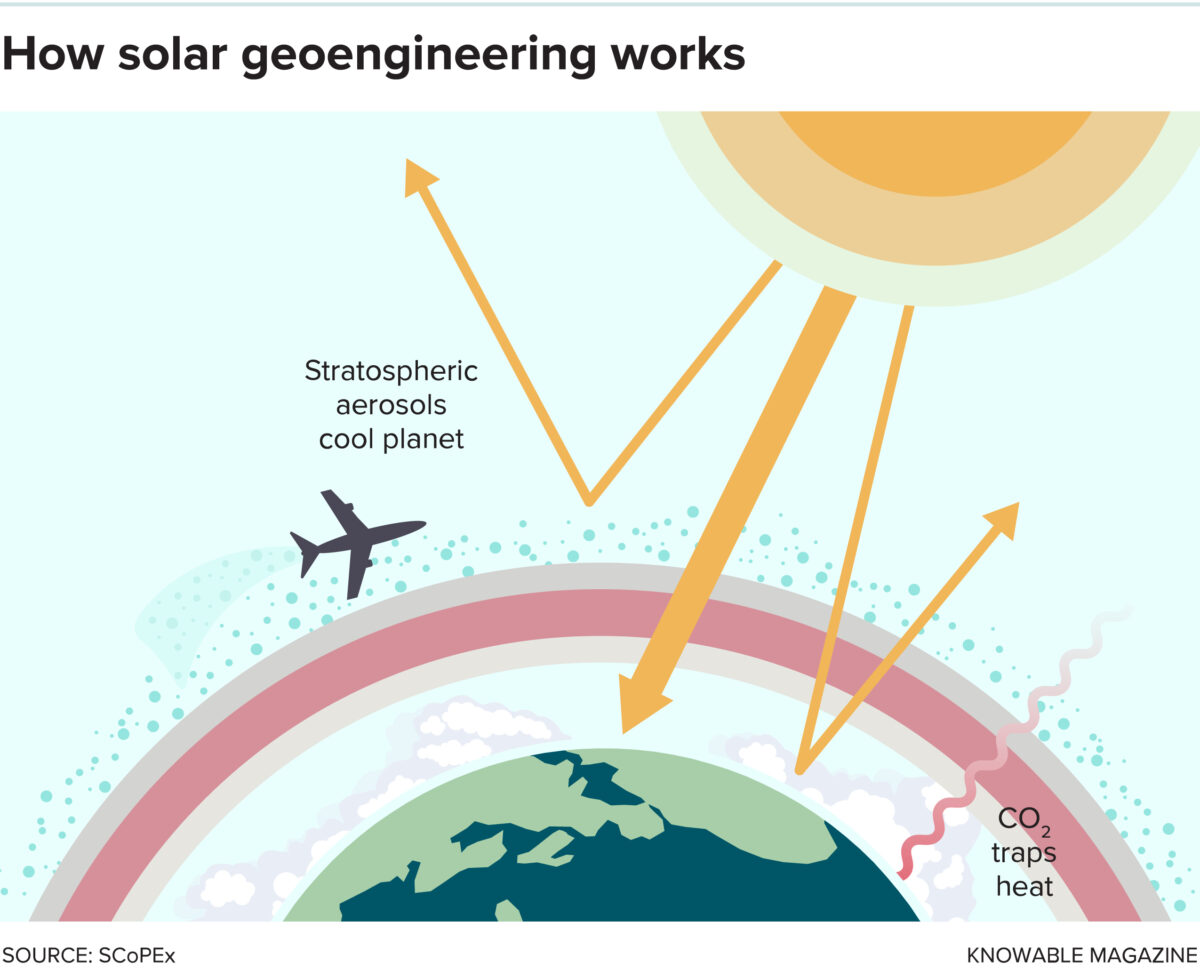
Source: State of the Planet - Columbia University — Solar Geoengineering To Cool the Planet: Is It Worth the ... · news.climate.columbia.edu
Question Connection
This UPSC question tests understanding that both techniques mentioned are climate cooling methods, not weather modification. The trap options suggest rain creation or cyclone control, but solar geoengineering specifically targets global temperature reduction.
Trap: Confusing geoengineering with weather modification — they target climate, not specific weather events
Trap: Thinking aerosol injection creates artificial rain — it actually reflects sunlight for cooling
Trap: Assuming cirrus cloud work is for cyclone control — it's for heat release, not storm management
Trap: Mixing up solar wind effects (space weather) with solar radiation management (climate)
Geoengineering Classification & Approaches
Environment
Geoengineering: Types, Methods & Global Governance
Two main types: Solar Radiation Management (SRM) and Carbon Dioxide Removal (CDR)
SRM provides rapid cooling but doesn't address ocean acidification
Most techniques remain experimental with unknown side effects
CDR addresses root cause but works slowly over decades
Geoengineering Classification
# Geoengineering
## Solar Radiation Management (SRM)
- Stratospheric Aerosols
- Cirrus Cloud Thinning
- Marine Cloud Brightening
- Space Reflectors
## Carbon Dioxide Removal (CDR)
- Direct Air Capture
- Bioenergy with CCS
- Ocean Alkalinization
- Enhanced Rock Weathering
## Other Approaches
- Ocean Iron Fertilization
- Glacier Preservation
- Desert Albedo Modification
SRM vs CDR Comparison
Aspect | Solar Radiation Management | Carbon Dioxide Removal |
|---|---|---|
Speed of Effect | Rapid (months to years) | Slow (decades to centuries) |
Cost | Relatively low | Very high |
CO₂ Levels | No change in atmospheric CO₂ | Directly reduces CO₂ |
Ocean Acidification | Continues (CO₂ still high) | Reduces as CO₂ drops |
Reversibility | Effects stop quickly if halted | Permanent CO₂ reduction |
Research Status | Mostly theoretical | Some pilot projects running |
Global Governance Challenges
No international treaty currently governs geoengineering research or deployment
Unilateral deployment by one country could affect global climate patterns
Termination problem — stopping SRM could cause rapid warming
UN Environment Programme calls for governance framework development
Moral hazard concern — geoengineering might reduce emission reduction efforts
Trap: Assuming all geoengineering removes CO₂ — SRM techniques don't touch CO₂ levels
Trap: Thinking geoengineering is currently operational — most remain in research phase
Trap: Confusing mitigation (emission cuts) with geoengineering (climate intervention)
Climate Change Response Strategies
Environment global warming
Climate Response: Mitigation, Adaptation & Geoengineering
Three main strategies: Mitigation (emission cuts), Adaptation (coping with impacts), Geoengineering (climate intervention)
Mitigation remains the primary strategy under Paris Agreement
Geoengineering is considered a last resort with high risks
Climate Response Strategies
Strategy | Approach | Examples | Status |
|---|---|---|---|
Mitigation | Reduce greenhouse gas emissions | Renewable energy, carbon pricing, efficiency | Primary global strategy |
Adaptation | Adjust to climate change impacts | Sea walls, drought-resistant crops, early warning | Complementary approach |
Geoengineering | Deliberately alter climate system | Solar radiation management, CO₂ removal | Research phase only |
India's Climate Strategy
National Action Plan on Climate Change focuses on mitigation and adaptation
Solar mission targets 450 GW renewable capacity by 2030
No official geoengineering policy — India emphasizes emission reduction
Climate vulnerability makes adaptation crucial for agriculture and coastal areas
UPSC Context
Questions often test understanding that geoengineering complements rather than replaces emission reduction. UPSC may ask about risks, governance gaps, or how these techniques fit into broader climate policy frameworks.