Consider the following statements: 1. Some species of turtles are herbivores. 2. Some species of fish are herbivores. 3. Some species of marine mammals are herbivores. 4. Some species of snakes are viviparous. Which of the statements given above are correct?
Contents19
- A1 and 3 only
- B2, 3 and 4 only
- C2 and 4 only
- D1, 2, 3 and 4
Show answer
Answer: (D) 1, 2, 3 and 4
The correct answer is (D) — All four statements are correct.
Some turtles are herbivores — the green sea turtle eats mainly seagrass and algae (statement 1).
Some fish are herbivores — parrotfish and rabbitfish eat algae (statement 2).
Some marine mammals are herbivores — manatees and dugongs eat seagrass and aquatic plants (statement 3).
Some snakes are viviparous, meaning they give birth to live young (no eggs) — like boa constrictors and green anacondas (statement 4).
Tip: Nature is full of surprises — vegetarian turtles, vegetarian fish, vegetarian sea mammals, and snakes that give live birth!
This question tests knowledge of diverse feeding habits and reproductive modes across animal groups - herbivorous marine species like green sea turtles, parrotfish, and manatees, plus viviparous snakes like boas.
UPSC uses biodiversity questions to check if students avoid oversimplified assumptions about animal behavior - not all reptiles are carnivorous, not all snakes lay eggs.
Herbivorous Turtle Species
Environment turtles herbivores
Herbivorous Turtles: Green Sea Turtle & Feeding Ecology
Green sea turtles are primarily herbivorous, feeding on seagrass and algae
Adult green turtles have serrated jaws adapted for cutting vegetation
Juvenile green turtles are omnivorous but become herbivorous as adults
Green turtles are found in tropical and subtropical waters worldwide
Turtle Feeding Diversity
Most people think all turtles eat fish or insects, but green sea turtles are nature's marine vegetarians. Adult green turtles feed almost exclusively on seagrass and algae, making them crucial for maintaining healthy seagrass beds.
Turtle Species by Diet
Species | Diet Type | Primary Food | Jaw Adaptation |
|---|---|---|---|
Green Sea Turtle | Herbivorous | Seagrass, algae | Serrated for cutting plants |
Hawksbill Turtle | Carnivorous | Sponges, jellyfish | Sharp beak for tearing |
Loggerhead Turtle | Carnivorous | Crabs, mollusks | Powerful jaws for crushing |
Leatherback Turtle | Carnivorous | Jellyfish | Backward-pointing spines |
Green Turtle Ecology
Green turtles are ecosystem engineers — their grazing keeps seagrass beds healthy
They migrate thousands of kilometers between feeding and nesting areas
Listed as Endangered under IUCN Red List due to habitat loss and hunting
Trap: Assuming all turtles are carnivorous — green sea turtles are primarily plant-eaters
Confusion: Green turtle juveniles are omnivorous, but adults are herbivorous
Mix-up: Green refers to their fat color from plant diet, not shell color
Herbivorous Fish Species
Environment fish herbivores
Herbivorous Fish: Parrotfish, Rabbitfish & Reef Ecology
Parrotfish and rabbitfish are major herbivorous fish families
Herbivorous fish control algae growth on coral reefs
Some herbivorous fish have specialized teeth for scraping algae
Surgeonfish and tangs are also important reef herbivores
Fish Diet Diversity
While most fish are carnivorous, many species are strict vegetarians. Parrotfish use their beak-like mouths to scrape algae from coral, while rabbitfish graze on seaweed like underwater sheep.
Major Herbivorous Fish
Fish Family | Feeding Method | Primary Food | Ecological Role |
|---|---|---|---|
Parrotfish | Scraping with beak | Algae on coral/rocks | Coral sand production |
Rabbitfish | Grazing | Seaweed, algae | Algae control |
Surgeonfish/Tangs | Browsing | Filamentous algae | Reef cleaning |
Damselfish (some) | Farming | Cultivated algae | Algae gardening |
Reef Ecosystem Impact
Herbivorous fish prevent algae from smothering corals — critical for reef health
Parrotfish produce coral sand by grinding coral skeleton while feeding
Overfishing herbivorous fish leads to algae overgrowth and coral decline
Parrotfish Feeding
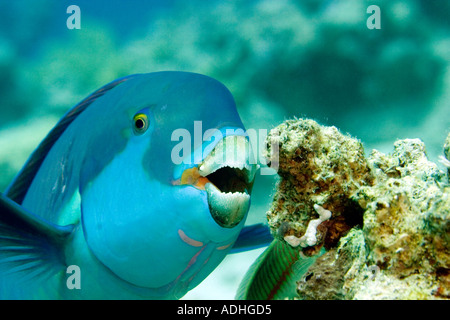
Source: Alamy — Parrotfish scraping algae off dead coral with beak like fused teeth in ... · www.alamy.com
Trap: Thinking all fish are carnivorous — many reef fish are strict herbivores
Confusion: Parrotfish scrape algae (don't bite prey like carnivorous fish)
Overlooked fact: Herbivorous fish are keystone species for coral reef survival
Herbivorous Marine Mammals
Environment marine mammals herbivores
Herbivorous Marine Mammals: Manatees & Dugongs
Manatees and dugongs are the only herbivorous marine mammals
Both belong to order Sirenia — also called sea cows
They feed exclusively on seagrass and aquatic plants
Dugongs are found in Indo-Pacific, manatees in Atlantic/Caribbean
Marine Mammal Exception
Among all marine mammals (whales, dolphins, seals, etc.), only sirenians are herbivorous. These gentle giants are the ocean's only vegetarian mammals, spending their days grazing underwater seagrass meadows.
Sirenian Species Comparison
Species | Distribution | Habitat | Tail Shape | Conservation Status |
|---|---|---|---|---|
West Indian Manatee | Florida, Caribbean | Warm coastal waters | Paddle-shaped | Vulnerable |
Amazonian Manatee | Amazon Basin | Freshwater rivers | Paddle-shaped | Vulnerable |
West African Manatee | West Africa coast | Rivers and coasts | Paddle-shaped | Vulnerable |
Dugong | Indo-Pacific | Shallow coastal waters | Whale-like flukes | Vulnerable |
Ecological Importance
Sirenians are ecosystem engineers — their grazing maintains seagrass bed health
They can consume 10-15% of body weight daily in vegetation
Seagrass beds they maintain are carbon sinks and nurseries for fish
Dugong vs Manatee

Source: Wildlife Nomads — 12 Fascinating Dugong Facts | Secrets of the Ocean's Gentle Giant · www.wildlifenomads.com
Trap: Assuming all marine mammals eat fish — sirenians are strict vegetarians
Confusion: Dugongs and manatees are different species, not the same animal
Geography mix-up: Dugongs in Indo-Pacific, manatees in Atlantic regions
Viviparous Snake Species
Environment snakes viviparous
Viviparous Snakes: Live Birth vs Egg-laying
Viviparous snakes give birth to live young without laying eggs
Boa constrictors and green anacondas are viviparous
Most snakes are oviparous (egg-laying), but some are viviparous
Sea snakes and many pit vipers are also viviparous
Snake Reproduction Types
While most snakes lay eggs, some species give birth to fully-formed live young. This viviparity is an evolutionary adaptation that helps species survive in cold climates or aquatic environments where eggs wouldn't survive.
Snake Reproduction Methods
Type | Definition | Examples | Advantage |
|---|---|---|---|
Oviparous | Lay eggs externally | Pythons, cobras, most snakes | Less energy cost to female |
Viviparous | Give birth to live young | Boas, anacondas, sea snakes | Protection in harsh environments |
Ovoviviparous | Eggs hatch inside mother | Some rattlesnakes, adders | Combines benefits of both |
Common Viviparous Snakes
Boa Constrictors — large South American constrictors that give live birth
Green Anacondas — world's heaviest snakes, semi-aquatic and viviparous
Sea Snakes — all species are viviparous due to marine lifestyle
Garter Snakes — common North American species, live birth in cold climates
Viviparity Evolution
%%{init: {"flowchart": {"wrappingWidth": 460}}}%%
flowchart TD
  s1["`**Cold Climate Challenge**
Eggs cannot survive freezing temperatures`"]
  s2["`**Aquatic Challenge**
Eggs would drown or be eaten underwater`"]
  s3["`**Evolutionary Solution**
Females retain eggs inside body`"]
  s4["`**Live Birth**
Fully-formed young born ready to survive`"]
  s1 --> s2
  s2 --> s3
s3 --> s4Trap: Assuming all snakes lay eggs — boas and anacondas give live birth
Confusion: Pythons lay eggs, boas give live birth (both are constrictors)
Term mix-up: Viviparous = live birth, oviparous = egg-laying