Consider the following: 1. Carbon monoxide 2. Methane 3. Ozone 4. Sulphur dioxide Which of the above are released into atmosphere due to the burning of crop/biomass residue?
Contents13
- A1 and 2 only
- B2, 3 and 4 only
- C1 and 4 only
- D1, 2, 3 and 4
Show answer
Answer: (D) 1, 2, 3 and 4
The correct answer is (D) — All four gases are released.
When crop residue or biomass is burned, it releases a wide range of pollutants:
- carbon monoxide (CO)
- methane (CH4)
- ozone (O3)
- sulphur dioxide (SO2)
along with CO2, black carbon, and other harmful substances.
This is why stubble burning in states like Punjab and Haryana causes severe air pollution in Delhi every winter.
Tip: Burning crop residue = releases almost every harmful gas imaginable. All four listed gases are emitted.
Stubble burning in Punjab and Haryana releases carbon monoxide, methane, ozone, and sulphur dioxide, causing severe winter air pollution in Delhi-NCR every year.
UPSC asked this in 2019 when stubble burning had become a major annual crisis, with Supreme Court interventions and government schemes to stop the practice.
The trap is assuming ozone forms only in the upper atmosphere - biomass burning actually releases ozone directly at ground level along with precursor gases.
Crop Residue Burning Pollutants
Environment Carbon monoxide Methane Ozone Sulphur dioxide burning of crop biomass residue
Crop Residue Burning: Complete Pollutant Profile
Crop residue burning releases all major air pollutants — CO, CH₄, O₃, SO₂, CO₂, black carbon
Punjab and Haryana stubble burning causes Delhi's winter air pollution crisis
Biomass burning is incomplete combustion — produces both primary and secondary pollutants
The Problem
Crop residue burning (stubble burning) is incomplete combustion of agricultural waste. Unlike clean industrial processes, biomass burning releases virtually every harmful atmospheric pollutant known.
Pollutants from Crop Burning
Pollutant | Source Mechanism | Health Impact | Climate Effect |
|---|---|---|---|
Carbon Monoxide (CO) | Incomplete combustion | Reduces oxygen in blood | Indirect warming |
Methane (CH₄) | Organic matter breakdown | Respiratory issues | 28x stronger than CO₂ |
Ozone (O₃) | Secondary formation from precursors | Lung damage, asthma | Greenhouse gas |
Sulphur Dioxide (SO₂) | Sulfur compounds in biomass | Acid rain, respiratory | Cooling effect |
Additional Emissions
Black carbon (soot) — major component causing haze and warming
Particulate Matter (PM2.5, PM10) — most dangerous for human health
Nitrogen oxides (NOₓ) — contribute to acid rain and smog formation
Volatile Organic Compounds (VOCs) — react to form ground-level ozone
India Context
Punjab, Haryana, and western UP burn rice stubble after harvest (October-November). Wind carries pollutants to Delhi NCR, causing the annual winter air quality crisis. Farmers burn because it's the cheapest disposal method before wheat sowing.
Trap: Students often miss ozone — but crop burning produces ozone precursors that form O₃ in atmosphere
Trap: Don't confuse with industrial emissions — biomass burning is messier and releases more variety
UPSC loves: 'Which gases are NOT released?' — answer is usually none, biomass burning releases everything
Stubble Burning Crisis in India
Environment Punjab Haryana Delhi
India's Stubble Burning Crisis: Geography & Solutions
October-November: Rice stubble burning season in Punjab-Haryana causes Delhi pollution
23 million tonnes of rice straw burned annually in northwest India
15-day window between rice harvest and wheat sowing drives burning urgency
Burning Hotspots
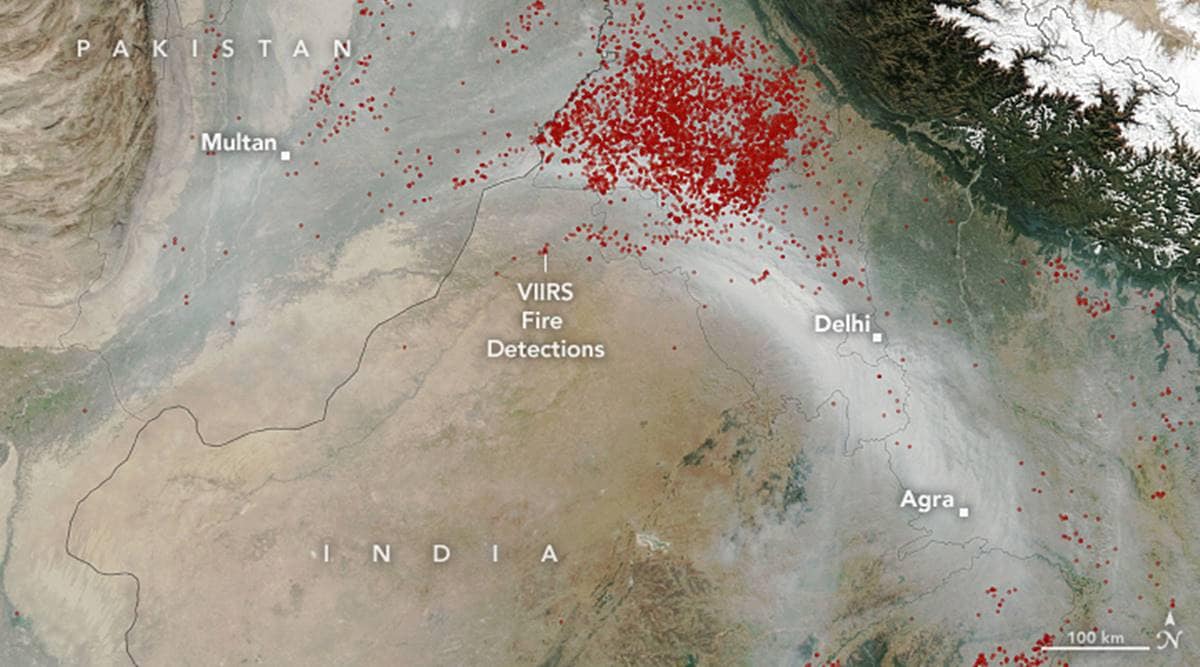
Source: The Indian Express — Delhi Air Pollution: NASA satellite data shows most active fire ... · indianexpress.com
Pollution Transport
%%{init: {"flowchart": {"wrappingWidth": 460}}}%%
flowchart TD
  s1["`**Rice Harvest (October)**
Farmers in Punjab-Haryana harvest rice, leave stubble`"]
  s2["`**Stubble Burning**
15-day window before wheat sowing — farmers burn fields`"]
  s3["`**Wind Transport**
Northwest winds carry smoke towards Delhi NCR`"]
  s4["`**Air Quality Crisis**
Delhi AQI shoots above 400 (severe category)`"]
  s1 --> s2
  s2 --> s3
  s3 --> s4
Government Solutions
Solution | Mechanism | Challenges | Status |
|---|---|---|---|
Happy Seeder Machine | Sows wheat without burning stubble | High cost (₹1.5 lakh) | Subsidies provided |
Bio-decomposer | Microbial solution to decompose stubble | Takes 20-25 days | Delhi govt initiative |
Stubble Power Plants | Convert stubble to electricity | Collection & transport costs | Few operational |
Legal Penalties | Fines for burning | Enforcement difficulties | Limited success |
Geography trap: Don't blame only Punjab — Haryana and western UP also major contributors
Timing trap: Peak burning is October-November (rice) not April-May (wheat harvest)
Solution trap: No single solution works — requires combination of technology + incentives + enforcement
Primary vs Secondary Air Pollutants
Environment Ozone
Primary vs Secondary Pollutants: Formation & Examples
Primary pollutants: Directly emitted from sources (CO, SO₂, CH₄)
Secondary pollutants: Formed in atmosphere through chemical reactions (O₃, acid rain)
Ozone paradox: Ground-level O₃ is harmful, stratospheric O₃ is protective
Classification of Air Pollutants
Type | Examples | Formation | Key Sources |
|---|---|---|---|
Primary | CO, SO₂, CH₄, NO₂, PM | Direct emission | Vehicles, industries, burning |
Secondary | O₃, H₂SO₄, HNO₃ | Atmospheric reactions | Chemical transformation of primaries |
Secondary Ozone Formation
%%{init: {"flowchart": {"wrappingWidth": 460}}}%%
flowchart TD
  s1["`**Primary Emissions**
NOₓ + VOCs released from vehicles, industry`"]
  s2["`**Sunlight Reaction**
UV radiation breaks down NO₂`"]
  s3["`**Ozone Formation**
Atomic oxygen combines with O₂ to form O₃`"]
  s4["`**Ground-level Smog**
Harmful ozone accumulates near surface`"]
  s1 --> s2
  s2 --> s3
  s3 --> s4
UPSC-Relevant Distinctions
Biomass burning produces both primary (CO, SO₂) and secondary (O₃) pollutants
Photochemical smog requires sunlight — worse in summer afternoons
Acid rain forms when SO₂ and NOₓ react with water vapor (secondary)
PM2.5 can be both primary (direct soot) and secondary (formed from gas reactions)
Ozone trap: Ground-level O₃ is bad (pollutant), stratospheric O₃ is good (UV protection)
Formation trap: Don't assume all pollutants are directly emitted — many form in atmosphere
Source trap: Secondary pollutants need precursor gases + atmospheric conditions to form