Among the following crops, which one is the most important anthropogenic source of both methane and nitrous oxide?
Contents17
- ACotton
- BRice
- CSugarcane
- DWheat
Show answer
Answer: (B) Rice
The answer is (B) Rice.
Rice paddies are the biggest crop-related source of BOTH methane AND nitrous oxide:
Why methane?
Rice fields are flooded with water, creating oxygen-free conditions.
Bacteria in this waterlogged soil produce methane.
Rice plants act as "chimneys," channeling methane into the air.
Why nitrous oxide?
Both the soil and rice plants emit N2O.
Fertilizer use makes this worse.
These gases are far more potent than CO2 — methane is 80+ times and N2O is 273 times stronger at trapping heat over 20 years.
Cotton, sugarcane, and wheat don't produce both gases in significant amounts like rice does.
Rice paddies are flooded agricultural systems that create anaerobic conditions where bacteria produce methane, while also emitting nitrous oxide from soil and fertilizer use.
Both methane and nitrous oxide are far more potent greenhouse gases than CO2, with methane being 80+ times stronger and nitrous oxide 273 times stronger at trapping heat over 20 years.
The question tests understanding of specific agricultural emission sources rather than general climate change knowledge.
Rice Cultivation & Greenhouse Gas Emissions
Environment Rice methane nitrous oxide
Rice Cultivation as Major Source of Methane & Nitrous Oxide
Rice paddies are the largest crop source of both methane (CH₄) and nitrous oxide (N₂O)
Flooded rice fields create anaerobic conditions that produce methane through bacterial fermentation
Rice plants act as transport channels carrying methane from soil to atmosphere
Fertilizer use in rice cultivation increases N₂O emissions significantly
Why Rice Fields
Rice cultivation requires continuous flooding of fields, creating unique waterlogged conditions. Unlike other crops that grow in well-drained soil, rice paddies remain submerged for months, creating the perfect environment for greenhouse gas production.
Methane Production Process
%%{init: {"flowchart": {"wrappingWidth": 460}}}%%
flowchart TD
  s1["`**Flooded Paddy Fields**
Water blocks oxygen from reaching soil`"]
  s2["`**Anaerobic Conditions**
Soil becomes oxygen-free environment`"]
  s3["`**Bacterial Fermentation**
Methanogenic bacteria break down organic matter`"]
  s4["`**Methane Production**
CH₄ gas is produced in waterlogged soil`"]
  s5["`**Plant Transport**
Rice plants channel methane to atmosphere`"]
  s1 --> s2
  s2 --> s3
  s3 --> s4
  s4 --> s5
Crop Comparison: GHG Emissions
Crop | Methane (CH₄) | Nitrous Oxide (N₂O) | Key Reason |
|---|---|---|---|
Rice | Very High | High | Flooded fields + fertilizers |
Cotton | Low | Moderate | Dry cultivation, some fertilizer use |
Sugarcane | Low | Moderate | Well-drained fields, fertilizer use |
Wheat | Very Low | Moderate | Dry cultivation, fertilizer use |
Global Impact Facts
Rice paddies contribute approximately 8-15% of global methane emissions
Asia produces 90% of world's rice, making it the emission hotspot
Methane is 80+ times more potent than CO₂ over 20 years
N₂O is 273 times more potent than CO₂ over 20 years
Trap: Confusing cotton as high methane source — cotton grows in dry fields, not waterlogged conditions
Trap: Thinking wheat produces significant methane — wheat cultivation doesn't involve flooding
Trap: Missing that rice produces BOTH gases significantly — other crops may produce one but not both at high levels
Greenhouse Gas Warming Potential
Environment methane nitrous oxide
Global Warming Potential of Major Greenhouse Gases
Methane (CH₄) is 80+ times more potent than CO₂ over 20 years
Nitrous Oxide (N₂O) is 273 times more potent than CO₂ over 20 years
Global Warming Potential (GWP) measures heat-trapping ability relative to CO₂
Understanding GWP
Global Warming Potential (GWP) measures how much heat a greenhouse gas traps compared to CO₂ over a specific time period. A gas with GWP of 100 means it traps 100 times more heat than the same amount of CO₂.
Major Greenhouse Gases: GWP Comparison
Gas | Chemical Formula | 20-Year GWP | 100-Year GWP | Atmospheric Lifetime |
|---|---|---|---|---|
Carbon Dioxide | CO₂ | 1 | 1 | 300-1000 years |
Methane | CH₄ | 82-84 | 28-30 | 9-10 years |
Nitrous Oxide | N₂O | 273 | 265 | 110-120 years |
Fluorinated gases | F-gases | 1,000-23,000 | 1,000-23,000 | 1-50,000 years |
Key Implications
Short-term impact: Methane has massive immediate warming effect but breaks down faster
Long-term persistence: N₂O remains in atmosphere for over a century
Policy focus: Reducing methane gives quick climate benefits within decades
Agricultural challenge: Food production is major source of both CH₄ and N₂O
Trap: Confusing 20-year vs 100-year GWP values — UPSC may test different time horizons
Trap: Thinking CO₂ is the most potent gas — it's the most abundant, not most potent per molecule
Anthropogenic Sources of Greenhouse Gases
Environment anthropogenic source
Major Human Sources of Methane & Nitrous Oxide
Agriculture is the largest source of both methane and nitrous oxide globally
Rice cultivation and livestock dominate methane emissions from agriculture
Fertilizer use and crop residue burning are major N₂O sources
Anthropogenic GHG Sources
# Human GHG Sources
## Agriculture (CH₄ & N₂O)
- Rice paddies
- Livestock (ruminants)
- Fertilizer application
- Crop residue burning
## Energy (CH₄)
- Coal mining
- Oil & gas extraction
- Natural gas leaks
- Biomass burning
## Waste (CH₄)
- Landfills
- Wastewater treatment
- Organic waste decomposition
## Industry (N₂O)
- Nitric acid production
- Fossil fuel combustion
- Biomass burning
Agricultural vs Other Sources
Source Category | % of Global CH₄ | % of Global N₂O | Key Activities |
|---|---|---|---|
Agriculture | 40-50% | 60-70% | Rice, livestock, fertilizers |
Energy Sector | 35-40% | 10-15% | Fossil fuel extraction/use |
Waste Management | 15-20% | 5-10% | Landfills, wastewater |
Industrial Processes | 5-10% | 15-20% | Chemical production |
India-Specific Context
India is the world's largest rice producer, contributing significantly to global methane
Kharif rice cultivation (monsoon season) produces more methane due to continuous flooding
System of Rice Intensification (SRI) being promoted to reduce water use and emissions
India's fertilizer subsidies inadvertently encourage higher N₂O emissions
Cotton, Sugarcane & Wheat Emissions
Environment Cotton Sugarcane Wheat
Why Other Crops Produce Lower GHG Emissions
Cotton, wheat, sugarcane grow in well-drained fields — no anaerobic methane production
These crops produce moderate N₂O from fertilizer use but minimal methane
Only rice requires continuous flooding, creating unique emission profile
Cultivation Methods & Emissions
Crop | Water Management | Soil Conditions | CH₄ Emissions | Main Emission Source |
|---|---|---|---|---|
Rice | Continuous flooding | Waterlogged/anaerobic | Very High | Bacterial fermentation |
Cotton | Irrigation/rainfall | Well-drained | Low | Limited organic decomposition |
Sugarcane | Furrow irrigation | Well-drained | Low | Fertilizer application only |
Wheat | Minimal irrigation | Dry/aerobic | Very Low | Fertilizer application only |
Key Distinctions
Aerobic vs Anaerobic: Well-drained crops allow oxygen into soil, preventing methane-producing bacteria
Fertilizer factor: All crops using nitrogen fertilizers produce some N₂O, but rice adds methane on top
Biomass burning: Some crops contribute to emissions through stubble burning, not cultivation itself
Rice vs Upland Crops
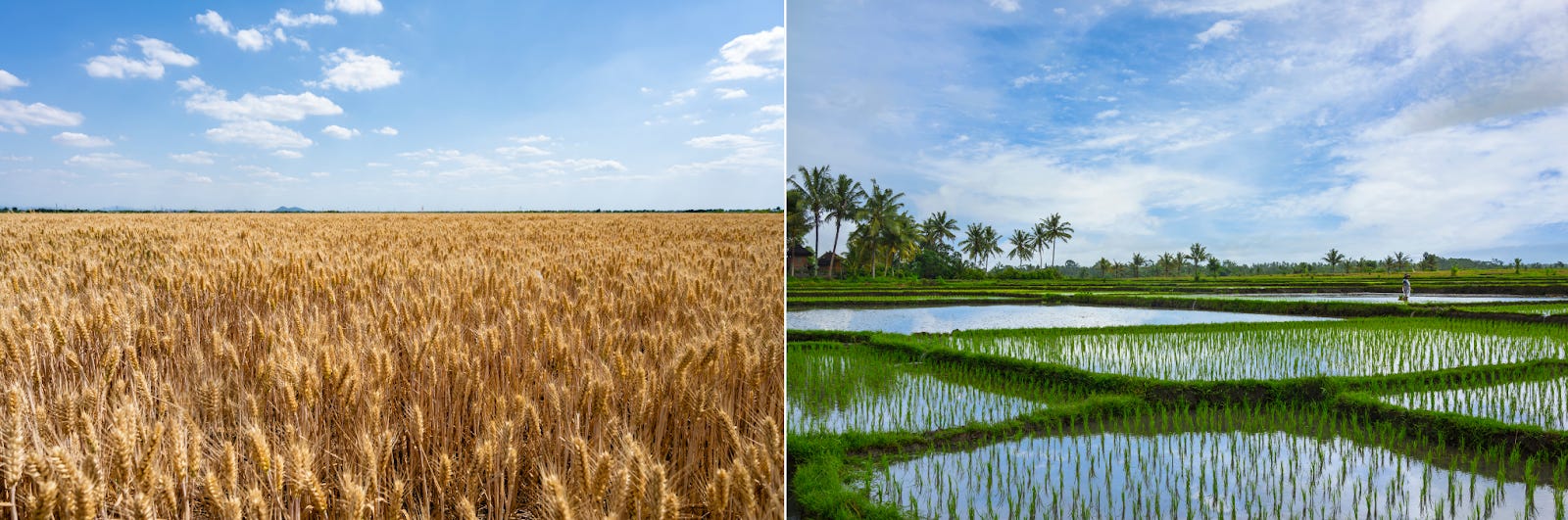
Source: Uncharted Territories — How Bread vs Rice Molded History - by Tomas Pueyo · unchartedterritories.tomaspueyo.com
Trap: Assuming sugarcane produces high methane because it's processed into ethanol — emissions come from cultivation, not processing
Trap: Thinking cotton is emission-heavy due to pesticide use — pesticides don't directly produce greenhouse gases during cultivation