Consider the following statements: 1. Bidibidi is a large refugee settlement in north-western Kenya. 2. Some people who fled from South Sudan civil war live in Bidibidi. 3. Some people who fled from civil war in Somalia live in Dadaab refugee complex in Kenya. Which of the statements given above is/are correct?
Contents13
- A1 and 2
- B2 only
- C2 and 3
- D3 only
Show answer
Answer: (C) 2 and 3
The answer is (C) Statements 2 and 3.
Statement 1 is WRONG:
Bidibidi is in UGANDA, not Kenya.
It's specifically in the West Nile area of northwestern Uganda.
It's the second-largest refugee settlement in the world.
The question says "north-western Kenya" — wrong country!
Statement 2 is CORRECT:
Bidibidi was opened in August 2016 to host refugees fleeing the civil war in South Sudan.
It houses over 270,000 South Sudanese refugees.
Statement 3 is CORRECT:
Dadaab refugee complex is in Kenya and primarily houses people who fled the civil war in Somalia.
It was first established in 1991 when Somali refugees crossed into Kenya.
A large influx also came in 2011 during famine.
Key locations to remember:
- Bidibidi = Uganda = South Sudanese refugees
- Dadaab = Kenya = Somali refugees
Bidibidi in Uganda and Dadaab in Kenya are among the world's largest refugee settlements, hosting hundreds of thousands of people displaced by regional conflicts.
The South Sudan civil war that began in 2013 and the ongoing Somalia conflict have created massive refugee flows that UPSC expects students to know about.
The question tests precise geographical knowledge of refugee settlements and their locations rather than general awareness of refugee issues.
Bidibidi Refugee Settlement
World Affairs (International Relations) Bidibidi refugee settlement north-western
Bidibidi Refugee Settlement: Location & Key Facts
Bidibidi is located in northwestern Uganda, not Kenya
Second-largest refugee settlement globally
Primarily hosts South Sudanese refugees since 2016
Houses over 270,000 refugees in West Nile region
Bidibidi refugee settlement is located in the West Nile region of northwestern Uganda, established in August 2016 to accommodate the massive influx of people fleeing South Sudan's civil war.
Key Characteristics
Second-largest refugee settlement in the world after Kutupalong in Bangladesh
Covers approximately 250 square kilometers across five zones
Managed by UNHCR in partnership with Uganda's Office of the Prime Minister
Provides basic services including health centers, schools, and water points
Most refugees are from Equatoria region of South Sudan
Location Context

Source: Operational Data Portal - UNHCR — Document - Map: Access Roads to Bidibidi, Imvepi, Lobule ... · data.unhcr.org
Country confusion: Statement 1 places Bidibidi in Kenya instead of Uganda - classic geographic trap
Don't confuse with Dadaab (Kenya) or Kutupalong (Bangladesh) refugee camps
West Nile refers to Uganda's region, not the river or disease
South Sudan Civil War & Refugees
World Affairs (International Relations) South Sudan civil war fled from South Sudan
South Sudan Civil War: Timeline & Refugee Crisis
Civil war began in December 2013, two years after independence
Over 2.2 million refugees displaced to neighboring countries
Main destinations: Uganda, Sudan, Ethiopia, Kenya
Conflict between President Kiir and Vice President Machar
South Sudan's civil war erupted in December 2013, just two years after gaining independence from Sudan. The conflict created one of Africa's largest refugee crises.
Refugee Crisis Timeline
%%{init: {"flowchart": {"wrappingWidth": 460}}}%%
flowchart TD
  s1["`**July 2011**
South Sudan gains independence from Sudan`"]
  s2["`**December 2013**
Civil war erupts between government forces and opposition`"]
  s3["`**2014-2016**
Massive refugee outflow begins, Bidibidi camp established`"]
  s4["`**2018**
Revitalized peace agreement signed`"]
  s5["`**Present**
Fragile peace, but refugees still in camps`"]
  s1 --> s2
  s2 --> s3
  s3 --> s4
  s4 --> s5
Refugee Distribution
Host Country | Refugee Numbers | Main Camps/Settlements |
|---|---|---|
Uganda | Over 900,000 | Bidibidi, Palorinya, Rhino |
Sudan | Over 800,000 | White Nile, Blue Nile states |
Ethiopia | Over 400,000 | Gambella region camps |
Kenya | Over 130,000 | Kakuma refugee camp |
DRC | Over 100,000 | Various border settlements |
Don't confuse South Sudan (independent 2011) with Sudan (host to refugees from South Sudan)
Civil war started in 2013, not immediately after 2011 independence
Dadaab Refugee Complex
World Affairs (International Relations) Dadaab refugee complex Somalia Kenya
Dadaab Refugee Complex: World's Largest Refugee Camp
Located in northeastern Kenya near Somalia border
Established 1991 for Somali civil war refugees
Once world's largest refugee complex with 500,000+ people
Comprises five camps: Dagahaley, Hagadera, Ifo, Ifo 2, Kambioos
Dadaab refugee complex in northeastern Kenya was established in 1991 following the collapse of Somalia's government. It became a symbol of protracted refugee situations, hosting generations of Somali families.
Dadaab Timeline
%%{init: {"flowchart": {"wrappingWidth": 460}}}%%
flowchart TD
  s1["`**1991**
First camp (Ifo) established as Somali government collapses`"]
  s2["`**1992**
Dagahaley and Hagadera camps opened`"]
  s3["`**2011**
Major influx during Horn of Africa famine crisis`"]
  s4["`**2016**
Kenya announces closure plans citing security concerns`"]
  s5["`**Present**
Remains operational with reduced population`"]
  s1 --> s2
  s2 --> s3
  s3 --> s4
  s4 --> s5
Dadaab vs Major Refugee Settlements
Camp/Settlement | Location | Primary Refugees | Established |
|---|---|---|---|
Dadaab | Kenya | Somali | 1991 |
Bidibidi | Uganda | South Sudanese | 2016 |
Kutupalong | Bangladesh | Rohingya | 1992 |
Zaatari | Jordan | Syrian | 2012 |
Geographic Context
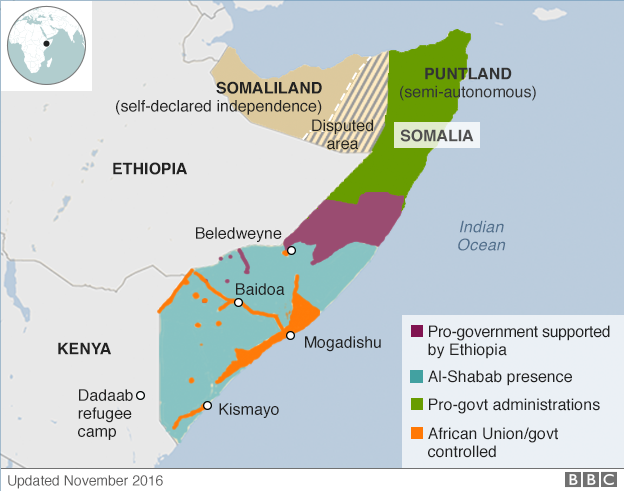
Source: BBC — Kenyan closure of Dadaab refugee camp blocked by high court - BBC News · www.bbc.com
Don't confuse Dadaab (Kenya-Somalia refugees) with Bidibidi (Uganda-South Sudan refugees)
Somalia refugees go to Dadaab, not South Sudanese - each conflict creates specific refugee flows
Major African Refugee Situations
World Affairs (International Relations)
Major African Refugee Crises: Regional Overview
Africa hosts over 26% of world's refugees despite economic constraints
Horn of Africa and Great Lakes regions most affected
Most refugees stay within neighboring countries in same region
Africa experiences multiple protracted refugee situations due to ongoing conflicts, with most displacement occurring within regional boundaries rather than intercontinental movement.
Major African Refugee Situations
Source Country | Primary Cause | Main Host Countries | Key Refugee Settlements |
|---|---|---|---|
Somalia | Civil war since 1991 | Kenya, Ethiopia, Yemen | Dadaab (Kenya), Dollo Ado (Ethiopia) |
South Sudan | Civil war since 2013 | Uganda, Sudan, Ethiopia | Bidibidi (Uganda), Gambella (Ethiopia) |
DRC | Eastern conflicts | Uganda, Rwanda, Tanzania | Nakivale (Uganda), Mahama (Rwanda) |
CAR | Sectarian conflict | Cameroon, Chad, DRC | Minawao (Cameroon), Dosseye (Chad) |
Eritrea | Political repression | Ethiopia, Sudan | Shimelba (Ethiopia), Shagarab (Sudan) |
Regional Refugee Patterns
# African Refugee Movements
## Horn of Africa
- Somalia → Kenya/Ethiopia
- Eritrea → Ethiopia/Sudan
- South Sudan → Uganda/Sudan
## Great Lakes
- DRC → Uganda/Rwanda
- Burundi → Tanzania
- Rwanda historical flows
## West Africa
- Mali → Burkina Faso
- CAR → Cameroon/Chad
- Nigeria internal displacementRegional proximity rule: Refugees typically flee to neighboring countries, not distant ones
Don't mix up source countries (where people flee from) and host countries (where they go)
Protracted situations: Many African refugee camps operate for decades, not just emergency response