Consider the following statements: 1. Gujarat has the largest solar park in India. 2. Kerala has a fully solar powered International Airport. 3. Goa has the largest floating solar photovoltaic project in India. Which of the statements given above is/are correct?
Contents21
- A1 and 2
- B2 only
- C1 and 3
- D3 only
Show answer
Answer: (B) 2 only
The answer is (B) Statement 2 only.
Statement 1 is WRONG:
India's largest solar park is Bhadla Solar Park in RAJASTHAN (Jodhpur district), not Gujarat.
It's spread over 14,000 acres and is actually the world's largest solar park.
Statement 2 is CORRECT:
Cochin International Airport (CIAL) in Kerala became the world's FIRST fully solar-powered airport in 2015.
It won the UN's "Champion of the Earth" award in 2018.
Statement 3 is WRONG:
India's largest floating solar plant is in ANDHRA PRADESH (at NTPC Simhadri), not Goa.
It's a 25 MW project by BHEL covering 100 acres.
Memory tips:
- Largest solar park = Bhadla, Rajasthan (not Gujarat)
- Solar airport = Cochin, Kerala (correct!)
- Largest floating solar = NTPC Simhadri, Andhra Pradesh (not Goa)
Cochin International Airport in Kerala became the world's first fully solar-powered airport in 2015 and won the UN Champion of the Earth award in 2018.
Solar energy projects gained prominence around 2020-2022 with India's push toward renewable energy targets and announcements of major solar installations across states.
The question tests whether students can distinguish between different types of solar projects - parks, airports, and floating installations - and avoid confusing similar-sounding state achievements.
Bhadla Solar Park
Environment Gujarat largest solar park
Bhadla Solar Park: World's Largest Solar Installation
Bhadla Solar Park in Rajasthan is India's and world's largest solar park
Located in Jodhpur district, covers 14,000 acres
Statement 1 trap: Gujarat was the wrong state - it's Rajasthan
Developed by Rajasthan Urja Vikas Nigam Limited (RUVNL)
Bhadla Solar Park represents India's leadership in renewable energy infrastructure. Located in the Thar Desert region, it leverages Rajasthan's exceptional solar radiation levels.
Key Specifications
Parameter | Details |
|---|---|
Location | Bhadla village, Jodhpur district, Rajasthan |
Area | 14,000 acres (5,700 hectares) |
Capacity | 2,245 MW (2.25 GW) |
Status | World's largest operational solar park |
Developer | RUVNL with multiple EPC contractors |
Commissioning | 2018-2020 (phased completion) |
Strategic Importance
Part of India's 175 GW renewable energy target by 2022
Demonstrates utility-scale solar deployment capabilities
Located in Solar Park Zone with excellent irradiation levels
Attracts international solar developers and technology partnerships
Bhadla Solar Park Layout
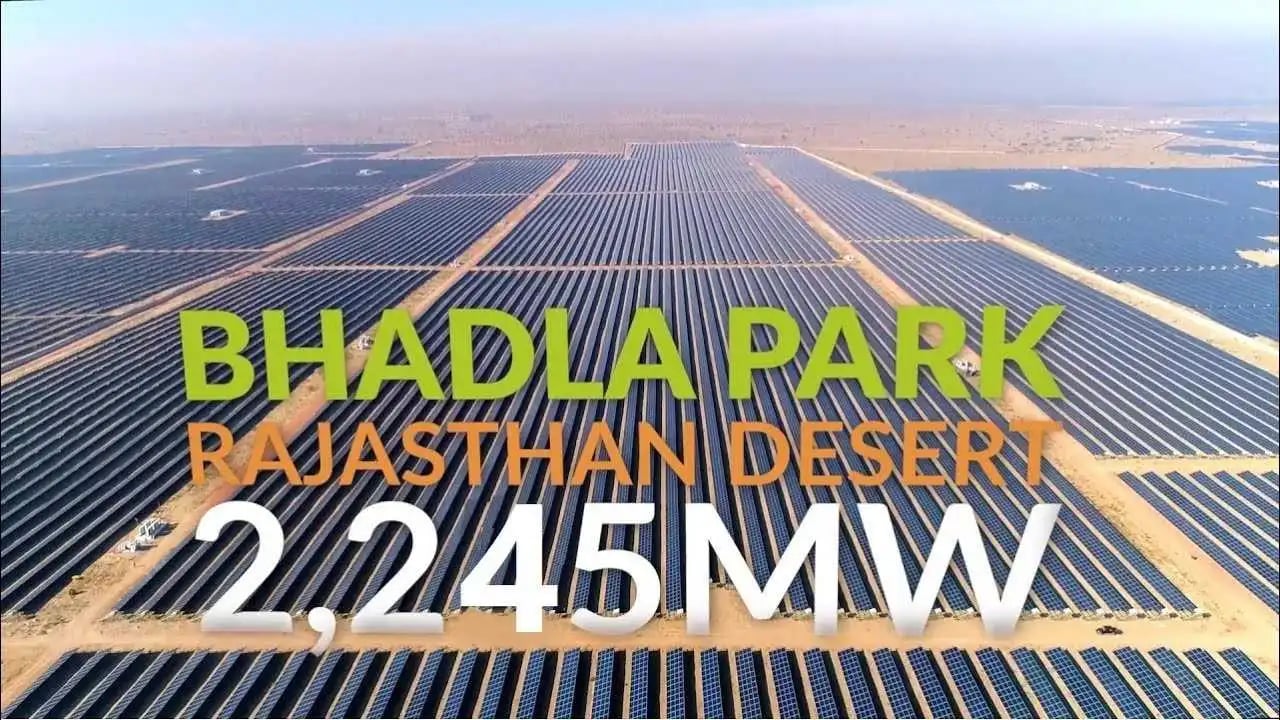
Source: Blackridge Research & Consulting — Bhadla Solar Park, Rajasthan: World's Largest Solar Power Plant · www.blackridgeresearch.com
Trap: Gujarat vs Rajasthan - Gujarat has many solar projects but Bhadla is in Rajasthan
Don't confuse with Charanka Solar Park in Gujarat - that's much smaller
Remember: Bhadla = Biggest = both in Rajasthan
Cochin International Airport Solar Project
Environment Kerala solar powered International Airport
Cochin International Airport: World's First Fully Solar-Powered Airport
Cochin International Airport (CIAL) in Kerala is world's first fully solar-powered airport
Achieved full solar power in 2015, won UN Champion of Earth award 2018
Statement 2 was correct - Kerala does have fully solar-powered international airport
Generates 65,000 units daily from 46 MW solar plant
Cochin International Airport Limited (CIAL) became a global pioneer by achieving complete energy self-sufficiency through solar power, setting a benchmark for sustainable aviation infrastructure worldwide.
Solar Installation Details
Parameter | Specification |
|---|---|
Total Capacity | 46 MW across multiple phases |
Daily Generation | 65,000 units on average |
Panel Area | 45 acres of solar panels |
Investment | Approximately ₹620 crore |
Carbon Reduction | 300,000 tonnes CO₂ annually |
Energy Status | 100% solar-powered since 2015 |
Global Recognition
UN Champion of Earth Award 2018 for entrepreneurial vision category
First airport globally to achieve complete carbon neutrality through solar
Model replicated by airports in India and internationally
Featured in ICAO environmental initiatives as best practice
Implementation Timeline
%%{init: {"flowchart": {"wrappingWidth": 460}}}%%
flowchart TD
  s1["`****2013****
Started with **1.1 MW** pilot project`"]
  s2["`****2014****
Expanded to **12 MW** capacity`"]
  s3["`****2015****
Achieved **full solar power** with additional capacity`"]
  s4["`****2018****
Won **UN Champion of Earth Award**`"]
  s5["`****Present****
Maintains **46 MW** total solar capacity`"]
  s1 --> s2
  s2 --> s3
  s3 --> s4
s4 --> s5Remember: Cochin International Airport, not Trivandrum or other Kerala airports
World's FIRST fully solar-powered airport - this superlative is frequently tested
2015 achievement year and 2018 UN award year - don't mix the dates
NTPC Simhadri Floating Solar Project
Environment Goa largest floating solar photovoltaic project
NTPC Simhadri: India's Largest Floating Solar Project
India's largest floating solar plant is at NTPC Simhadri in Andhra Pradesh, not Goa
25 MW capacity covering 100 acres of reservoir water surface
Statement 3 trap: Goa was wrong state - it's Andhra Pradesh
Developed by BHEL (Bharat Heavy Electricals Limited)
NTPC Simhadri floating solar project demonstrates India's innovation in space-efficient renewable energy. Built on the cooling water reservoir of NTPC's thermal power station, it maximizes land utilization while reducing water evaporation.
Project Specifications
Parameter | Details |
|---|---|
Location | NTPC Simhadri, Visakhapatnam, Andhra Pradesh |
Capacity | 25 MW floating solar photovoltaic |
Water Area | 100 acres of reservoir surface |
Developer | BHEL (Bharat Heavy Electricals Ltd) |
Technology | Floating PV with anchoring systems |
Status | India's largest operational floating solar plant |
Floating Solar Advantages
Higher efficiency - water cooling reduces panel temperature by 8-15%
Reduces water evaporation by 90% from covered surface area
No land acquisition required - uses existing water bodies
Prevents algae growth in reservoirs by blocking sunlight
NTPC Renewable Portfolio
# NTPC Green Energy
## Solar Projects
- Simhadri Floating (25 MW)
- Kayamkulam Floating
- Ramagundam Floating
## Wind Projects
- Multiple states
- Target capacity expansion
## Hybrid Projects
- Solar + Wind
- Storage integration
## Target
- 60 GW by 2032
- Carbon neutral by 2070
Floating Solar Technology
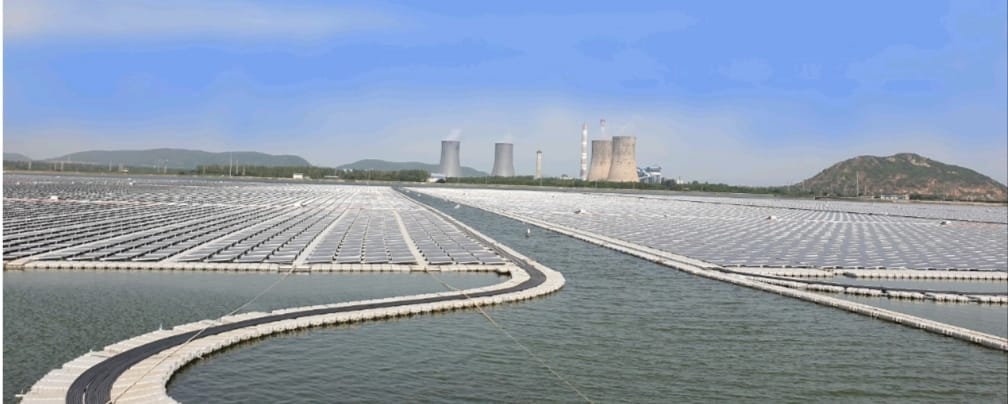
Source: Press Release:Press Information Bureau — Press Release:Press Information Bureau · www.pib.gov.in
Trap: Goa vs Andhra Pradesh - Goa has smaller floating solar projects, not the largest
Remember: Simhadri is NTPC's thermal power station with floating solar add-on
25 MW capacity - don't confuse with other NTPC floating projects of different sizes
Floating Solar Technology in India
Environment floating solar photovoltaic
Floating Solar PV: Technology & Indian Projects
Floating solar uses water bodies for solar panel installation with anchoring systems
India has multiple floating solar projects led by NTPC, SECI, and state agencies
Simhadri (AP) is largest, followed by Kayamkulam (Kerala) and Ramagundam (Telangana)
Technology offers higher efficiency and water conservation benefits
Floating Solar Photovoltaic (FPV) technology addresses India's land scarcity challenge while enhancing solar efficiency through natural water cooling. Major projects utilize thermal power plant reservoirs and irrigation canals.
Major Floating Solar Projects in India
Project | Location | Capacity | Developer | Status |
|---|---|---|---|---|
NTPC Simhadri | Andhra Pradesh | 25 MW | BHEL | Operational (Largest) |
NTPC Kayamkulam | Kerala | 92 MW | NTPC | Under development |
NTPC Ramagundam | Telangana | 100 MW | NTPC | Under development |
Sagardighi | West Bengal | 41.6 MW | NHPC | Operational |
Koyna Dam | Maharashtra | 50 MW | NHPC | Planned |
Technical Advantages
15-20% higher generation due to water cooling effect on panels
Reduces water evaporation by 70-90% from covered area
Prevents land acquisition conflicts and costs
Algae control in water bodies improves water quality
Floating Solar Ecosystem
# Floating Solar in India
## Technology
- HDPE floats
- Anchoring systems
- Underwater cables
- Inverter platforms
## Locations
- Thermal plant reservoirs
- Irrigation canals
- Mining ponds
- Hydroelectric reservoirs
## Benefits
- Land conservation
- Higher efficiency
- Water conservation
- Grid stability
## Challenges
- Higher CAPEX
- Maintenance complexity
- Environmental clearances
- Technology adaptationDon't assume largest capacity under development = largest operational project
NTPC leads floating solar in India - remember this for PSU-related questions
Floating solar ≠ offshore solar - these are different technologies for different water types
India's Solar Energy Achievements
Environment
India's Solar Energy Program: Key Milestones & Achievements
India ranks 4th globally in solar capacity with 70+ GW installed
National Solar Mission targets 100 GW by 2022, achieved ahead of schedule
India leads International Solar Alliance (ISA) headquartered in Gurugram
Solar tariffs dropped from ₹17/unit (2010) to ₹2-3/unit (2023)
India's National Solar Mission launched in 2010 transformed the country into a global solar leader through policy support, competitive bidding, and international cooperation.
Solar Mission Phases & Targets
Phase | Period | Target | Achievement | Key Focus |
|---|---|---|---|---|
Phase I | 2010-2013 | 1.3 GW | Achieved | Technology demonstration |
Phase II | 2013-2017 | 10 GW | Exceeded | Scale-up and cost reduction |
Phase III | 2017-2022 | 100 GW | Achieved early | Grid integration & storage |
Current | 2022-2030 | 280 GW | In progress | Green hydrogen & manufacturing |
Global Leadership Initiatives
International Solar Alliance (ISA) - 121 member countries for solar cooperation
One Sun One World One Grid - global solar power transmission network
Solar Park Scheme - 50 solar parks totaling 37.5 GW planned capacity
Rooftop Solar Program - 40 GW distributed solar target by 2022
Solar Policy Framework
# India Solar Policy
## Central Schemes
- National Solar Mission
- Solar Park Scheme
- Rooftop Solar Program
- KUSUM (Agricultural)
## Financial Support
- MNRE subsidies
- Green bonds
- Concessional financing
- Tax incentives
## Manufacturing
- PLI Scheme
- DCR (Domestic Content)
- Approved models list
- Quality standards
## Grid Integration
- RPO compliance
- Net metering
- Green corridors
- Storage mandates100 GW target achieved in 2022 - don't say it's still a target, it's accomplished
ISA headquarters is in Gurugram, India - not Geneva or other international cities
India is 4th in solar capacity globally after China, USA, Japan - rank changes frequently