Consider the following statements Statement-I: The Indian Flying Fox is placed under the “vermin” category in the Wild Life (Protection) Act, 1972. Statement-II: The Indian Flying Fox feeds on the blood of other animals. Which one of the following is correct in respect of the above statements ?
Contents14
- ABoth Statement-I and Statement-II are correct and Statement-II explains Statement-I
- BBoth Statement-I and Statement-II are correct, but Statement-II does not explain Statement-I.
- CStatement-I is correct, but Statement-II is incorrect
- DStatement-l is incorrect, but Statement-II is correct.
Show answer
Answer: (C) Statement-I is correct, but Statement-II is incorrect
Correct Answer: (c) Statement-I is correct, Statement-II is incorrect.
Statement I: The Indian Flying Fox is categorised as vermin — ✓ CORRECT.
It was listed under Schedule V of the Wildlife Protection Act, 1972 as vermin because it raids fruit orchards (especially mango and guava).
It was later moved to Schedule II for higher protection.
Statement II: It feeds on blood — ✗ WRONG.
The Indian Flying Fox is a fruit and nectar eater, NOT a blood-feeder.
Don't confuse it with vampire bats (which do feed on blood and are found in the Americas, not India).
The Flying Fox is actually a keystone species — it helps in seed dispersal for many tropical plants.
The Indian Flying Fox was initially classified as vermin under Schedule V of the Wildlife Protection Act because it damages fruit crops, but was later moved to Schedule II for higher protection.
UPSC is testing whether students can distinguish between fruit bats (like the Indian Flying Fox) and vampire bats - only vampire bats feed on blood and they are found in the Americas, not India.
Indian Flying Fox Biology
Environment Indian Flying Fox blood
Indian Flying Fox: Biology & Ecological Role
Indian Flying Fox is a fruit and nectar-eating bat, NOT blood-feeding
Keystone species for tropical forest ecosystems through seed dispersal
Feeds primarily on mangoes, guavas, figs and flower nectar
Largest bat species in India with wingspan up to 1.5 meters
The Indian Flying Fox (Pteropus giganteus) is India's largest bat and a crucial ecosystem engineer. Despite its intimidating name, it's a gentle frugivore that plays a vital role in forest regeneration.
Flying Fox vs Vampire Bats
Characteristic | Indian Flying Fox | Vampire Bats |
|---|---|---|
Diet | Fruits, nectar, flowers | Blood of mammals |
Location | India, South/Southeast Asia | Central & South America |
Size | Large (1.5m wingspan) | Small (15cm wingspan) |
Teeth | Flat for crushing fruits | Sharp for piercing skin |
Ecological Role | Seed dispersal, pollination | Disease vector control |
Ecological Importance
Seed dispersal: Can carry large fruits up to 20 km from parent trees
Pollination: Key pollinator for kapok, eucalyptus and many wild flowers
Forest regeneration: Helps establish new forest patches in degraded areas
Economic value: Pollinates commercially important fruits like durian in Southeast Asia
Species Identification
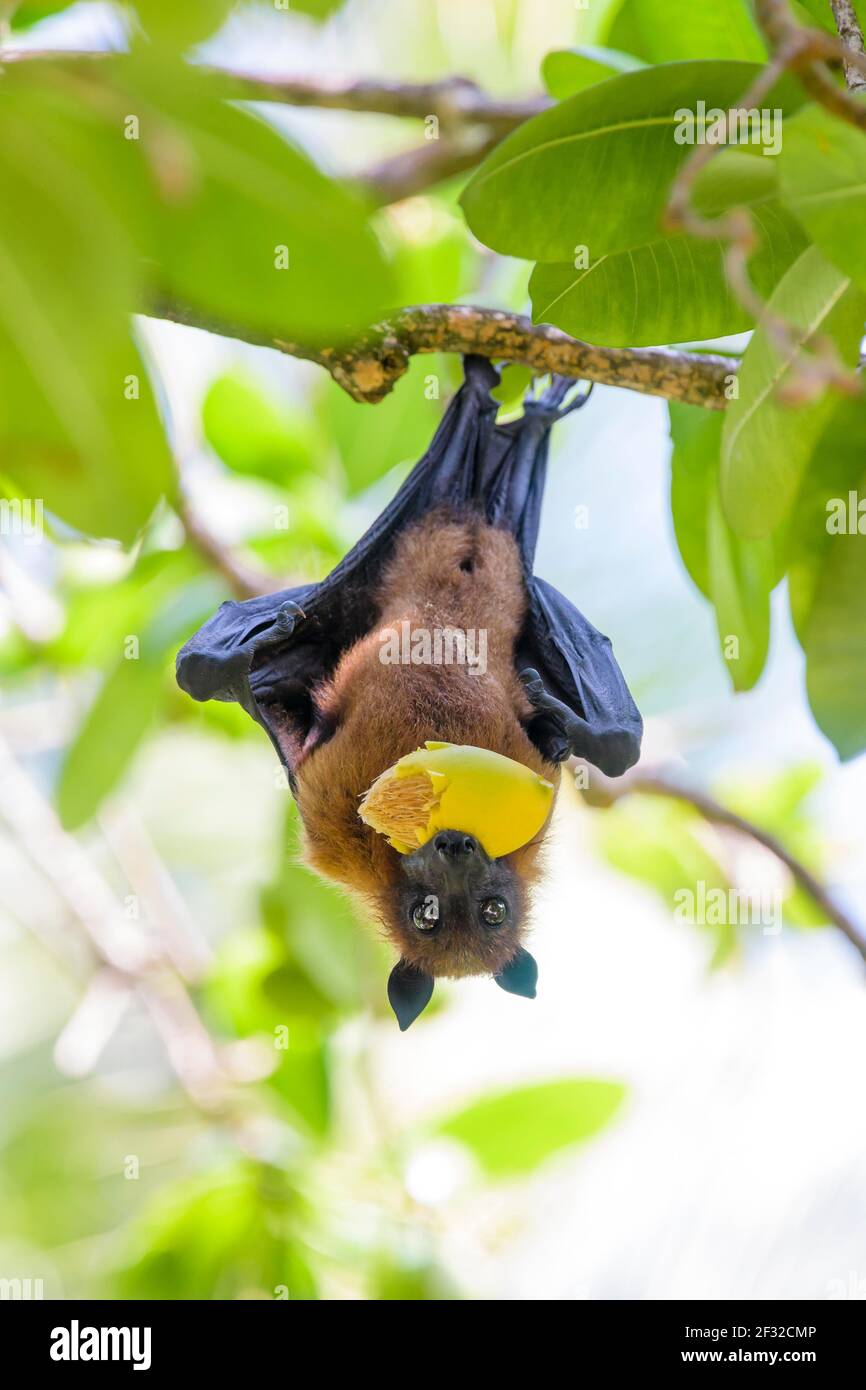
Source: Alamy — Indian Flying Fox (Pteropus medius), eats fruit, Kuramathi ... · www.alamy.com
Trap: Name confusion — 'Flying Fox' ≠ blood-feeder. The name refers to its fox-like face, not feeding behavior
Trap: Don't confuse with vampire bats which are found in Americas only, not India
Trap: 'Vermin' status doesn't mean the animal is harmful — it often reflects human-wildlife conflict over crops
Wildlife Protection Act Schedules
Environment vermin Wild Life (Protection) Act, 1972 Schedule
Wildlife Protection Act 1972: Schedule Classification System
Six Schedules in Wildlife Protection Act 1972 with different protection levels
Schedule V = Vermin category for species causing crop damage
Schedule I has highest protection (like tigers, elephants)
Species can be moved between schedules based on conservation needs
The Wildlife Protection Act 1972 classifies species into six schedules based on their conservation status and human-wildlife conflict potential. This classification determines hunting regulations and penalties.
Schedule Classification System
Schedule | Protection Level | Examples | Penalty for Hunting |
|---|---|---|---|
Schedule I | Highest Protection | Tiger, Elephant, Rhinoceros | 3-7 years imprisonment |
Schedule II | High Protection | Leopard, Monkey, Flying Fox (after amendment) | 3-7 years imprisonment |
Schedule III | Medium Protection | Sambhar, Spotted Deer, Turtle | 2-3 years imprisonment |
Schedule IV | Lower Protection | Falcons, Magpie | 6 months to 3 years |
Schedule V | Vermin Category | Common Crow, Fruit Bat, Rat | No protection, can be hunted |
Schedule VI | Cultivation Restriction | Specified plants | Cultivation prohibited |
Vermin Category Explained
Schedule V (Vermin): Species causing significant crop damage or human-wildlife conflict
No legal protection: Can be hunted or killed without permits under this schedule
Dynamic classification: Species moved in/out based on population status and conflict levels
Examples: Common crow, house rat, fruit bats (including Flying Fox initially)
Recent Amendments
The Indian Flying Fox was moved from Schedule V to Schedule II in recent amendments, recognizing its ecological importance despite crop raiding behavior. This shift reflects evolving understanding of keystone species and ecosystem services.
Trap: Vermin ≠ harmful — it's a legal category for crop raiders, not ecological assessment
Trap: Schedule numbers are counter-intuitive — Schedule I is highest protection, Schedule V is lowest
Trap: Species can change schedules — don't memorize static lists, focus on current status
Trap: Wildlife Protection Act vs Biological Diversity Act — different laws with different purposes
Human Wildlife Conflict Management
Environment vermin fruit orchards
Human-Wildlife Conflict: Causes & Management Strategies
Habitat loss drives wildlife into agricultural areas seeking food
Crop raiding species often classified as vermin despite ecological importance
Win-win solutions balance farmer livelihoods with species conservation
Human-wildlife conflict occurs when wildlife needs overlap with human activities, often due to habitat fragmentation and agricultural expansion into natural areas. The challenge is balancing immediate farmer concerns with long-term ecosystem health.
Common Conflict Species & Impacts
Species | Crop Damage | Economic Impact | Conservation Status |
|---|---|---|---|
Elephant | Paddy, sugarcane, banana | ₹500+ crore annually | Schedule I (Protected) |
Wild Boar | Rice, potato, vegetables | ₹200+ crore annually | Schedule III (Protected) |
Flying Fox | Mango, guava, dates | ₹50+ crore annually | Schedule II (Protected) |
Nilgai | Wheat, mustard, gram | ₹100+ crore annually | Schedule III (Protected) |
Monkey | Fruits, vegetables, grains | ₹150+ crore annually | Schedule II (Protected) |
Conflict Management Strategies
# Human-Wildlife Conflict Management
## Physical Barriers
- Electric fencing
- Trenches
- Solar fencing
- Mesh nets
## Deterrents
- Bio-fencing
- Ultrasonic devices
- Light reflectors
- Scare tactics
## Compensation
- Crop insurance
- Direct payments
- Alternative livelihoods
- Eco-tourism
## Habitat Management
- Corridor creation
- Water hole management
- Buffer zones
- Alternate food sourcesTrap: 'Vermin' classification often reflects farmer pressure, not actual ecological harm
Trap: Protected status doesn't prevent crop damage — creates management challenges
Trap: Economic loss figures vary widely — focus on relative impact rather than exact numbers
Bat Species Classification
Environment
Bat Diversity: Megabats vs Microbats Classification
Two main groups: Megabats (fruit-eaters) and Microbats (insect-eaters)
Only 3 species globally feed on blood — all in Americas, none in India
India hosts 130+ bat species — world's 3rd highest bat diversity
Bats (Order Chiroptera) are the only flying mammals, with over 1,400 species worldwide. Understanding their classification helps avoid common misconceptions about their feeding habits and ecological roles.
Megabats vs Microbats
Feature | Megabats | Microbats |
|---|---|---|
Size | Large (15cm-40cm) | Small (3cm-15cm) |
Diet | Fruits, nectar, pollen | Insects, small animals |
Echolocation | Poor/absent (use vision) | Highly developed |
Eyes | Large, well-developed | Small, vision poor |
Distribution | Tropical regions | Worldwide |
Examples | Flying Fox, Dog-faced bat | Horseshoe bat, Pipistrelle |
Indian Bat Diversity
130+ species across 9 families, making India a global hotspot
Western Ghats and Northeast have highest bat diversity
No vampire bats in India — blood-feeding bats restricted to Central & South America
Ecosystem services: Pest control worth billions annually through insect consumption
Trap: All large bats ≠ fruit-eaters — some megabats also eat insects
Trap: 'Flying Fox' name misleading — it's a bat, not related to foxes
Trap: Vampire bats only in Americas — never confuse with Indian bat species
Trap: Echolocation mainly in microbats — megabats rely on vision and smell